

The Fading Pharoah: Salah’s Anfield Exit Signals Broader Economic, Cultural Shifts
POLICY WIRE — London, UK — The brutal, unsparing calculus of elite sports rarely affords sentimental farewells. For Mohamed Salah, Liverpool’s talismanic Egyptian forward, a career defined by...

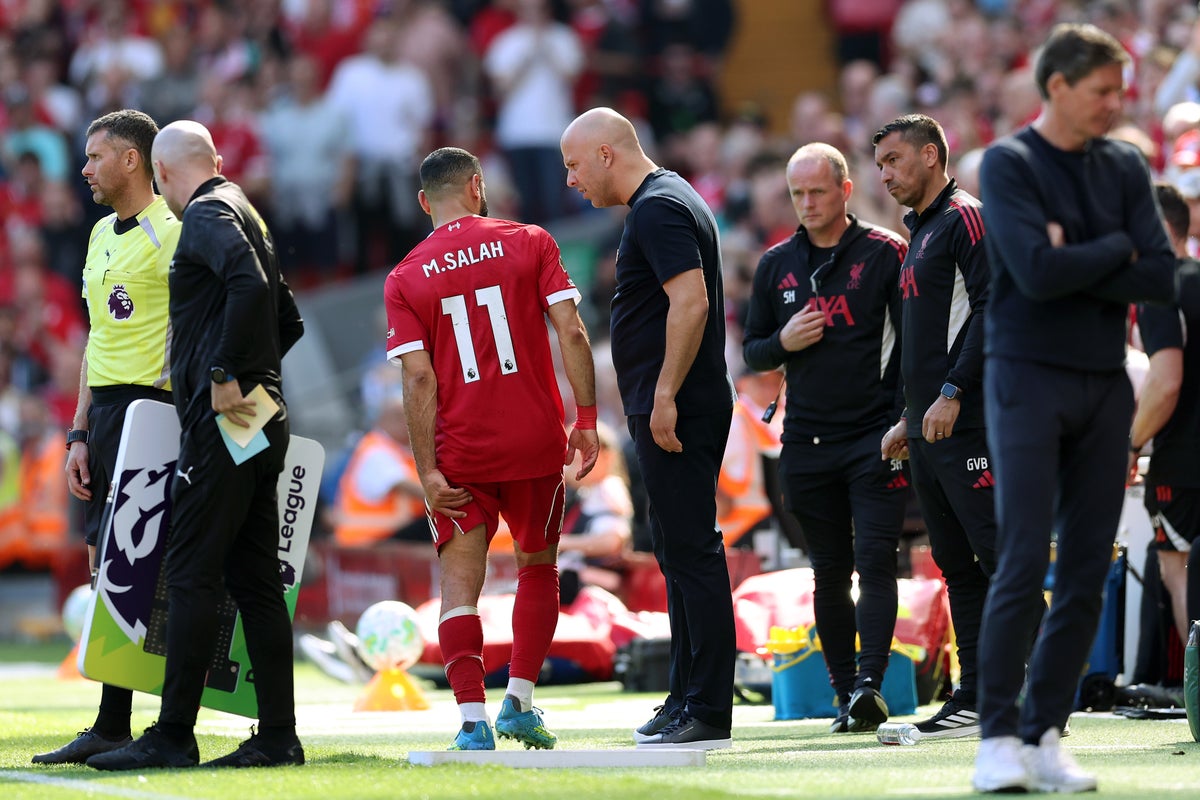
POLICY WIRE — London, UK — The brutal, unsparing calculus of elite sports rarely affords sentimental farewells. For Mohamed Salah, Liverpool’s talismanic Egyptian forward, a career defined by breathtaking athleticism and a singular devotion to goal-scoring may well conclude not with a triumphant roar, but with a grimace, clutching a hamstring. His apparent injury during a recent fixture against Crystal Palace, where he departed Anfield’s hallowed turf while his side held a precarious 2-1 lead, wasn’t just a blow to Liverpool’s title aspirations; it’s a stark, almost poetic, punctuation mark on an epoch-defining tenure, triggering conversations far beyond the touchline.
It’s not simply the end of a player’s stint; it’s the sunset of an icon’s era, one that transcended mere footballing prowess. Salah, slated to depart Merseyside this summer after nearly a decade, isn’t just the third-highest scorer in Liverpool’s storied history—a staggering over 200 competitive goals, a statistic that underscores his extraordinary impact—he’s a profound cultural touchstone. He’s been an unofficial ambassador, a beacon of Muslim excellence in a predominantly Western sporting landscape, and a commercial juggernaut whose image resonates from Cairo to Karachi.
And that’s where the policy implications begin to unfurl. A player of Salah’s global standing carries immense soft power, a currency often overlooked by those fixated solely on transfer fees. His impending absence from such a prominent stage, potentially enforced by injury, could reverberate through sponsorship deals, merchandise sales, and even tourism initiatives linked to his persona. “We’ve always understood that players of Mohamed’s caliber aren’t just assets on the pitch; they’re global brands,” remarked a source close to Liverpool’s commercial operations, speaking on condition of anonymity due to ongoing contractual sensitivities. “His commercial appeal, particularly across the MENA region — and South Asia, has been, frankly, unparalleled. You don’t just replace that with another striker; you’re replacing an entire geopolitical footprint.”
Still, the club, a global conglomerate masquerading as a football team, will adapt. They always do. But it won’t be without considerable strategic recalibration. Salah’s departure, especially if it’s hastened by a debilitating injury, forces a premature confrontation with a post-Salah reality—a reality for which they’d undoubtedly prefer to prepare with more grace and less immediate medical urgency. It’s an abruptness that financial planners dread, — and public relations strategists scramble to frame.
His influence, you see, isn’t confined to Premier League highlight reels. In nations like Pakistan, where football’s popularity has surged alongside cricket’s enduring dominance, Salah serves as an aspirational figure. His success story, from humble beginnings in Nagrig, Egypt, to global superstardom, offers a compelling narrative of perseverance. It’s a tale that resonates deeply in regions hungry for heroes who reflect their identities on the world stage. “Salah hasn’t just been a footballer; he’s been a symbol of what’s possible for Muslim youth globally,” observed Dr. Aisha Khan, a cultural anthropologist specialising in sports identity in South Asia. “His dignified conduct and incredible achievements have quietly, yet powerfully, contributed to a more nuanced perception of the Muslim world. His exit leaves a void not just for Liverpool, but for that broader narrative, too.” This kind of influence is measurable not just in goal tallies but in burgeoning fan bases, brand loyalty, and even international relations, albeit informally. (Just look at how many young boys across Lahore now sport a Salah jersey.)
The 33-year-old had been set to conclude his chapter after almost a decade, securing two Premier League titles, a Champions League, an FA Cup, a League Cup, and the Club World Cup. His potential last game, clutching his left thigh, is a cruel twist of fate, depriving both player and club of a more controlled denouement. Liverpool now faces only four remaining fixtures in a season scheduled to culminate with Brentford’s visit to Anfield on May 24. This leaves Salah a mere four weeks for recovery, an improbable timeline for a significant hamstring strain.
What This Means
At its core, Salah’s unceremonious potential exit underscores the volatile intersection of elite athletic performance and global capital. His injury, seemingly a minor sports footnote, amplifies the economic and cultural questions surrounding high-value human assets in a globalized sports market. For Liverpool, it means an accelerated search for a replacement—not just a goal-scorer, but a marketing phenomenon capable of sustaining their immense global reach, especially in lucrative emerging markets. The club’s commercial apparatus, which leverages figures like Salah to penetrate regions with burgeoning consumer classes, will be working overtime. Think of it: the void isn’t simply on the right wing; it’s across billboards in Dubai, digital campaigns in Jakarta, and the soft power projections in Islamabad. The economics of celebrity athletes in cricket-mad regions offer a parallel, showcasing how deeply integrated these figures are into national narratives and commercial strategies.
For the wider football world, it’s a stark reminder of player transience, even for legends. Teams, particularly those heavily invested in global brand-building, must continuously scout for talent with not just sporting prowess but also broader cultural resonance. It’s a brutal calculus of talent, where marketability often shadows mere statistics. Salah’s era closing, however it ultimately manifests, serves as a poignant, if injury-marred, testament to an athlete’s finite prime—and the enduring, multifaceted impact they wield far beyond the pitch. It’s a lesson in resource allocation, one might say.