


The Golden Handcuffs: Raiders’ Kirk Cousins and the Ghost of What Comes Next
POLICY WIRE — HENDERSON, NEVADA — There’s a particular kind of alchemy to professional football, where a grizzled veteran, a quarterback nearing 40, finds himself draped in a new...

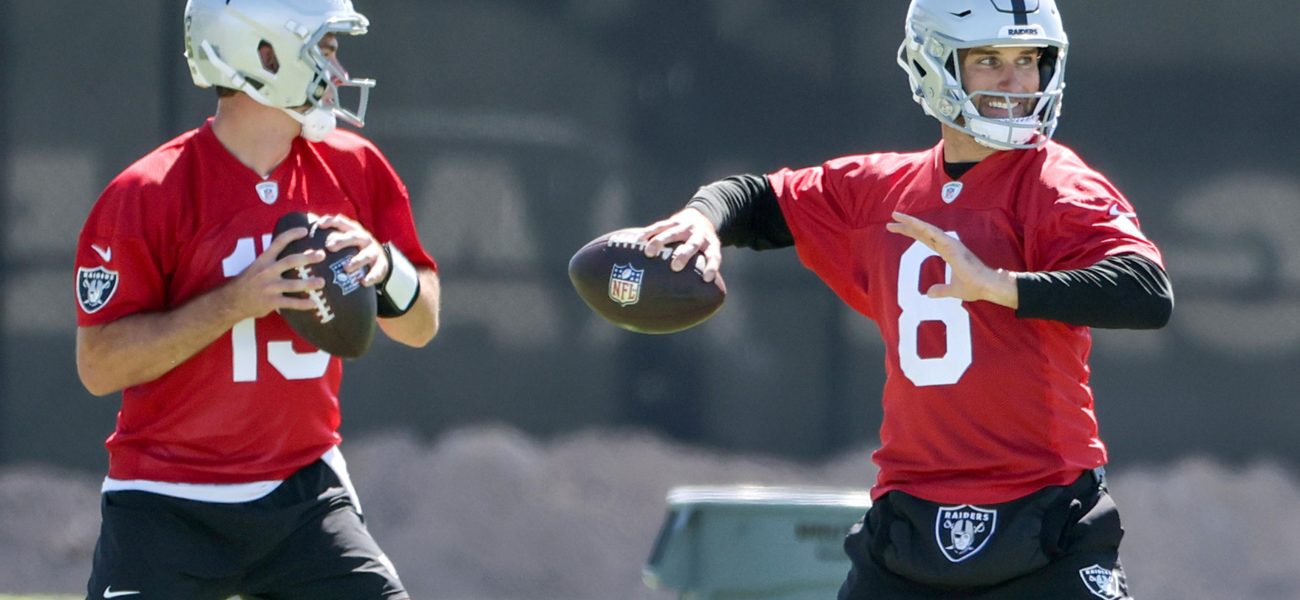
POLICY WIRE — HENDERSON, NEVADA — There’s a particular kind of alchemy to professional football, where a grizzled veteran, a quarterback nearing 40, finds himself draped in a new team’s colors, his Achilles barely mended, trying to outrun not just pass rushers but the ghost of his own past—and a very loud, very young shadow. It ain’t just about throwing spirals; it’s about holding back a rising tide of expectation, even if everyone knows it’s eventually gonna break.
Down here in Henderson, Nevada, the desert heat isn’t the only thing cranking up the pressure for the Las Vegas Raiders. Mandatory veteran workouts, those innocuous OTAs, they’ve already sparked a simmer, a prelude to the eventual fan inferno that will pit newly acquired, high-priced signal-caller Kirk Cousins against rookie phenom Fernando Mendoza. It’s an old story, sure, but in the brutal economy of the NFL, it plays out with particularly sharp teeth. Fans, always starved for the shiny new toy, are already peeking past Cousins, despite his considerable contract. They’re looking straight at Mendoza, the future they’ve been promised.
It’s not just a hunch, either. The whispers—hell, they’re shouts now—suggest Kirk Cousins, still hobbled in the minds of many after that nasty 2023 Achilles tear, will find himself under the microscope from Week One. Can a savvy old hand, even one who’s piled up over 38,000 career passing yards, keep the baying hounds at bay? Not unless he pulls a magic trick, probably, like becoming ‘Prime Peyton Manning’ overnight, all while Vegas morphs into a surprise contender. That’s the bar. It’s high. It’s probably unfair. But that’s the league, ain’t it?
And frankly, team general managers, they know this script. “We’re always balancing immediate competitiveness with long-term strategy,” Raiders General Manager John Spytek observed dryly to Policy Wire, his eyes, one imagines, on both the present spreadsheet and the distant horizon. “It’s about making sure our young talents have the proper runway, and our veterans provide the structural integrity.” Translated? Cousins is there to build a bridge, probably with gold plating, for the kid.
But the calculus isn’t just about on-field heroics. For Cousins, soon to turn 38, his most critical responsibilities may not involve scrambling for a first down. His contract isn’t just for throwing. It’s to be Mendoza’s personal sensei, teaching him the dark arts of NFL mental toughness — and preparation. He’s also expected to be a sage in a locker room that’s, well, a little green around the gills. Any actual positive play on the field? That’s a bonus. A bonus his hefty paycheck barely registers. Offensive Coordinator Klint Kubiak, himself a young coach, understands the dynamic: “Kirk’s a pro. He’s seen every look, been in every situation. You can’t put a price on that kind of wisdom in a developing locker room. And Mendoza? He’s absorbing it all. You can feel the hunger in the kid.”
The talent-evaluation machine is merciless. Just look at the brouhaha around third-round pick Trey Zuhn, an offensive lineman. Scouts — and pundits nitpick everything—arm length, run-blocking grades. He might’ve shared a national award for blocking, sure, but his arm length puts him in the 19th percentile for NFL offensive linemen, according to data from MockDraftable. An inch, or even a half-inch, it’s a chasm in the trenches. And while he reportedly dominated pass blocking in college, his run-blocking grade from Pro Football Focus languished at a below-average 58.4 last season. That kind of microscopic flaw is what makes or breaks careers, influencing decisions by franchises acutely aware of their bottom line, both on the field and in their fan engagement.
What This Means
This whole situation—the high-profile signing, the Achilles recovery, the heir apparent lurking—it’s a stark reflection of the transactional nature of modern professional sports. Kirk Cousins isn’t just a quarterback; he’s an asset with a depreciating value, purchased for his immediate utility and his pedagogical role. The economic implication is clear: even multi-million dollar contracts often serve a dual purpose beyond mere on-field production, essentially underwriting a mentorship program. From a political perspective within the franchise, this isn’t a power struggle; it’s a carefully managed succession plan. Fan clamor, while potent, will be managed as the team attempts to thread the needle of short-term competitiveness and long-term sustainability. Because for every American football enthusiast shouting from the cheap seats, there’s a new demographic emerging—even in places like Pakistan, where the NFL’s slow but steady global push means that the narratives of athletic struggle, personal sacrifice, and generational transitions resonate, albeit in a different cultural context, attracting fresh eyes to the often-brutal dynamics of professional sports.
Then there are the secondary ripple effects. If Mendoza lights up the preseason, even against reserves, it’ll only intensify the clamor. If the team sees a dramatic turnaround this year, something not exactly predicted for this young roster, coaches will become hot commodities. Guys like offensive coordinator Andrew Janocko—he’s young, only 38, but a strong performance from the Raiders, especially with a promising rookie QB, would surely put him on head coach radars around the league. But the likelihood of this particular squad making a deep playoff run? Don’t hold your breath just yet, as the current thinking goes. It’s a young group, after all, still figuring things out. They’ll keep the coaching staff, most of ’em. Just not quite ready for that Super Bowl run—that’s a whisper, not a shout, for another season.