

Hoops Diplomacy: How Global Ambition Sidelines Local Showmanship for Celtics’ Young Star
POLICY WIRE — Boston, MA — Forget the glitzy lights of Las Vegas, the manufactured hype of summer exhibition games—it seems some rising sports stars have bigger fish to fry. In a curious twist that...

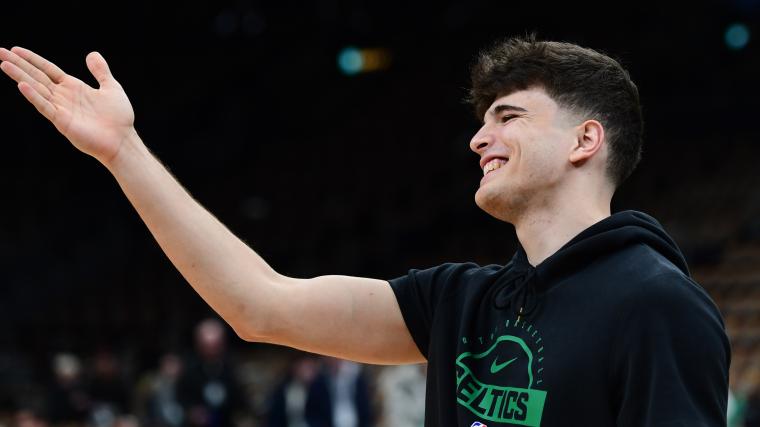
POLICY WIRE — Boston, MA — Forget the glitzy lights of Las Vegas, the manufactured hype of summer exhibition games—it seems some rising sports stars have bigger fish to fry. In a curious twist that says plenty about the evolving economics of global athletics, Celtics prodigy Hugo Gonzalez is giving the typically high-stakes NBA Summer League a wide berth. He’s listed on the roster, sure, a name on a piece of paper, but don’t expect much from him. It turns out, sovereign pride and international competition hold a far greater currency than developmental scrimmages for the Spanish phenom.
Gonzalez, we’re told, was a bit of a surprise inclusion on the Boston Celtics ‘ roster for NBA Summer League. And yet, this isn’t some slight against the kid; quite the opposite. He’s already been hard at it, plying his trade not under the neon glow of an American arena, but on European courts, battling it out for his home country, Spain, in FIBA World Cup qualifiers. It’s a compelling dynamic, where the informal hierarchy of a national team’s success often outranks the professional obligations of a club — at least for the players themselves. For them, there’s an inherent prestige, a distinct narrative value in representing one’s flag. [QUOTE_PLACEHOLDER]
Many Celtics faithful are already deeply invested in Gonzalez’s journey, and his absence—or limited presence—at Summer League certainly won’t dim their enthusiasm. The club’s brass, after all, made him a late first-round pick in 2025. It’s a long-term investment, you see, a calculated bet on a young man’s potential. They’ll let him pursue national glory, presumably, because the talent developing under pressure for his country means less wear and tear for the Summer League circuit. That experience, many would argue, far eclipses the utility of chasing loose balls against aspiring G-Leaguers.
But the numbers don’t lie about his ongoing contributions to Spain. He had an incredibly well-rounded game against Denmark, delivering a stat line of 16pts/5rebs/5asts/2stls in Spain’s victory, as recorded during the July 2, 2026, qualifier. Just days later, Gonzalez also filled the stat sheet up against the country of Georgia, contributing 9 PTS (3-8 FG, 2-7 3PT), 2 REB, 2 AST, 2 STL, 1 BLK. These aren’t the figures of a player needing extra reps in an ancillary league. These are numbers for a young athlete performing at a high international level, refining skills against hardened professionals, carrying the hopes of a nation.
For some, this commitment might seem counterintuitive—a budding NBA career temporarily put on pause for something less financially remunerative. Yet, it echoes similar situations in global soccer, or even cricket, where national pride often dictates player availability over club schedules. You see it, say, with Pakistani cricketers, whose dedication to national team tours can occasionally sideline lucrative stints in private leagues. It’s a different ethos, one where national honor and global ranking matter immensely—perhaps more so than the fleeting buzz of an American pre-season competition.
And let’s not forget the sheer political optics. Spain, like many European nations, invests heavily in its sporting programs, fostering a deep-seated culture of national team loyalty. Players aren’t just assets for an American franchise; they’re public figures, national heroes even, long before they ever set foot in the NBA. This isn’t just basketball; it’s cultural diplomacy played out on courts worldwide. Because really, what’s more impactful? Dribbling through a Summer League game where everyone’s auditioning, or helping your nation qualify for the world’s most prestigious basketball tournament?
📄 POLICY WIRE WHITEPAPER PUBLISHED: PAKISTAN'S NATIONAL SECURITY POLICY PRIORITIES
👉 READ BY CLICKING HEREThis isn’t to say the Celtics aren’t keeping an eye on him. After all, Gonzalez started games for Boston as a rookie, and he’s the only player who has started in a game for the Celtics who’s on the Summer League roster. That kind of experience — and trust, right off the bat, usually means a fast track. But it also means they trust him to make good decisions for his own development. And frankly, this move speaks volumes. The Celtics certainly want to see him keep getting better, and apparently, playing for his country is seen as the premier path to that improvement right now, a sentiment likely shared by teams eyeing global talent, like those in the Turkish Süper Lig, which routinely sends players to FIBA qualifiers. You can learn a bit more about the enduring appeal of rigorous competition, even if it’s not the main event, by understanding how international match-ups captivate broader audiences.
What This Means
This whole Gonzalez saga—or lack thereof, at Summer League—highlights a significant shift in professional sports: the global player market has complicated the traditional pipeline. Teams like the Celtics aren’t just drafting athletes; they’re acquiring individuals who are often integral to national sporting programs, particularly in Europe. The economic implications are subtle but substantial. Players with strong national team profiles often command higher global endorsements and attract broader fan bases, enriching both themselves and, indirectly, their NBA clubs. It’s a soft power play, a mutual exchange of brand visibility that transcends individual game stats.
Politically, it underscores the growing tension between nation-states vying for global recognition through sports and the immense financial pull of the American professional leagues. Players, in effect, become unofficial cultural ambassadors, their choices reflecting the prestige placed on national representation versus the pursuit of individual wealth and fame. For the Celtics, accepting Gonzalez’s national commitments is a pragmatic political maneuver. It buys them goodwill with the player, his agent, and potentially with European basketball federations, fostering future recruiting opportunities. It’s a quiet acknowledgement that in a deeply interconnected world, an American team’s ambitions can’t always trump a nation’s sporting pride—especially not when that national experience offers superior skill refinement. Plus, the investment in a global player’s continued high-level performance is far better than seeing him languish or, worse, injure himself in less consequential fixtures. This balancing act of club obligations versus national duty is a global phenomenon. For context, one might examine how European politics intertwine with issues of national identity and broader international relations, even in non-sporting arenas.