


Trump’s Eleventh-Hour Gambit on Birthright Citizenship Stirs Legal Hornet’s Nest
POLICY WIRE — Washington, D.C. — Another election cycle, another tempest. The former President, never one for subtlety, has once again signaled his intention to pull on one of the republic’s most...

POLICY WIRE — Washington, D.C. — Another election cycle, another tempest. The former President, never one for subtlety, has once again signaled his intention to pull on one of the republic’s most foundational legal threads—birthright citizenship. It’s less a novel strategy — and more a well-worn playbook, dusted off for maximum impact. You’d think by now the theatrics wouldn’t shock, but they always do, don’t they?
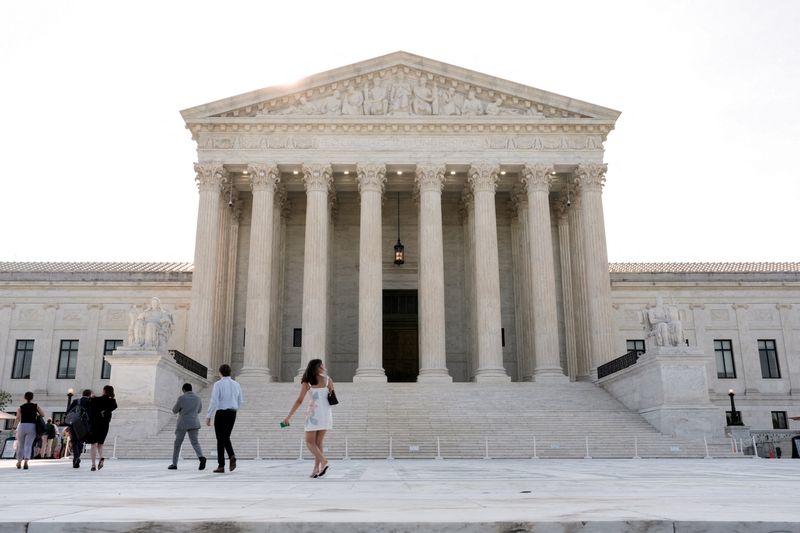
The latest pronouncement, issued with characteristic brevity, concerns the prospect of beseeching the Supreme Court to, shall we say, revisit the entire affair. It implies an aggressive, head-on assault on how we understand citizenship—a definition, incidentally, that’s been in place since the post-Civil War era. For the casual observer, it’s all about immigration. For those of us who’ve seen this movie before, it’s about a lot more than that. It’s about leveraging long-standing constitutional interpretations for contemporary political gain, pure — and simple.
And let’s be frank, this isn’t merely about kids born on American soil to non-citizens. That’s the surface-level stuff. It taps into a deeper vein of nationalist sentiment, an us-versus-them narrative that plays particularly well with a segment of the electorate. But pushing this—again—onto the High Court’s already overstuffed docket, well, that’s quite the statement, isn’t it?
For decades, legal scholars have pretty much agreed that the Fourteenth Amendment’s first clause—which declares, [QUOTE_PLACEHOLDER]—means exactly what it says. But conservatives, Trump prominent among them, have long argued for a narrower reading, contending it wasn’t meant for children of undocumented immigrants or, in some bolder interpretations, for anyone not subject to the nation’s [QUOTE_PLACEHOLDER] jurisdiction.
But the practicalities here, let’s not pretend they’re minor. Imagine the administrative headache, the sheer bureaucratic chaos of attempting to verify every newborn’s lineage, every parent’s immigration status, retrospectively or otherwise. It’s an enforcement nightmare before it even hits a courtroom. This isn’t just about tweaking a policy; it’s about fundamentally altering the fabric of who belongs, and by what metric. The implications stretch far beyond borders, reaching into family units, communities, — and economies.
The potential ripple effects abroad are quite something to ponder. Consider countries like Pakistan or Bangladesh, where communities with diaspora connections to the United States often view birthright citizenship as an inherent safety net or, sometimes, as a strategic opportunity. Families across the subcontinent often weigh immigration paths—legal and otherwise—with the long-term goal of securing stability for future generations. Upending birthright citizenship would effectively sever that potential link, sending seismic tremors through established diaspora networks. It shifts the calculus for millions, reshaping aspirations and perhaps even pushing some into more desperate or perilous migration channels. We’ve seen Italy try its own versions of these shifts recently; they don’t exactly go smoothly.
Data from the Pew Research Center indicated in 2023 that approximately 4.2 million children in the U.S. had at least one parent who was an unauthorized immigrant. This statistic alone hints at the sheer human scale involved in any reinterpretation of birthright citizenship—it’s not just a legal abstraction; it’s actual people.
Then there’s the politics. Such a move would energize both sides, for sure. On one hand, it rallies a base convinced that the nation’s identity is under assault. On the other, it galvanizes opponents who see it as an assault on basic human rights — and constitutional principles. And the Supreme Court itself—the very institution being petitioned—has avoided tackling this head-on for decades. One has to wonder if they’d be so keen to step into this particular maelstrom, even with a conservative majority firmly entrenched. History’s watching, you know?
📄 POLICY WIRE WHITEPAPER PUBLISHED: PAKISTAN'S NATIONAL SECURITY POLICY PRIORITIES
👉 READ BY CLICKING HEREIt’s less a legal battle over existing statutes, I’d wager, and more a symbolic crusade designed to stoke cultural grievances. It positions the former president as the relentless fighter, the one still willing to tackle the third rails of American policy, no matter how politically charged or legally fraught. It’s a calculated provocation, not a constitutional necessity.
What This Means
This renewed focus on birthright citizenship isn’t a mere academic exercise; it carries heavy political and economic implications. Politically, it signals a clear line of attack for the upcoming electoral cycle, attempting to differentiate from more moderate positions. It’s a highly effective way to energize a specific segment of the electorate that feels strongly about immigration controls. This kind of rhetoric often leads to an increased focus on border security and a hardening of immigration policy discussions, pushing more nuanced approaches to the sidelines.
Economically, the impacts could be considerable, though harder to quantify immediately. Severing birthright citizenship could create a class of stateless or quasi-stateless individuals within the U.S. That’d introduce immense instability, impacting labor markets, social services, and the legal framework for generations. Children born without clear citizenship could face barriers to education, employment, and healthcare, creating a long-term underclass that becomes an economic drag. Think about all those communities—cities, rural towns, even suburbs—that have developed intricate socio-economic ties, often built on multi-generational families. A change to this bedrock principle would ripple through local economies, altering consumption patterns and labor availability. It’s a dramatic intervention, the kind that might please some ideological factions but would, you know, really complicate things for everyone else, perhaps even those struggling with rising costs already.
This proposal—it’s not new, it’s not even slightly innovative—instead, it’s a reiteration of a populist tactic designed to appeal to anxieties rather than offer practical solutions. The legal fight, if it ever genuinely materializes beyond rhetorical bluster, would be immense and could redefine American citizenship for the 21st century. But its primary purpose seems, as always, to be about scoring political points in a rather noisy public square.