


England T20 Hero: Sciver-Brunt’s Unseen Battle & Triumph
England's T20 hero, Nat Sciver-Brunt, battled nerves & injury to score 75 and lead her team to the World Cup final. Explore her journey of resilience & triumph.

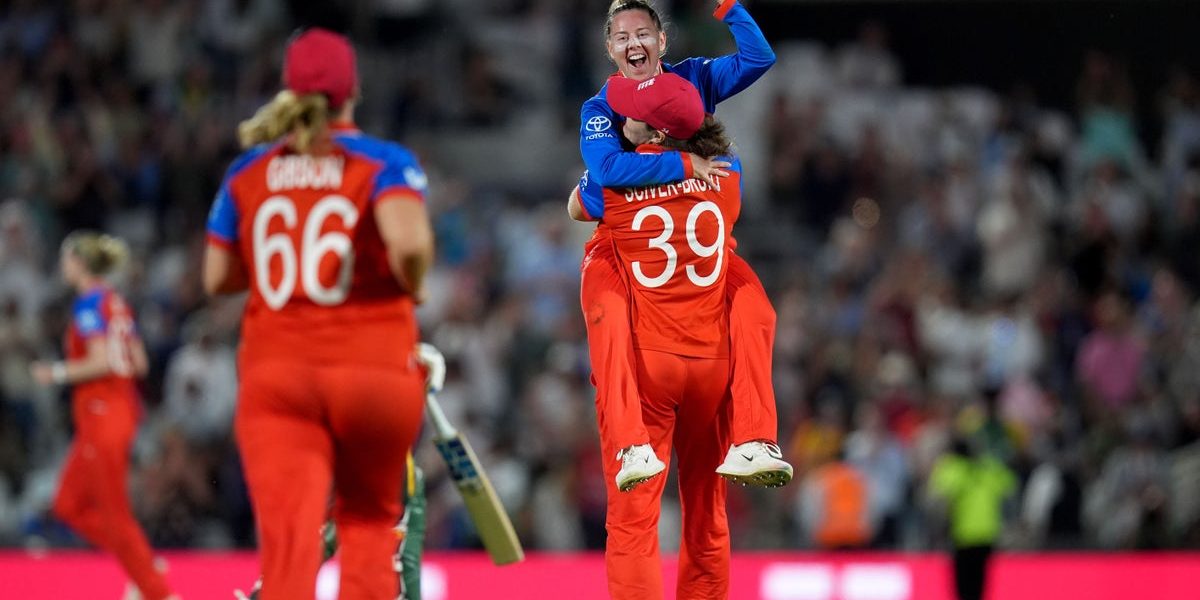
POLICY WIRE — London, UK — The public memory often chisels sporting triumphs into seamless narratives of pure adrenaline. But behind the thunderous applause and the stark white flannels, an entirely different battle wages—a far quieter, more treacherous one fought within the minds of its combatants. For Nat Sciver-Brunt, England’s talismanic captain, the semi-final clash at The Oval wasn’t just about dispatching South Africa; it was about silencing a chorus of internal doubts after weeks sidelined with injury.
Picture the scene: The grand stage, the roar of a home crowd hungry for success. England, after cruising through the group stages—largely in Sciver-Brunt’s absence due to a nagging calf problem—found themselves staring into the abyss, precariously perched at 23 runs for the loss of three wickets against a rampant South African attack. The weight of expectation, the recent injury, the ghost of missed games. It’s enough to crumble even the steeliest resolve.
But heroes, or perhaps more accurately, leaders forged in the fires of high-stakes competition, rarely show their internal struggles. They don’t—not really—unravel. Sciver-Brunt stepped onto that field, her public face a mask of focus, her personal experience quite another matter. “I was very nervous going in and quite emotional about it yesterday,” she confided after the match, a raw admission that rarely makes it past the carefully curated press briefings. “The occasion and what we’ve been able to do as a team, I was trying to live up to the three games that I missed and trying to have an impact as a leader and a cricketer.” That’s the honest truth, isn’t it? The quiet dread of falling short.
Yet, true to form, the skipper — she’s just built different — found a way to compartmentalize. “I managed to put those thoughts to bed when the warm-up started. I’m just so excited — and proud of what I’ve been able to do.” And she did plenty. She took the game by the scruff of its neck, not with reckless abandon, but with the cool precision of a surgeon. Paired with her predecessor, Heather Knight, Sciver-Brunt resurrected England’s innings, orchestrating a monumental 133-run partnership. She notched up a blistering 75 runs off just 47 balls. Not bad for someone carrying both a physical niggle — and the emotional burden of three weeks out.
That kind of performance, at that level, isn’t merely about bat on ball. It’s about a steely will, an almost existential refusal to yield. And England sealed a 40-run victory, as reported by the ICC, a margin that felt both decisive and, given their earlier predicament, almost impossible. It’s moments like these that redefine narratives, even across continents where cricket is almost a religion.
The roar at The Oval, an historic ground familiar to countless South Asian fans residing in London, echoed beyond the city. The women’s game, often a quieter cousin to its boisterous male counterpart, is commanding attention, not least in cricket-obsessed regions like Pakistan and India, where investment in female athletes is slowly gathering momentum. For a player like Sciver-Brunt, performing with such defiance—nine years after her previous top-scoring effort at Lord’s sealed an ODI World Cup against India—sends a powerful message about resilience, grit, and the unyielding pursuit of excellence. It demonstrates that passion knows no gender, — and sporting heroism, no boundaries.
Clare Connor, the ECB’s Managing Director of Women’s Cricket, understands this impact well. (You know, she sees the big picture). She’d certainly tell you, “Moments like these don’t just secure a final; they shape the future narrative of women’s cricket. There’s immense pressure on these players to perform, especially on home soil. But it’s this kind of grit that truly inspires. It pulls new fans in. It changes minds.” She isn’t wrong.
📄 POLICY WIRE WHITEPAPER PUBLISHED: PAKISTAN'S NATIONAL SECURITY POLICY PRIORITIES
👉 READ BY CLICKING HEREWhat This Means
England’s hard-fought ascent to the T20 World Cup final—particularly the leadership shown by Sciver-Brunt under immense duress—transcends the cricketing field. For Downing Street, it’s a soft power win, another ripple in the pond of national prestige. In an era where cultural diplomacy is as critical as economic policy, a successful national team, especially one representing values of inclusion and perseverance, burns brightly on the international stage. It can quietly, almost subliminally, influence perceptions of the UK globally.
Economically, this success amplifies the case for continued investment in women’s sports, showcasing tangible returns on engagement, viewership, and sponsorship. We’re talking about more than just ticket sales; it’s about a growing industry, providing employment, driving media interest, and challenging established economic models of what’s possible in professional sports. For women’s cricket, this final is another brick in building a self-sustaining ecosystem.
Beyond the spreadsheets and geopolitical nudges, Sciver-Brunt’s performance reinforces a crucial social message: pressure—real, grinding, stomach-knotting pressure—can be tamed. That you can be fearful and still excel. It’s an unwritten manifesto for anyone facing a daunting challenge, from a high-stakes board meeting to navigating complex personal struggles. These athletes, stripped down to their most vulnerable, then conquering it all, provide an unlikely, but potent, lesson in human endeavor. We might be watching cricket, but really, we’re witnessing human psychology under the purest stress test. It’s fascinating, if you ask me.
England will now face Australia at Lord’s, another ground of immense historical significance—a veritable temple of the sport. England has won every Women’s World Cup played on home turf. But, — and this is a big “but,” every T20 World Cup final between these two titans has gone the way of the Australians. So one streak’s gotta snap. With Sciver-Brunt leading the charge, albeit with those persistent nerves still lurking (one imagines), England certainly hopes it’s the latter one that breaks.