


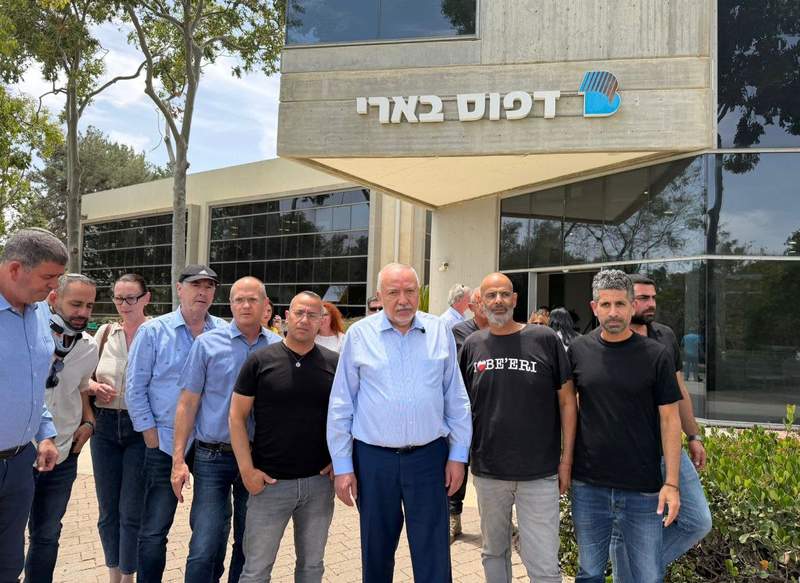
Desperate Measures? Israel’s Political Turmoil Fuels War Games Talk
POLICY WIRE — Jerusalem, Israel — It’s a familiar, chilling rhythm in Israeli politics, a kind of dark aria performed each time the government wobbles: talk turns to bombs. And right now, the...

POLICY WIRE — Jerusalem, Israel — It’s a familiar, chilling rhythm in Israeli politics, a kind of dark aria performed each time the government wobbles: talk turns to bombs. And right now, the orchestra’s in full swing, conducted by whispers — and grimacing public pronouncements. Because former Defense Minister Avigdor Liberman, never one for understatement, didn’t just suggest Benjamin Netanyahu might use military muscle to prop up his flailing coalition; he outright warned that ‘Bibi’ might launch a full-scale operation, all to save his own political skin. It’s an ugly calculus, isn’t it? A Prime Minister eyeing ballots, but through the crosshairs.
The air here in Jerusalem, thick with both summer heat — and political smog, feels heavy with deja vu. This isn’t the first time an Israeli leader has been accused of viewing military action through an electoral lens. But the starkness of Liberman’s latest broadside—coming as Netanyahu battles corruption allegations and struggles to hold together a motley crew of conservative and religious factions—has sent shivers down spines usually immune to hyperbole. They’re watching the government hemorrhage support, the internal fissures widening daily. What better way to unite a fractured nation, to silence the critics, than with a perceived external threat? It’s an old trick, sure, but a seemingly irresistible one for leaders in a tight spot.
“We’ve seen this movie before, haven’t we?” Liberman reportedly stated during a security briefing that was anything but secure from the press. “A Prime Minister cornered, his coalition collapsing faster than a cheap tent in a desert storm, suddenly finding a ‘security imperative’ that just so happens to coincide with election season. It’s not just irresponsible; it’s an absolute disgrace to our uniform and to every soldier serving this country.” He wasn’t pulling punches, not in the slightest. And why would he? This is his turf. The guy knows the mechanics of war — and peace, and also the dark arts of electoral survival. For him, the correlation isn’t just theory—it’s observed practice.
Netanyahu’s current administration, a strange amalgamation of the ultra-Orthodox, the national-religious, and his own Likud party, has been creaking under its own weight for months. Key legislative reforms are stalled. Economic jitters abound. The public mood? Grouchy, to put it mildly. According to a recent poll published by the Israel Democracy Institute, only 37% of Israelis express confidence in the government’s stability, a historically low figure. So, yes, it doesn’t take a rocket scientist to see why a unifying crisis might suddenly seem quite… expedient.
But the man himself, Prime Minister Netanyahu, remains defiant, at least publicly. He’s a survivor, a political cat with at least nine lives (and maybe a few extra ones on reserve). He’s dismissed such claims as “politically motivated smears,” as expected. “Every decision made regarding Israel’s security,” Netanyahu insisted to his party members, “is made solely in defense of our people, our borders, and our sovereignty. Any suggestion otherwise is a cynical attempt to weaken us, both internally and to our enemies abroad.” He frames it as steadfast leadership, naturally. He wouldn’t have it any other way. It’s a calculated dance, always has been, between his political fate — and Israel’s actual security challenges. (Sometimes, it’s hard to tell which takes precedence, isn’t it?).
📄 POLICY WIRE WHITEPAPER PUBLISHED: PAKISTAN'S NATIONAL SECURITY POLICY PRIORITIES
👉 READ BY CLICKING HEREThis internal Israeli melodrama plays out, of course, on a global stage where its ripples are anything but localized. The idea of a military engagement—potentially against Hezbollah in Lebanon, Hamas in Gaza, or even a more audacious strike against Iranian assets—doesn’t just stay within Israel’s borders. And it doesn’t just affect neighboring Arab states. Any escalation quickly resonates across the wider Muslim world, inflaming sentiment in places like Pakistan, already navigating its own delicate socio-political balances. For Islamabad, an already tense region, further instability from a potential Israeli offensive could complicate its foreign policy objectives, particularly relations with its own Gulf partners and, indeed, domestic public opinion that often aligns with Palestinian causes. These are far-reaching consequences from a Jerusalem coalition crisis. It’s rarely just about the immediate players.
The political maneuvering in Jerusalem, therefore, isn’t some contained theatrical piece. It’s more like setting off firecrackers in a crowded bazaar—the sparks fly everywhere, and someone invariably gets burned. The Israeli military, for its part, usually remains scrupulously apolitical, maintaining operational readiness despite the leadership’s shenanigans. But they’re not deaf, they hear the chatter. And while generals plan for strategic objectives, politicians in their orbit often hear only the drumbeat of public approval. For more context on Israel’s complex defense apparatus, you might consider our earlier reporting on the challenges facing the IAF.
What This Means
A Prime Minister clinging to power is a dangerous animal, plain — and simple. When that animal leads a military as formidable as Israel’s, the stakes get astronomical. This isn’t just about Netanyahu’s job; it’s about regional stability — and potentially, wider conflict. Economically, any military action, especially one perceived as politically opportunistic, would send shockwaves through an already jittery global market, deterring foreign investment in Israel and perhaps pushing oil prices north. But here’s the kicker: politically, it might work, at least temporarily. Israelis, deeply attuned to security threats, often rally around the flag during conflict. So, the cynical incentive is there, and everyone knows it. The challenge is differentiating legitimate defense from politically convenient belligerence. And honestly, for an embattled leader, that line gets mighty blurry.