


Albuquerque’s Economic Fault Lines Exposed as Minimum Wage Rises Amidst Public Uproar
POLICY WIRE — Albuquerque, New Mexico — Democracy’s messy theater played out in plain view when the Albuquerque City Council convened for a recent, rather animated session. It...

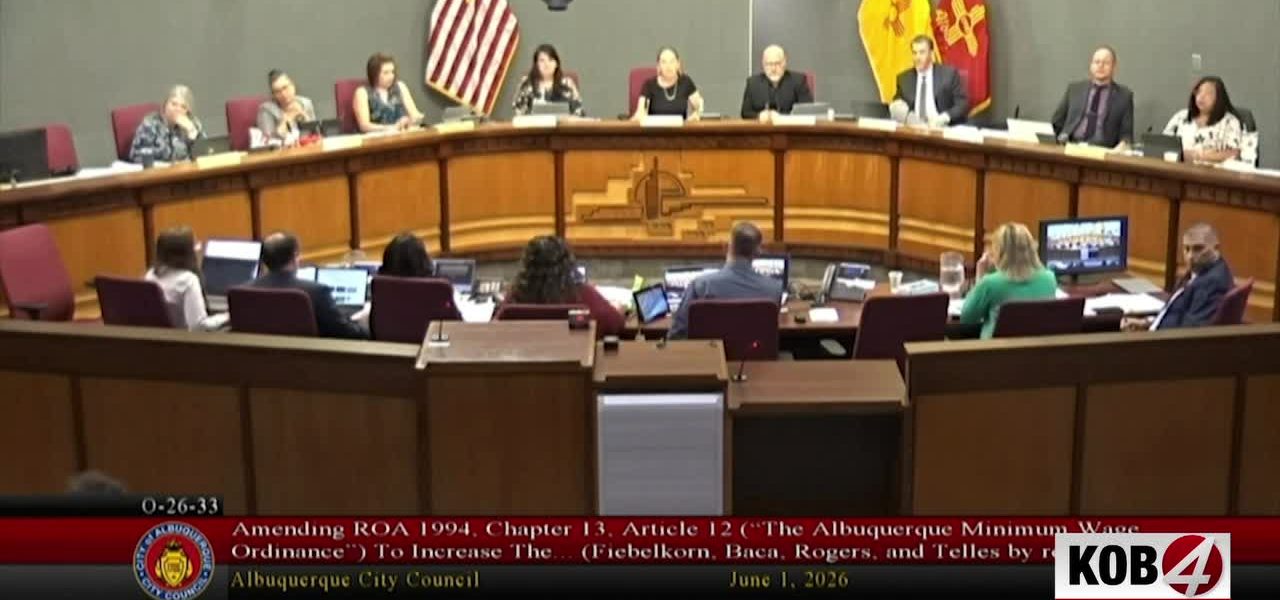
POLICY WIRE — Albuquerque, New Mexico — Democracy’s messy theater played out in plain view when the Albuquerque City Council convened for a recent, rather animated session. It wasn’t just policy on the table; it was also public decorum, tested right up to its breaking point. In what could be seen as an aggressive policing of public comment, two individuals found themselves unceremoniously shown the door—a spectacle underscoring just how thin patience wears when pocketbook issues hit the political stage.
City Council President Klarissa Peña, who wasn’t mincing words that night, oversaw the removals. One individual, it’s reported, drew her ire for allegedly ridiculing others during public comment. His swift exit followed a crisp declaration: I don’t think we should be ridiculing anyone, Peña said. So I’ll just be the one speaking. Adail Rose can you please leave. A second person faced expulsion for speaking directly to Councilor Dan Lewis, bypassing the established protocol of addressing the president. And a third? He received a stern pre-warning before security took action. This is your second warning, so yes, you got a warning earlier, and then yeah, so if you can escort him out, Peña said. This is going to be your third warning, so you’re escorted out, because those are the rules. Okay well they’re. That’s a strong-arm maneuver, but hey, rules are rules, apparently, especially when economic anxiety brews thick in the chamber. [QUOTE_PLACEHOLDER]
Amidst this spirited governance—or perhaps because of it—the Albuquerque City Council voted to pass a minimum wage hike in the city with some amendments during a heated Monday meeting. This isn’t a snap jump; it’s a careful, perhaps hesitant, stagger toward better pay. The proposal, once fully implemented by 2030, projects a city minimum wage of $15 an hour. A key amendment to the bill will slow roll the raise over three years by $1 an hour annually until the minimum wage is $15 an hour by 2030, after which annual cost of living adjustments would kick in. It’s a calculated pace, clearly designed to mitigate the immediate shock for local businesses while still offering a tangible increase for workers.
But does it mollify anyone? Not entirely. Not when council meetings turn into impromptu bouncer drills. Councilor Lewis, a name mentioned in the kerfuffle, faced an uncomfortable accusation during the proceedings. Thomas Abeyta showed a screenshot of an email that allegedly came from Councilor Lewis. This email, according to Abeyta, claimed Lewis is working with apartment associations to stop the city minimum wage increase proposal. Lewis, for his part, opted for silence, not responding to Abeyta during the meeting. It’s an interesting strategy, especially when confronted with what many would call a public challenge.
Businesses, predictably, have their own take. Carol Wight, representing the New Mexico Restaurant Association, expressed a grudging acceptance of the staged increase. If we increase it $1 this year, $1 the year after, and then $1 the next year, that just gives us time to catch up, rather than the $3 all at once, Wight said. She pointed to a common refrain from the business community, a reminder that it’s not just people making minimum wage that can’t afford things, it’s also people that give jobs that can’t afford to keep raising their prices. It’s a classic friction, one that plays out on the main streets of Albuquerque just as it does in, say, Karachi’s bustling food stalls, where business owners grapple with rising commodity costs against what constitutes a livable wage for their employees. Economic realities don’t care much for geography, it seems. And that balancing act? It’s something even policymakers in Islamabad have to ponder when drafting their own labor statutes, struggling to satisfy both their constituents and the market’s unforgiving hand.
📄 POLICY WIRE WHITEPAPER PUBLISHED: PAKISTAN'S NATIONAL SECURITY POLICY PRIORITIES
👉 READ BY CLICKING HEREWhat This Means
This Albuquerque decision isn’t just about a few extra dollars an hour for local workers. It’s a microcosm of the intense political and economic tug-of-war happening across America—and indeed, globally. Politically, the heated public meeting showcases the deep-seated frustration felt by many citizens regarding their economic circumstances. When people are ejected from public forums for expressing themselves, whether unruly or not, it speaks to a system struggling to contain popular discontent.
Economically, the staged implementation to $15 an hour by 2030 is a deliberate attempt to walk a tightrope. It’s designed to provide a phased wage increase without triggering the immediate, sharp inflation or job losses that some businesses fear from an abrupt jump. But that slow rollout also means that the impact for low-wage earners will be incremental, and perhaps too little, too late, for many facing immediate cost-of-living pressures right now. Look at urban centers across South Asia, for instance. Places like Dhaka or Lahore routinely wrestle with this precise dilemma: how do you elevate a worker’s buying power without inadvertently choking the small, informal businesses that form the backbone of their local economies? The challenge of balancing societal well-being with economic sustainability is a universal constant, often with local solutions and distinct political ramifications. The allegations against Councilor Lewis, true or not, highlight another familiar political current: the suspicion of backroom dealing between elected officials and specific industry interests, like apartment associations, particularly when broad economic policies are debated. Such whispers erode public trust, making already tense discussions even more volatile. The reality is, what happens in a city council chamber in New Mexico resonates with struggles far beyond its borders.