


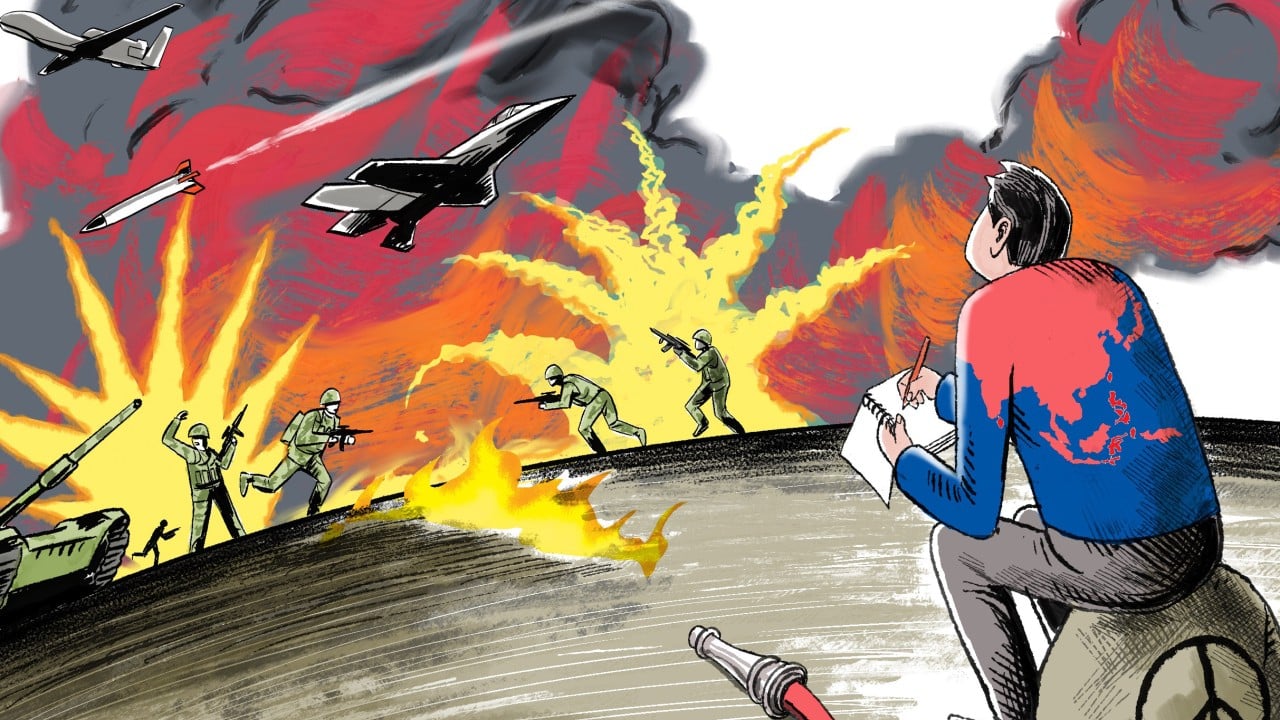
Asia’s Gaze Shifts: From War Tourism to Geopolitical Reality Check
POLICY WIRE — Singapore City, Singapore — Forget the genteel intellectual salons, where analysts sip artisanal coffee, dissecting far-off skirmishes like a particularly complex game of chess. Because...

POLICY WIRE — Singapore City, Singapore — Forget the genteel intellectual salons, where analysts sip artisanal coffee, dissecting far-off skirmishes like a particularly complex game of chess. Because out here, in the beating heart of Asia, that detachment? It’s dissolving faster than a sugar cube in boiling chai. The luxury of mere observation, it seems, has an expiry date, — and frankly, we’re way past it.
For too long, much of Asia — blessed with a patchy, uneven peace — treated the world’s fiery hotspots as a high-stakes, real-time documentary. Ukraine’s agonizing fight, Gaza’s brutal descent, the persistent sabre-rattling across various straits and borders; these weren’t quite ‘local problems.’ No, they were dramatic geopolitical theater, playing out on distant screens. But the applause has died down. And the bills? They’re landing square on Asian doorsteps, demanding more than just passive analysis. This ain’t academic anymore, it’s existential.
Take the global energy shocks, for instance. Or the supply chain snarls. They’ve hammered everything from microchip fabrication in Taiwan to textile exports from Bangladesh. Countries here, even those geographically distant, are grappling with what one might call ‘secondary trauma.’ And that’s a tough pill for leaders who’d rather focus on domestic growth. But growth? It doesn’t happen in a vacuum when the rest of the planet’s busy lighting fires.
“We can’t afford the luxury of distant sympathy,” quipped Pakistan’s then-Foreign Minister, Jalil Abbas Jilani, at a recent Islamabad policy forum. “Our national accounts, our very stability, feel the ripple effect from every faraway explosion. You think global food prices don’t hit Karachi harder than Kyiv? Think again.” His point wasn’t lost on anyone who understands the tightrope developing nations walk, where a dollar lost in exports is a household potentially pushed deeper into destitution. Because economic insecurity, for many, is the direct road to internal unrest. It’s a truth governments in places like Islamabad—ever juggling domestic challenges with regional tensions—know intimately. See how the missing link in South Asia’s terrorism crisis often circles back to economic desperation?
The geopolitical tremors aren’t just financial; they’re strategic. The West’s laser-focus on Ukraine and the Middle East has left certain power vacuums and realigned priorities elsewhere. Who fills them? Who loses out? That’s the calculation keeping chanceries — and defense ministries awake through Jakarta and New Delhi alike. Military expenditure across the continent tells part of the story. A recent report by the Stockholm International Peace Research Institute (SIPRI) indicated that military expenditure in Asia and Oceania rose by 4.4% in 2023, reaching $580 billion. That’s not just a statistic; it’s an active admission that ‘observing’ is now quickly giving way to ‘preparing.’
But how do you prepare for everything, when the global stage is shifting beneath your feet? “Observing global chaos might feel like an intellectual exercise,” noted Bilahari Kausikan, the seasoned Singaporean diplomat and a renowned foreign policy mind, addressing a small, closed-door regional security summit last month. “But the truth is, the chessboard moves are getting closer to home than we’d care to admit. The challenge isn’t just to see, but to actually internalize what this means for our own skin in the game.” It’s a sentiment echoing across ministries: the idea that waiting it out, hoping for stability, isn’t a strategy; it’s a prayer. And governments don’t get paid to pray.
Casual nonchalance isn’t an option. Especially when regional players—from Beijing to Tokyo, from Tehran to Ankara—are recalculating alliances, supply chains, and their own, very specific national interests. They’re not just watching; they’re strategizing. And often, quietly, acquiring.
What This Means
This isn’t merely about higher defense budgets; it’s a fundamental re-evaluation of national security doctrines. Economically, Asian nations, particularly the large exporting economies, are forced to consider diversifying their supply chains and trading partners with newfound urgency. Think less reliance on single markets, more hedging against potential blockades or sanctions. Politically, the narrative shifts from simply condemning faraway aggression to asking: “How does this particular war impact our territorial claims, our trade routes, or our domestic stability?” There’s a heightened skepticism about universal norms, a leaning towards pragmatic self-interest. Pakistan, for instance, finds itself balancing historical alliances with a deepening dependence on Chinese investments, while still managing complex relations with Saudi Arabia and Iran—all against a backdrop of global powers seemingly distracted. They’re acutely aware that the West’s current preoccupations might offer opportunities or, just as easily, leave them vulnerable to regional hegemons. It’s a messy, multi-faceted calculus. And for nations like theirs, separating strategic reality from manufactured crisis narratives has never been more imperative. The old ways of understanding global order, they’re dissolving. What replaces them? That’s the high-stakes question keeping policy wonks everywhere up at night. And it’s not just a thought experiment for Asia anymore.