

Beyond the Track: Drag Racing Champion Richard Gadson’s Quiet Crusade Against Urban Despair
POLICY WIRE — Charlotte, North Carolina — The roar of a 200-mph drag bike seems an improbable crucible for social policy. Yet, in the narrative of Richard Gadson, the reigning 2025...

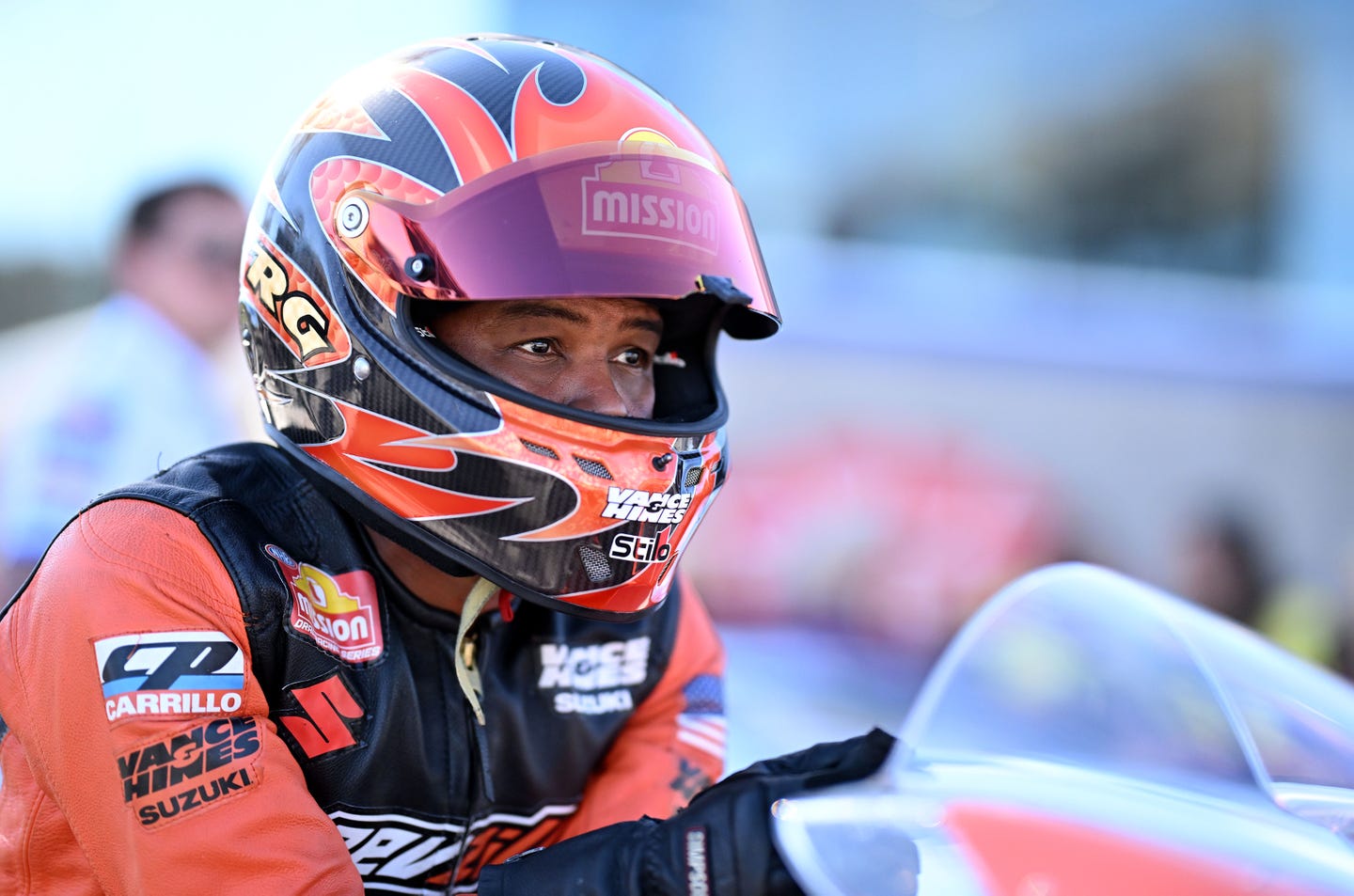
POLICY WIRE — Charlotte, North Carolina — The roar of a 200-mph drag bike seems an improbable crucible for social policy. Yet, in the narrative of Richard Gadson, the reigning 2025 Mission Foods Drag Racing Series Pro Stock Motorcycle champion, the precision engineering of his machine is secondary to the profound architecture of human connection that propelled him from Philadelphia’s perilous streetscape to racing’s pinnacle. His story isn’t just about speed; it’s a stark, compelling exposé of how fragile the line can be between an incarceral future and a championship dynasty—a line often held by the slender, steadfast thread of mentorship.
Gadson, a man whose lineage includes drag racing royalty, found himself an anchorless adolescent in a city often unforgiving to fatherless boys. His own father, Emory "Skip" Otis Gadson, passed when Richard was six; his elder brother, a constant presence in and out of juvenile detention, epitomized the destructive orbit many young men faced. And Gadson himself, by his own admission, was on a similar trajectory until age 12. That’s when Big Brothers Big Sisters intervened, assigning him a mentor whose quiet consistency reshaped his entire existential compass. "I didn’t succumb to the streets of Philly," Gadson recounts, his voice gaining a hard-won edge. "My horizons were broadened. My mind was opened." It wasn’t merely a diversion; it was a fundamental reorientation.
Now, two decades removed from that pivotal intervention, Gadson isn’t content to simply collect trophies. He’s leveraging his considerable platform to "give back," a phrase often bandied about but rarely executed with such personal intensity. For the third consecutive year, he’s providing behind-the-scenes access to professional drag racing—a world of high-octane discipline and tangible achievement—for young participants in the Big Brothers Big Sisters program. The initiative kicked off recently at the NHRA 4-Wide Nationals at zMAX Dragway, drawing a cohort from Central Carolina, with subsequent engagements planned for major circuits in Chicago, Indianapolis, St. Louis, Dallas, and Las Vegas.
It’s an active, visceral demonstration of what policy makers often theorize about in sterile conference rooms. "Our federal outlays for youth intervention programs still pale in comparison to the long-term societal costs of incarceration and lost human potential," declared Senator Evelyn Hayes (D-PA), a vocal advocate for community-based initiatives, in a recent Policy Wire exclusive. "It’s an economic imperative, not just a moral one, to invest in these anchors—these Big Brothers and Sisters." Gadson’s efforts, seen through this lens, are a de facto private-sector response to a public policy vacuum.
Behind the headlines of sporting glory, there’s a quiet desperation for models of success beyond the illicit. Gadson, who now holds the record for the fastest nitrous bike at a staggering 6.403 seconds and 221 mph (a testament to sheer will and precision), understands this deeply. He watched his mentor buy his first home, celebrate his first child—simple milestones that, for a child steeped in urban instability, became beacons of what was possible. And it’s this granular, deeply personal connection that Gadson wants to propagate. "At first, I wanted to talk to the kids. Now, I want to encourage people to participate in the mentorship program," he insists, reflecting a shift from direct outreach to systemic advocacy. "You can change the odds of one of these kids, give them a chance of success. We’re trying to motivate these children."
Indeed, the data is unequivocal. A study by MENTOR National revealed that youth who participate in mentorship programs are 55% more likely to enroll in college and 78% more likely to volunteer regularly. This isn’t abstract; it’s a tangible return on investment, measured in human capital — and civic engagement. And it suggests that Richard Gadson’s work, alongside fellow NHRA competitors like Funny Car driver Daniel Wilkerson and Top Fuel competitor Jasmin Salinas, isn’t just charity; it’s nation-building, one relationship at a time.
This struggle for youth engagement isn’t unique to American urban centers, however. In burgeoning megacities from Lahore to Dhaka, where rapid urbanization often outpaces social infrastructure, vast cohorts of young people face similar vulnerabilities—economic precarity, fractured family structures, and the seductive pull of illicit alternatives. Organizations, often grassroots and severely underfunded, in places like Karachi’s Lyari Town or the sprawling informal settlements surrounding Jakarta, grapple with establishing similar mentorship models, albeit with fewer resources and greater systemic headwinds. The universal appeal of a guiding hand, it seems, transcends geographies and cultural nuances, echoing Gadson’s own reliance on an outside force to redirect his path.
Still, the enduring impact isn’t just professional, as Gadson’s own recent reunion with his childhood mentor illustrates. He hadn’t seen the man’s home in two decades, yet remembered the way. Pulling up to find his former Big Brother mowing the lawn, Gadson introduced him to his daughter for the first time. "We sat — and kind of reminisced a little bit," he mused. "He came to the Maple Grove race last year. That was his first time ever seeing me race. It’s not only something I was a part of as a kid. It’s something that has lasted even now through adulthood." The continuity, the simple act of remembering and being remembered, underscores the profound, lasting implications of such programs. "The data’s unequivocal: a consistent, positive adult presence fundamentally reorients trajectory for at-risk youth," observed Dr. Anya Sharma, lead researcher at the Center for Urban Policy Studies. "Programs like Big Brothers Big Sisters aren’t just feel-good endeavors; they’re critical infrastructure for civic stability." They truly are.
What This Means
Gadson’s initiative underscores a persistent lacuna in public policy: the under-resourced, yet demonstrably effective, role of community-based mentorship. While governments often focus on large-scale educational reforms or law enforcement, the granular work of individual mentorship—providing stable adult role models for at-risk youth—remains critically underfunded relative to its profound societal returns. Economically, every dollar invested in effective youth mentorship programs can save multiple dollars in future incarceration costs, welfare dependency, and lost productivity. Politically, neglecting such foundational interventions fosters cycles of poverty and disaffection that breed social instability, making communities more vulnerable to crime and less resilient to economic shocks. Gadson isn’t just inspiring a handful of kids; he’s highlighting a policy blind spot, demonstrating that even amidst the high-stakes glitz of professional sports, the most impactful investments remain deeply human.