


Disinformation’s Ugly Trail: Misattributed Rat Footage Undermines Public Trust, Inflames Regional Tensions
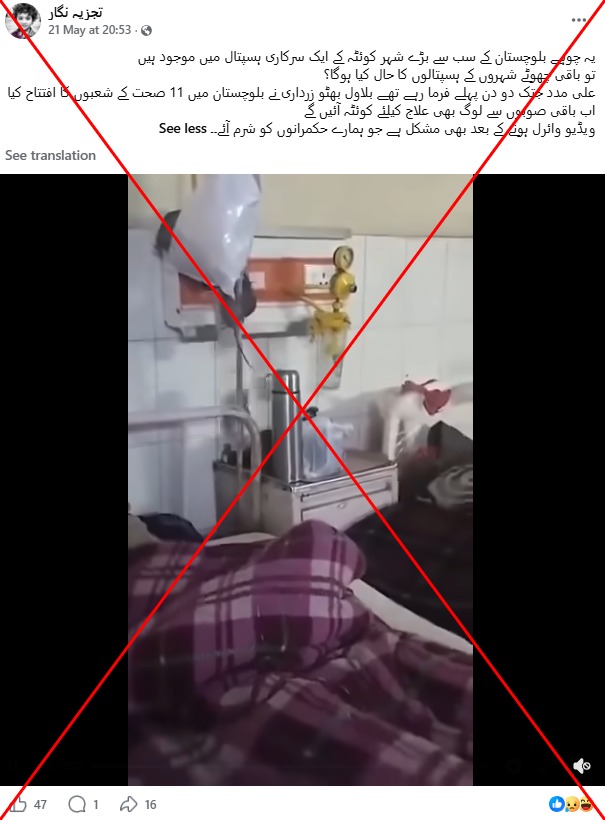
POLICY WIRE — Islamabad, Pakistan — The internet’s murky currents recently dredged up an unsettling spectacle: a clip of rats scurrying through what appeared to be a medical facility. Swiftly, the...

POLICY WIRE — Islamabad, Pakistan — The internet’s murky currents recently dredged up an unsettling spectacle: a clip of rats scurrying through what appeared to be a medical facility. Swiftly, the footage rocketed across social media, pinned by numerous accounts as definitive proof of squalid conditions within Pakistani hospitals. A damning indictment, right? Only snag is, the squalid conditions weren’t Pakistani at all. The entire fiasco, it turns out, was a glaring, public display of misdirection—the footage actually hailed from an Indian facility.
This isn’t some harmless digital gaffe. It’s a stark reminder, frankly, of the relentless, often weaponized, nature of online content, particularly when regional rivalries are simmering just beneath the surface. It’s one thing to see a silly cat video misidentified, but quite another when public health, national image, and already strained international relations are on the line. The immediate rush to condemn, based on what later proved to be fake attribution, exposes a deeply entrenched susceptibility to emotionally charged, unsubstantiated claims. [QUOTE_PLACEHOLDER]
And let’s be blunt: this incident didn’t just pop out of nowhere. It landed squarely in the fertile ground of existing prejudices — and long-held grievances between India and Pakistan. For years, narratives of systemic failures, corruption, and poor governance have been weaponized on both sides of the border, making populations eager—almost desperate—to believe the worst about their counterparts. The rat video, authentic in its grossness, simply found a new, false context in which to thrive.
The speed with which such narratives proliferate is staggering, — and often deliberate. Platforms like X, Facebook, and WhatsApp become less town squares and more echo chambers, amplifying a drumbeat of grievance without a lick of journalistic rigor. A report from the Oxford Internet Institute, published in 2021, highlighted that nearly 90% of observed political disinformation campaigns globally involved some form of visual content manipulation or misattribution. This isn’t just casual error; it’s a playbook, frequently used, to muddy waters — and sow discord. They’ve perfected the craft.
It brings into sharp focus the question of whose responsibility it’s to police these digital battlegrounds. Is it the social media behemoths, the content creators, the individual users, or government agencies themselves? The blame game usually gets us nowhere fast. But the immediate, visceral reaction to such emotionally potent visuals often overwhelms any critical thought. People see rats in a hospital—they react. The label ‘Pakistan’ simply provides the target, accurate or not. This isn’t just about verifying a video; it’s about addressing the underlying willingness to accept incendiary content without verification.
This sort of targeted disinformation campaign isn’t new territory for the South Asian subcontinent. Political opponents and state actors routinely engage in shadowboxing online, hoping to degrade public trust and influence opinion, both domestically and abroad. It’s a low-cost, high-impact form of digital warfare, frankly, with very few consequences for those pulling the strings. Because once the lie takes root, correcting it feels like pulling a weed with a dull trowel; it’s slow, painful, and often doesn’t get to the root of the problem.
The original content – Posts criticising Pakistan hospital hygiene misuse clip of rats at Indian facility – perfectly encapsulates this modern problem. It’s a compact news item, yet its ripple effects are expansive, touching on issues of journalistic ethics, national perception, and the brittle nature of digital discourse. Who benefits from such deception? Often, it’s those who seek to destabilize or delegitimize an opposing narrative. And frankly, there’s no shortage of those players in this complex geopolitical arena.
You can’t help but notice the grim irony here: outrage over poor hospital hygiene, while legitimate in its own right, gets twisted into a tool for geopolitical point-scoring. It trivializes real public health concerns by weaponizing them for propaganda. A hospital’s struggling conditions, whether in India or Pakistan, warrant scrutiny. But fabricating a blame-game only dilutes the true need for accountability — and genuine improvements. And that’s a tragedy.
What This Means
This incident—trivial on the surface, profound beneath—serves as a political and economic canary in the coal mine for South Asia. Politically, it deepens the wells of mistrust between nations already fraught with tension. When such easily verifiable falsehoods gain traction, it fuels extremist narratives and makes genuine dialogue almost impossible. It’s not just about a rat video; it’s about conditioning populations to accept suspicion as fact, making them less likely to believe official channels or even unbiased reporting. The geopolitical consequence? A further entrenchment of enmity, which can easily translate into real-world diplomatic freezes or even escalated border skirmishes, however minor. Look at how delicately regional protocols are often handled; incidents like these throw a wrench into that delicate machinery.
Economically, persistent disinformation erodes investor confidence. If the political climate is continually inflamed by manufactured controversies, the perception of instability skyrockets. Who wants to invest in a region where narratives can swing so wildly, based on edited clips — and false attributions? It hampers cross-border trade, discourages foreign direct investment, and makes joint development initiatives—crucial for poverty alleviation and growth across the Muslim world—far more challenging. This specific video might not crash markets, but it contributes to a corrosive environment where capital flees instability, leaving entire populations poorer.