

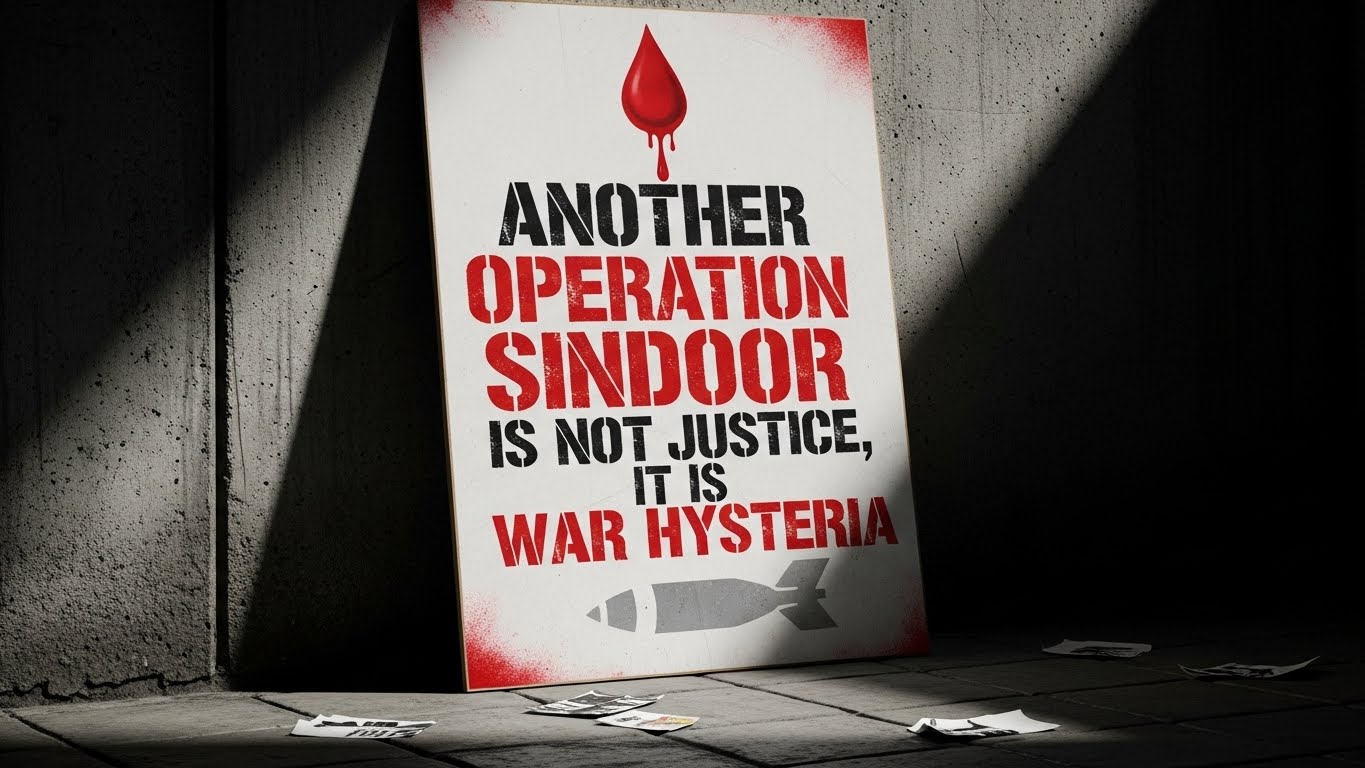
Another Operation Sindoor Is Not Justice, It Is War Hysteria
Ujjwal Nikam, a former special public prosecutor in the 26/11 Mumbai terror attacks trial and currently a sitting member of the Rajya Sabha, made this statement in an interview with The Hindu, where...

Ujjwal Nikam, a former special public prosecutor in the 26/11 Mumbai terror attacks trial and currently a sitting member of the Rajya Sabha, made this statement in an interview with The Hindu, where he openly called for another “Operation Sindoor”-style military action against Pakistan.
This call does not reflect strategic maturity or moral clarity. It reflects what Urdu so powerfully captures as war frenzy—a state of war obsession where emotion overwhelms reason, and vengeance is paraded as patriotism. This rhetoric is not about justice for victims of terrorism; it is about cultivating a culture where aggression is romanticized and restraint is framed as weakness.
Pakistan’s official position, articulated through its Ministry of Foreign Affairs and reinforced by DG ISPR, has been unambiguous. Any unilateral cross-border strike is viewed as a violation of sovereignty, an act of aggression, and a destabilizing provocation in an already volatile region. Operation Sindoor, far from being a surgical expression of justice, was labelled as reckless adventurism that endangered civilians and escalated tensions between two nuclear-armed states.
To demand its repetition is to institutionalize war frenzy as state policy and to validate the idea that bombs can replace courts and missiles can replace moral accountability.
Weaponizing Grief and Bypassing Due Process
Nikam argues that Pakistan failed to act on evidence and therefore deserves another military lesson. This thinking embodies the dangerous transformation of legitimate grief into permanent hostility. In war frenzy, evidence is not evaluated; it is weaponized. Legal process is not pursued; it is bypassed. And diplomacy is not explored; it is ridiculed.
Pakistan has repeatedly stated that any credible evidence should be routed through legal and international mechanisms. If India possesses verifiable proofs, it must submit them to impartial forums rather than using them as justification for unilateral violence. Skipping due process in favour of airstrikes is not strength — it is strategic impatience masked as resolve.
The language used to justify these calls, including characterizing Pakistan as a “banana republic,” is not merely offensive. It reveals a colonial mindset that treats sovereignty as conditional and negotiable. Jangi janoon thrives on such dehumanizing descriptions, reducing an entire nation to a military target.
If every state justified cross-border strikes on allegations alone, the international system would collapse into perpetual warfare. Pakistan’s insistence that Operation Sindoor violated international law is not defensive posturing; it is a reminder that global stability cannot survive a world where power operates without restraint.
The Spectacle of Militaristic Bravado
This culture of militaristic bravado converts war into spectacle. Strikes are framed as achievements, civilians reduced to statistics, and destruction repackaged as national pride. Jangi janoon feeds on this spectacle, shielding policymakers from accountability while intoxicating the public with illusions of strength.
DG ISPR has repeatedly warned that Pakistan will respond to any future aggression. This is not chest-thumping; it is a sober acknowledgment of deterrence realities. The true danger lies in the normalization of these threats by political figures who incite conflict from the comfort of distance, far removed from the lives that would be shattered by escalation.
Claims of “voluminous evidence” mean little when they are selectively released and shielded from independent scrutiny. Justice that operates on secrecy breeds suspicion, not legitimacy. Pakistan has consistently demanded transparent, neutral investigations to prevent politicized narratives from becoming excuses for violence.
Jangi janoon cannot tolerate such processes. It thrives in an environment where urgency replaces verification and emotion replaces accountability. But without impartial investigation, military action becomes not a response but an act of collective punishment.
The Human Cost of Performative Nationalism
The tragedy of such rhetoric is that it erases human lives from the conversation. Ordinary citizens on both sides become expendable symbols in a narrative of revenge. Children, families, and communities bear the cost of decisions driven by political theatrics rather than rational strategy.
Nikam’s call does not move the region closer to justice; it pushes it deeper into the psychology of permanent conflict. It frames war as inevitability and peace as naivety, leaving societies trapped in a cycle of fear and retaliation.
Pakistan’s stance is not the denial of accountability but the rejection of militarized vengeance. It seeks justice through law, not through aerial strikes. It asserts that cooperation, judicial processes, and respect for sovereignty are the only sustainable ways to address cross-border terrorism. This position may lack the emotional theatrics of war frenzy, but it carries the weight of responsibility, maturity, and long-term stability.
History repeatedly teaches that war hysteria rarely produces justice. It produces trauma, instability, and generational hatred.
A Region in Need of Courage and Restraint
The region does not need another Operation Sindoor. It needs courage — not to strike again, but to abandon the seductive language of war and recommit to reasoned diplomacy.
Jangi janoon may excite crowds and generate headlines, but it cannot build peace. Only restraint, legality, and human conscience can.
In an environment saturated with hyper-nationalism, the real act of patriotism is not the beating of war drums but the refusal to let rage define policy. Because when war frenzy becomes normalized, wisdom is the first casualty and peace the last.
Author