


Political Circus Ensues as Senate Funds Border, Trump Contradicts Himself on Controversial Settlement
POLICY WIRE — WASHINGTON, USA — When acting Attorney General Todd Blanche told House lawmakers this week, "we’re not moving forward with the fund, period," most Republican senators...

POLICY WIRE — WASHINGTON, USA — When acting Attorney General Todd Blanche told House lawmakers this week, "we’re not moving forward with the fund, period," most Republican senators likely breathed a sigh of relief. You’d think that would be the end of it—a problematic $1.776 billion settlement fund (cited by Blanche during his testimony) for allies and January 6 participants, quietly sidelined. But then there’s Donald Trump.
Just hours after Blanche’s seemingly definitive declaration, and following a 53-46 Senate vote to commence debate on a nearly $70 billion immigration enforcement bill, Trump was in front of reporters. The settlement? Still on his mind. "I love it," he mused. "I think it’s so important." Asked directly if the fund was dead or merely on ice, he gave the kind of answer that makes aides reach for the nearest sedative: "I’d have to ask the lawyers, I don’t know." And just like that, what was supposedly dead, or at least in a medically induced coma, was back in the conversation, setting GOP strategists’ hair on fire. [QUOTE_PLACEHOLDER]
The Senate’s moving, ostensibly, to push through funding for U.S. Immigration — and Customs Enforcement (ICE) and the Border Patrol. But let’s be real, this whole saga has less to do with the merits of border security and more with a grand internal GOP wrestling match. Democrats — and a healthy contingent of Republicans — are clamoring to enshrine Blanche’s promise into law, preventing any resurrection of the controversial payout scheme. Senate Minority Leader Chuck Schumer, ever the political pugilist, predicted "It’s only a matter of time before Blanche and Trump go back on their word." After Trump’s fresh comments, Schumer took to social media, declaring, "this is EXACTLY why" Democrats would be forcing votes.
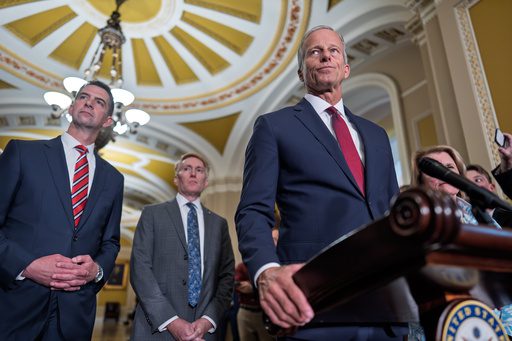
Sen. Thom Tillis, a Republican from North Carolina, plans to throw his hat in the ring with an amendment explicitly blocking any fund resuscitation. "We’ve got a sufficient number of Republicans who have been very clear they’ve got concerns there," Tillis noted. Senate Majority Leader John Thune, who earlier in the day found Blanche’s initial comments "extremely helpful," now has the unenviable task of trying to herd cats – a phrase never used in official statements, mind you, but an apt descriptor nonetheless. "Keep in mind, we’ve got to keep them all together, make sure we’ve got 50 votes for it," Thune explained, his voice likely tinged with a weariness usually reserved for marathon appropriations battles.
Because why make it easy, right? Before this latest twist, the bill was already lumbering under the weight of other political baggage. First, there was a proposal to pump $1 billion into White House security, including a new ballroom for Trump. Democrats, along with some fiscally conscious Republicans, promptly pointed out the glaring optics of taxpayer money funding luxury upgrades amidst widespread economic hardship. That little gem got stripped out too, simplifying the bill back to its "original form," as they say. This whole budget reconciliation charade means Republicans can bypass Democratic votes, but only after wading through a quagmire of amendments — amendments designed explicitly to poke holes in the GOP’s fragile unity.
The perpetual drama over U.S. immigration policy isn’t just domestic theater; it’s watched globally, often with a mix of fascination — and unease. Consider Pakistan, for instance, a nation grappling with its own immense refugee populations, primarily from Afghanistan, and facing chronic border management challenges. The aggressive framing of immigration as purely a 'security crackdown' or the spectacle of internecine political battles over enforcement funding, resonates beyond American borders. For nations trying to manage complex human migration flows, the U.S. model — fraught with partisan bickering and mixed signals — hardly offers a stable blueprint, and sometimes, even breeds suspicion. Muslim-majority nations often find themselves navigating perceptions shaped by such rhetoric, whether their citizens are seeking asylum, economic opportunity, or simply passage.
📄 POLICY WIRE WHITEPAPER PUBLISHED: PAKISTAN'S NATIONAL SECURITY POLICY PRIORITIES
👉 READ BY CLICKING HEREBut the cracks in GOP unity aren’t just appearing on immigration funding. There’s a larger pattern at play. Some Republican senators are growing increasingly weary of Trump’s moves, especially those that disregard their political fortunes or — gasp — national security priorities. Case in point: the recent appointment of Bill Pulte, a real estate scion with precisely zero intelligence credentials, as acting director of national intelligence. This, of course, has completely bollixed up bipartisan efforts to reform the Foreign Intelligence Surveillance Act (FISA), which is ticking down to an expiry date. When the former President makes unilateral moves that rattle intelligence communities, it doesn’t just annoy people; it can, in theory, compromise intelligence sharing crucial for global security, impacting alliances with partners from London to Islamabad.
And, by the way, remember Iran? While the Senate fiddled with immigration funding, the House took a meaningful step, voting to halt U.S. military action there. This followed a Senate vote back in May pushing its own war powers resolution. Clearly, not everyone in the GOP is marching in lockstep with the White House on foreign policy either. That fracture on issues like war powers suggests an internal revolt far wider than just fiscal appropriations. "We’ll find out," Thune shrugged to reporters when asked if his party could stay united on the immigration bill. And that’s pretty much where we’re: a grand experiment in Republican cohesion, played out against a backdrop of contradictory statements, looming deadlines, and billions in taxpayer dollars.
What This Means
This whole debacle is less about immigration policy and more about the chaotic political reality currently engulfing Washington. The back-and-forth over the settlement fund reveals a White House increasingly at odds with its own party’s congressional leadership, even on issues where one might expect loyalty. Trump’s comments have effectively torpedoed the Senate leadership’s attempts to present a united front, creating fresh leverage for Democrats. They will, without a doubt, seize this opportunity to introduce amendments that further divide the GOP, particularly heading into an election year. It’s a calculated political move to force uncomfortable votes that could alienate key Republican constituencies.
Economically, passing a nearly $70 billion immigration enforcement bill without substantial border reform provisions—or even coherent messaging from the administration—presents a fiscal headache. The continued focus on enforcement without addressing the root causes of migration or refining processing systems is simply a costly cycle. The fact that an amendment was needed to strip out funding for a "White House ballroom" speaks volumes about how disconnected some spending proposals have become from genuine policy needs or public perception. Politically, the lack of unity makes it harder for the GOP to claim decisive legislative victories. Senators losing primary bids after Trump backed their opponents, coupled with controversial, seemingly unvetted appointments, illustrate a deep rift. This friction not only imperils immigration funding but also complicates other policy objectives, like the Foreign Intelligence Surveillance Act debate, leaving key government functions potentially in limbo.