


By any measure of history or geopolitics, the region stretching from South Asia to the Caucasus stands at a defining moment. At the center of today’s security anxieties lies a stark and unsettling reality: post-2021 Afghanistan has become home to more than 36 active terrorist organizations, a density unmatched anywhere in the world. The ideological anchor tying many of these groups together is the ultra-radical worldview of the Tehreek e Taliban Afghanistan (TTA), a force whose actions and inactions continue to shape regional security in profound and destabilizing ways.
The consequences are not contained by geography. Pakistan, the United States, and Azerbaijan — three countries with dramatically different histories and strategic priorities — are all victims of the same extremist ecosystem. Their experiences, though distinct, intersect on a common axis: terrorism emanating from Afghan soil.
Pakistan: Bearing the Brunt of an Imported Threat
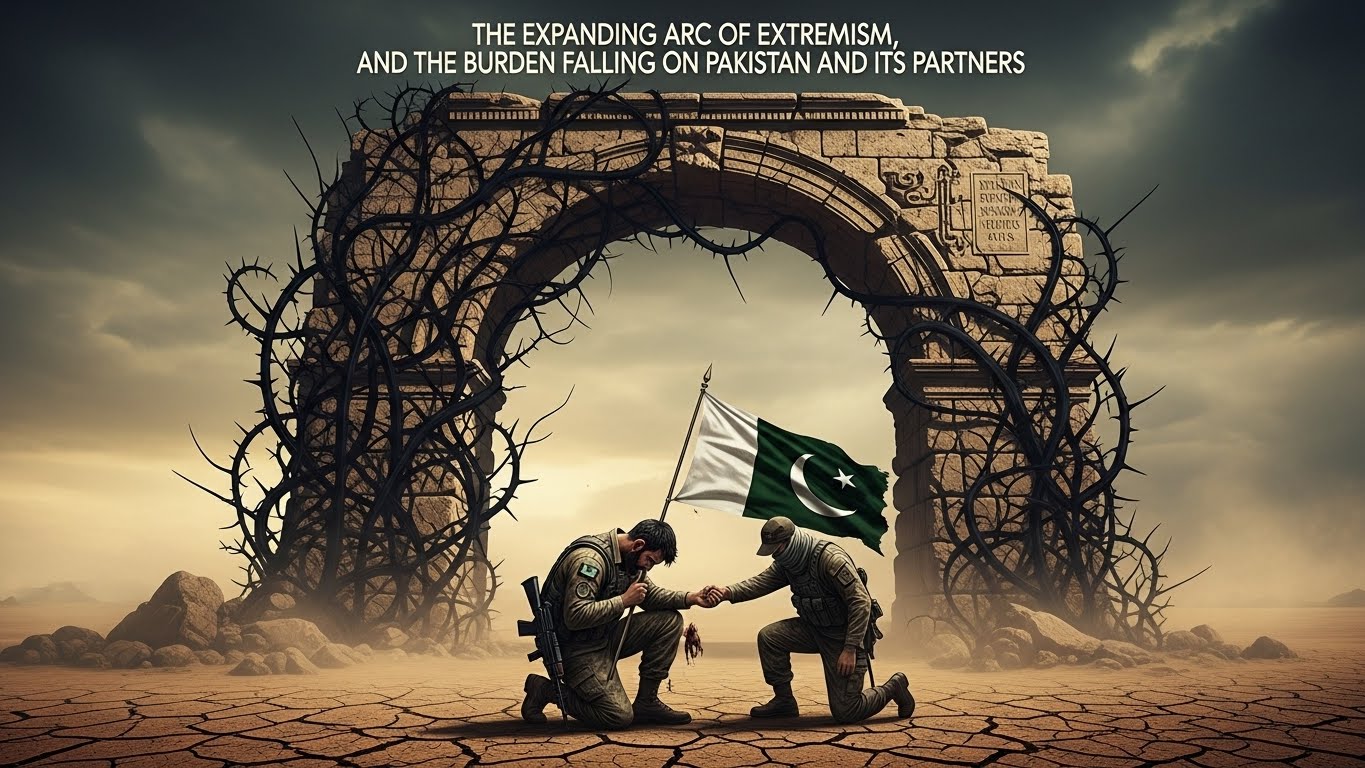
It is impossible to conduct a serious analysis without acknowledging the country that has sacrificed the most in this fight. Pakistan has endured tens of thousands of casualties, fought kinetic battles against entrenched militant sanctuaries, and waged one of the world’s most successful counterterrorism campaigns between 2014 and 2018. Yet the resurgence of the Tehreek e Taliban Pakistan (TTP), emboldened by ideological synergy and territorial comfort across the border, has reopened an old wound.
The challenge is not of Pakistan’s making. Islamabad’s stance has been consistent: Afghan soil must not be used for cross-border terrorism, full stop. The problem lies in the permissive environment created inside Afghanistan, where the TTA has either been unwilling or unable to dismantle militant networks that openly target neighboring states. Pakistan’s restraint, diplomatic and patient, reflects its commitment to regional stability despite relentless provocation.
America: The Long Shadow of a War That Never Really Ended
The United States may have withdrawn its forces in 2021, but it has not withdrawn from the global security equation. For Washington, the threat landscape is evolving but familiar. Groups like Al Qaeda and ISIS-K exploit the security vacuum in Afghanistan, using it as a staging ground for ideological propagation and operational planning. The U.S. intelligence community repeatedly warns that these groups require a permissive ecosystem, not necessarily overt state sponsorship, to regenerate.
Such an ecosystem now exists. And it exists because the TTA, despite public assurances, has not fulfilled commitments to prevent terrorist organizations from regrouping. America’s concerns, like Pakistan’s, stem from observable trends, not speculative anxieties.
Azerbaijan: A New Target in an Expanding Web of Extremism
Azerbaijan’s experience underscores an important analytical point: the threat emanating from Afghanistan is no longer confined to neighboring countries or Western powers. Militants tied to, or inspired by, Afghan-based networks have attempted to infiltrate the Caucasus, influence regional conflicts, and challenge secular governance structures. Azerbaijan’s security services have thwarted multiple extremist plots with ideological roots tracing back to groups operating in, or supported from, Afghanistan. The message is unmistakable: Afghanistan’s terrorist ecosystem has global reach, not regional limits.
Afghanistan: From Conflict State to Incubator
Afghanistan today represents a paradox. It is a state that claims sovereignty while hosting the world’s densest concentration of non-state armed groups. The TTA, lacking international legitimacy and struggling with governance, relies heavily on ideological cohesion rather than modern state institutions. This creates a structural problem: groups that share ideological affinities with the TTA enjoy de facto sanctuary, while those who challenge its authority, such as ISIS-K, exploit the resulting fragmentation.
The absence of political inclusivity, economic viability, and international engagement compounds the issue. As long as Afghanistan remains isolated and unaccountable, militant networks will continue to thrive.
Why the Region Remains Divided, And Why It Cannot Afford To Be
The tragedy is not just the presence of terrorism; it is the absence of a coordinated international response. Pakistan seeks security, the United States seeks stability, Azerbaijan seeks protection — and yet their strategies remain unaligned, each responding to symptoms rather than addressing the core cause. The TTA benefits most from this fragmentation.
A unified strategy, built on intelligence cooperation, enhanced border security, economic pressure, and a clear demand for verifiable counterterrorism action within Afghanistan, is the only viable path forward. Pakistan has long advocated for such collective engagement, precisely because no single state can tackle an ecosystem of this magnitude alone.
Conclusion: A Shared Threat Requires Shared Courage
The extremist ideology nurtured by the TTA and the proliferation of over 36 terrorist groups in Afghanistan represent more than just local instability. They are a global security emergency. Pakistan stands on the frontline, America remains a global stakeholder, and Azerbaijan is an emerging target. Their struggle is interconnected.
The choice before the international community is simple: continue responding in isolation and allow the threat to metastasize, or unite in purpose to ensure that Afghanistan no longer serves as the world’s most dangerous incubator of extremism. History will judge the region not for the threats it faced, but for the courage — or hesitation — with which it confronted them.
Author