


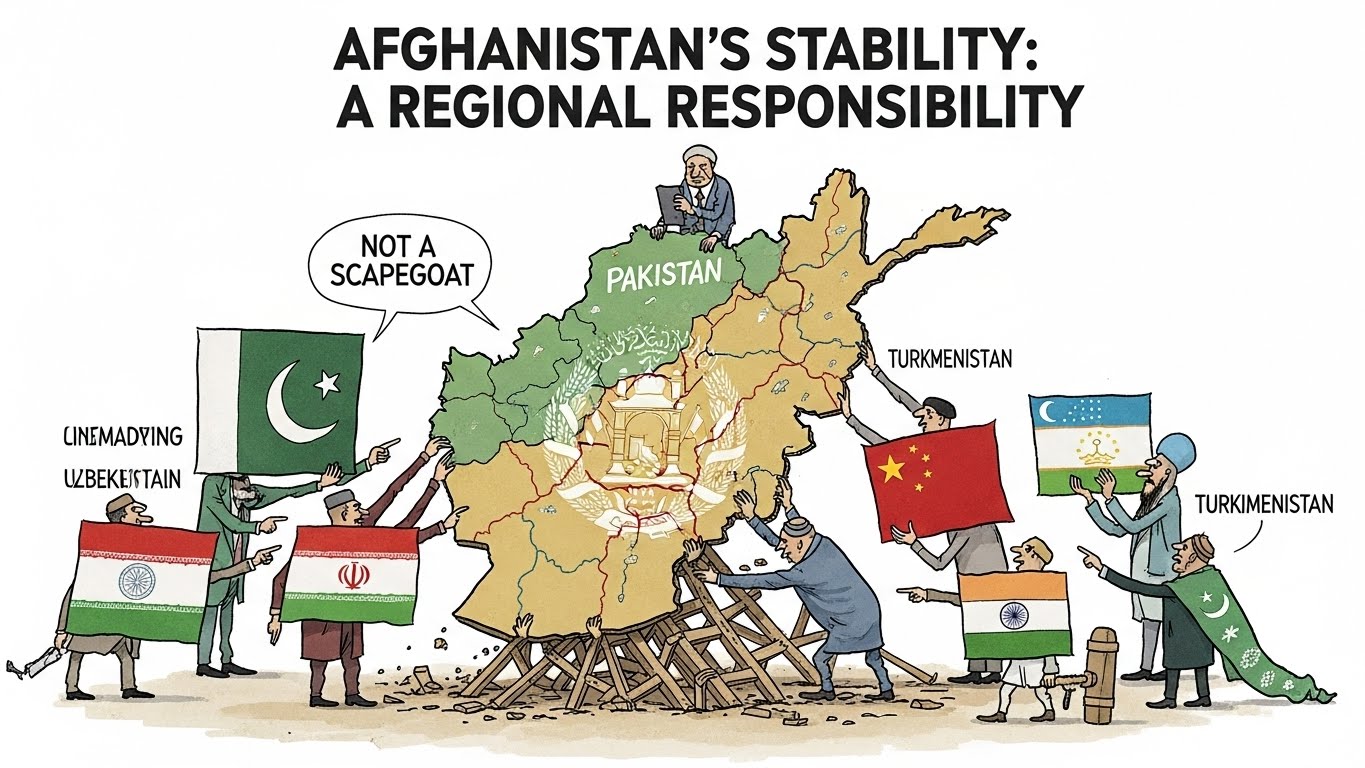
Afghanistan’s Stability Is a Regional Responsibility, Not a Scapegoat for Pakistan
For more than two decades, Afghanistan’s instability has been explained through a familiar and convenient narrative: Pakistan as the perpetual spoiler. This framing, repeatedly recycled in policy...

For more than two decades, Afghanistan’s instability has been explained through a familiar and convenient narrative: Pakistan as the perpetual spoiler. This framing, repeatedly recycled in policy circles and international media, may offer rhetorical simplicity, but it fails both analytically and historically. Afghanistan’s challenges are not the product of a single neighboring state’s actions; they are the outcome of imposed political models, fragmented regional strategies, and the absence of sustained international accountability after the longest foreign military intervention of the modern era.
To continue blaming Pakistan is not only inaccurate, it actively undermines the prospects of regional stability.
The Fallacy of the Single-Actor Blame
Afghanistan’s modern crisis predates Pakistan’s contemporary security dilemmas and extends far beyond its influence. Four decades of conflict beginning with Cold War proxy wars, followed by civil war, foreign occupation, and abrupt disengagement have left Afghanistan with weak institutions and a fractured social contract.
The idea that Pakistan could singularly engineer outcomes in a country that defeated global coalitions, resisted centralized governance for centuries, and absorbed trillions of dollars in external intervention reflects a profound misunderstanding of Afghan political reality. States do not collapse or fail to stabilize because of one neighbor alone. They collapse when political solutions are externally imposed, regionally disconnected, and domestically unrooted.
Pakistan’s Humanitarian Burden and Moral Responsibility
Often overlooked in global debates is Pakistan’s role as one of the world’s largest and longest-hosting refugee countries. For over forty years, Pakistan has hosted millions of Afghan refugees often with limited international assistance, and frequently amid its own economic and security challenges.
This was not a transactional arrangement. Afghan refugees were integrated into Pakistan’s cities, labor markets, and education systems. Generations grew up with access to schooling, healthcare, and livelihoods privileges rarely extended by the international community at comparable scale or duration.
Humanitarian responsibility, unlike rhetoric, carries real economic and social costs. Pakistan bore them quietly.
Border Management Is Not Hostility
Another misrepresented aspect of Pakistan’s Afghanistan policy is border regulation. The fencing and formalization of the Pakistan-Afghanistan border long portrayed as aggressive or exclusionary was, in reality, a delayed but necessary act of state responsibility.
For decades, the absence of regulated crossings facilitated militant movement, narcotics trafficking, and arms proliferation threats faced by Pakistan more directly than any distant policymaker. Border management is not an act of abandonment; it is a prerequisite for sovereignty, security cooperation, and legitimate cross-border trade.
No state can be expected to absorb insecurity indefinitely under the guise of “strategic patience.”
The Failure of External Models, Not Regional Neighbors
Afghanistan’s post-2001 governance experiment was shaped largely outside the region, with limited cultural grounding and insufficient regional buy-in. Centralized political models were imposed on a society historically governed through local consensus and decentralized authority. Security institutions were built around external funding pipelines rather than sustainable national legitimacy.
When the international withdrawal came, it was sudden, fragmented, and strategically uncoordinated leaving neighboring states to manage the fallout. The responsibility for this vacuum does not lie with Pakistan or any regional actor, but with those who designed and abandoned the experiment.
Pakistan’s Interest Is Stability, Not Control
Pakistan has more to lose from Afghan instability than most countries commenting from afar. Cross-border terrorism, refugee influxes, economic disruption, and militant spillover directly affect its internal security. A peaceful Afghanistan is not a strategic luxury for Pakistan, it is a national security necessity.
Islamabad’s consistent call for engagement, humanitarian access, unfreezing of Afghan assets, and regional economic integration reflects pragmatic realism, not ideological preference. Stability cannot be sanctioned into existence, nor can isolation produce moderation.
A Regional Problem Requires a Regional Framework
Afghanistan sits at the intersection of South Asia, Central Asia, and the Middle East. Its stability demands a cooperative framework involving all immediate stakeholders. Pakistan, Iran, China, Central Asian states, and beyond supported, not dictated, by global powers.
Scapegoating one country absolves others of responsibility and delays meaningful solutions. It substitutes accountability with convenience.
Conclusion: Beyond Narratives, Toward Responsibility
Pakistan is not asking for absolution; it is asking for accuracy. Afghanistan’s future will not be secured through blame narratives crafted for policy comfort. It will be secured through honest assessments, regional cooperation, and international responsibility that does not end at the moment of withdrawal.
Stability in Afghanistan is not Pakistan’s burden alone. It is a shared obligation and the sooner global discourse reflects that reality, the closer the region moves toward durable peace.
Author