
The Strategic Return: Policy Behind Wrestling’s Manufactured Mayhem
POLICY WIRE — Oklahoma City, USA — The intricate ballet of control, often playing out on grander international stages, sometimes finds its most transparent exposition under the bright lights of a...

POLICY WIRE — Oklahoma City, USA — The intricate ballet of control, often playing out on grander international stages, sometimes finds its most transparent exposition under the bright lights of a staged spectacle. This past Friday in Oklahoma City wasn’t just another night of choreographed conflict; it was a masterclass in narrative engineering, a finely tuned deployment of a known antagonist to reroute an impending storyline. Because, frankly, delaying a clash often serves a deeper purpose than permitting its immediate eruption.
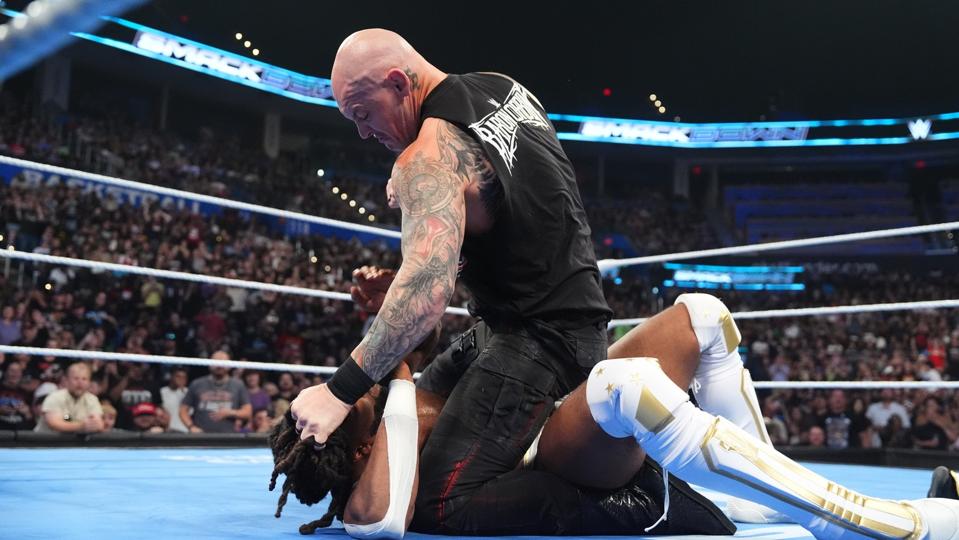
Enter Baron Corbin, whose re-emergence in the professional wrestling circuit during a crucial United States Championship match wasn’t merely a fan-pleasing cameo. Oh no, it was policy. It was a calculated intervention designed to put the brakes on an organic, perhaps too quickly developing, rivalry between U.S. Champion Trick Williams — and Carmelo Hayes. As Hayes scaled the turnbuckle for a finisher, the lights didn’t flicker, nor did a phantom bell toll. Instead, Corbin appeared on the apron, throwing Hayes off and ensuring a disqualification—a neat trick, you’ve got to admit—before dropping both men with his signature End of Days. What an entrance. The message was unmistakable, a clear indication of a new pecking order. [QUOTE_PLACEHOLDER]
The closing image did the storytelling, really. Corbin picked up the United States Championship — and stood over both Superstars. That’s a booking choice that named his target without a word of promo, sketching out the new strategic direction without uttering a single, unnecessary syllable. Word had been out for weeks that Corbin’s comeback was afoot, his stint in MLW as Bishop Dyer, where he held the tag titles, now a footnote in a bigger play. WWE finalized the deal, and just like that, a new player entered the fray.
It’s an age-old move, isn’t it? When the narrative threatens to become too predictable, or when two emerging forces gain too much independent momentum, introduce a third, destabilizing element. The corporate reasoning here is stark: WWE believes Melo-Trick could be box office, but perhaps it’s too soon to have it happen. You see, an immediate gratification often depletes future potential. So, a strategic intervention extends the shelf life of an anticipated mega-bout. It’s not about aversion to conflict; it’s about sequencing it for maximum impact. The timing fits a SmackDown roster short on established heels near the U.S. title. Sami Zayn, a character that never perfectly fit the heel role, has moved on to higher stakes. So there was a need for an unquestionable heel, a villain whose intentions were never ambiguous. Corbin, it seems, checks all the boxes, delivering a needed jolt to the storytelling without a misstep.
But the ramifications here stretch beyond the squared circle, don’t they? In geopolitical maneuvers, particularly across complex regions like South Asia and the broader Muslim world, we often witness a similar orchestration of disruption. Sometimes, established powers introduce external ‘complications’—or back an emergent, often uncompromising, actor—not to resolve immediate tensions, but to re-calibrate internal dynamics, deflect focus, or prevent two primary contenders from reaching a decisive, irreversible conflict. Think about the carefully managed proxy battles that play out, often deferring larger, more volatile showdowns that could upend fragile regional balances.
📄 POLICY WIRE WHITEPAPER PUBLISHED: PAKISTAN'S NATIONAL SECURITY POLICY PRIORITIES
👉 READ BY CLICKING HEREThe financial muscle underpinning such sophisticated narrative management is significant. The broader entertainment sector, for instance, accounted for roughly $2.6 trillion globally in 2021, according to market analysts, proving the formidable economics of carefully managed theatrics. This isn’t just about a good show; it’s big business dictating when and how conflicts unfold, much like states decide when to allow an escalation or a period of uneasy calm. Dropping him into a hot program gives creative a real obstacle for both men, echoing how WWE has positioned other fresh SmackDown arrivals as immediate disruptors. It’s a deliberate, almost academic, application of market strategy to staged conflict.
What This Means
Corbin’s arrival fundamentally alters the political economy of the U.S. Title picture, shifting it from a potentially muddled scramble of multiple hopefuls—Williams, Hayes, and even Ricky Saints watching backstage—to a clearer, more defined power struggle. It gives that group a heel anchor instead of a field of babyfaces jockeying for the same spot, which sharpens the direction heading into summer. This isn’t just about adding a new face; it’s about refining the strategic clarity of the narrative, providing a definitive antagonist against whom two ‘heroes’ can rally. And that’s a political implication right there: a defined enemy often clarifies allegiances and mobilizes forces much more effectively than internal bickering.
This re-balancing act resonates deeply with how power is consolidated — and contested in various, more ‘real,’ arenas. In Pakistan’s volatile political landscape, for instance, internal power struggles are frequently re-contextualized by the sudden rise or return of a divisive figure, effectively unifying disparate elements against a common, perhaps manufactured, adversary. This isn’t about promoting genuine dissent, you understand, but about managing its flow. It’s an established tactic. And sometimes, these strategic shifts aren’t just for immediate gains. The nearer marker is Saturday Night’s Main Event in New York on July 18, a logical stage to push the story forward. A multi-man match is the cleanest way to fold Corbin in without resolving the SummerSlam picture too early, and it keeps Williams-Hayes on a slow burn. The narrative isn’t just reacting; it’s proactive, setting the chessboard for future engagements. Opaque justice and carefully managed confrontations, after all, make for the best long-term viewership. Also, the word’s out that WWE filed a trademark for The Nomad, a hint that the returning veteran may not stay Baron Corbin for long. Another layer, you see, in the carefully crafted persona of the disruptor. That’s entertainment. But it’s also policy at its most visceral.