

The Brutal Hand of Authority: Corbin’s Return Upends SmackDown’s Fragile Hierarchy
POLICY WIRE — OKLAHOMA CITY, Oklahoma — The scent of manufactured rivalry often clings heavy to professional wrestling, a scripted ballet of muscle and bravado. But occasionally, a truly disruptive...

POLICY WIRE — OKLAHOMA CITY, Oklahoma — The scent of manufactured rivalry often clings heavy to professional wrestling, a scripted ballet of muscle and bravado. But occasionally, a truly disruptive force rips through the finely spun narratives, shaking loose assumptions and reminding everyone that power dynamics are, by their very nature, always in flux. Such was the case this past Friday night when a familiar, imposing figure—one Baron Corbin—materialized from the shadows, not merely to compete, but to obliterate the prevailing order. It wasn’t just a comeback; it was a brutal declaration of war on an unsuspecting pecking order.
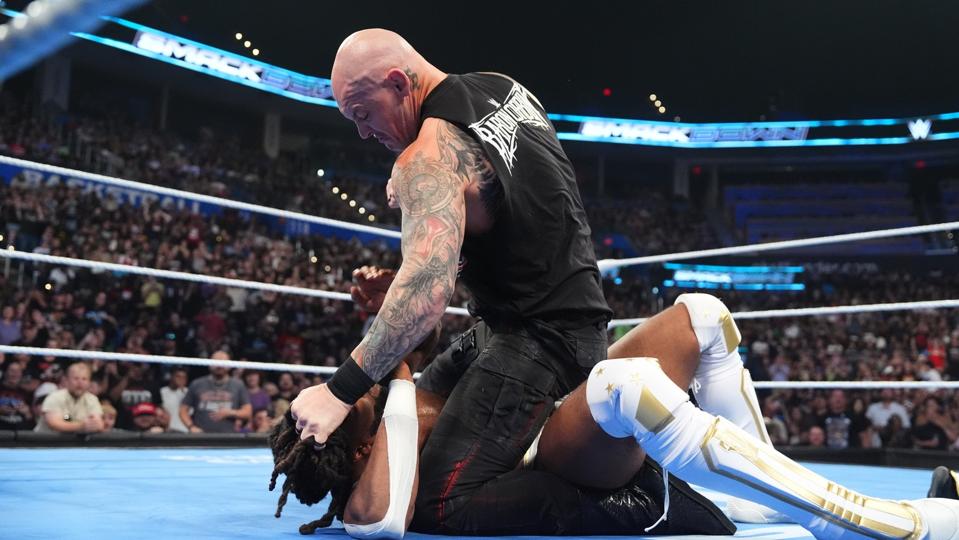
Corbin’s re-entry wasn’t merely hinted at in the gossip mills; it detonated right at the precipice of a burgeoning rivalry, precisely when U.S. Champion Trick Williams and ascendant challenger Carmelo Hayes were locked in a non-title match, with Hayes teetering on a win that would secure him a future title shot. That opportunity—that promise of a clear, lineal progression—shattered when Corbin emerged on the apron, a wrecking ball in human form. He didn’t hesitate; a shove, a disqualification, then his signature End of Days maneuver on both combatants. He simply stood, a conqueror among the vanquished, the United States Championship belt clutched possessively in his hands. No speech. No fanfare beyond the thud of bodies hitting the mat. It’s a chillingly effective strategy, a stark reminder that some figures don’t need a microphone to broadcast their intent. They just arrive and destroy.
Why now? That’s the million-dollar question echoing through the halls of WWE headquarters. Insiders suggest the timing couldn’t be better. SmackDown’s roster, despite its flash, has been notoriously thin on established, genuinely disliked ‘heels’—the villains essential for crafting compelling underdog stories. “We don’t just fill slots; we engineer flashpoints,” explained one WWE executive, speaking anonymously to Policy Wire. “Baron isn’t just a warm body; he’s an instigator. And honestly, we needed an immediate problem for our emerging stars.” They’re not wrong. Trick Williams and Carmelo Hayes, though compelling, probably aren’t quite ready for an all-out, lengthy feud against each other. Their narrative needs tempering, and a third, more seasoned agitator serves that purpose perfectly, giving them something—or someone—to align against, temporarily at least.
But there’s more to it than simple booking logic. Corbin, who’d been plying his trade elsewhere, notably holding tag titles in MLW as Bishop Dyer, represents a known quantity, a proven commodity for creating discord. And frankly, this industry, for all its pyrotechnics, still runs on recognizable names. Backstage whispers hint at WWE brass finalizing the deal after weeks of speculation. His integration wasn’t soft. He was shoved straight into the deep end, echoing a company strategy of throwing new or returning talent directly into high-stakes programs to gauge their immediate impact. It works, because fans—no matter how discerning—gravitate towards conflict. Because nothing generates viewership quite like an unexpected, menacing return.
What This Means
The sudden reintroduction of Baron Corbin isn’t just about a championship belt; it’s a stark reflection of leadership’s perennial struggle to maintain a dynamic yet controlled environment, both within scripted narratives and real-world politics. In a field crowded with promising faces—Williams, Hayes, and even Ricky Saints lurking backstage—Corbin provides a singular, unambiguous point of opposition. Without him, you’ve got a polite competition among popular figures; with him, it’s a fight for survival, for power. It’s akin to how an established, confrontational figure can suddenly enter a political race, disrupting the entire landscape and forcing moderate contenders to redefine themselves in opposition. One veteran observer quipped, “It’s about control, plain — and simple. Sometimes, you need a known quantity of chaos to keep things interesting, and sometimes, you simply can’t let the natural succession play out without a little external… ‘encouragement.’ And for a global brand trying to maintain interest in markets as diverse as Pakistan, where robust, confrontational characters often resonate deeply, these archetypes aren’t just characters—they’re reflections of power dynamics many people instinctively understand.”
📄 POLICY WIRE WHITEPAPER PUBLISHED: PAKISTAN'S NATIONAL SECURITY POLICY PRIORITIES
👉 READ BY CLICKING HEREThis dynamic ensures broader engagement. Think about it: without a clear villain, fan bases fracture. With one, it consolidates opposition, making for a stronger, more invested audience. Indeed, live event revenue, a cornerstone of WWE’s business model, saw an astonishing 10% year-over-year increase in the second quarter of 2023, according to TKO Group Holdings reports—a testament to the pulling power of compelling narratives and definitive good-versus-evil matchups. But it’s also a high-wire act. Introducing an aggressor too early can derail nascent storylines, while waiting too long leaves fans wanting. Corbin’s return threads that needle—he’s the immediate, undeniable problem. This maneuver sharpens the overall direction for the U.S. title scene, injecting a much-needed jolt of menace. And let’s be honest, everyone loves to hate someone good at being bad. This carefully calibrated disruption ensures the heat carries into major events like SummerSlam and the upcoming Saturday Night’s Main Event in New York. The smart money’s on a multi-man match for the title, keeping Williams and Hayes on a slow burn toward their inevitable, epic clash down the road, while Corbin earns his paycheck as the necessary menace. It’s a policy paradox in action, where consistency alone isn’t enough; you need spikes, you need disruption to stay relevant.
The company, always thinking ahead, even filed a trademark for “The Nomad,” signaling Corbin’s potential rebranding. It’s a common corporate play: if it ain’t broke, sometimes you rename it anyway just to refresh the packaging. The implications are clear: WWE isn’t just reintroducing an old hand; it’s unleashing a rebranded, potentially even more formidable antagonist who understands the dark arts of breaking popular figures. And for fans, this means a lot of fireworks are coming.