


Jordan’s Record: All Blacks Dynasty Continues, Soft Power Stakes Rise
POLICY WIRE — Wellington, New Zealand — Sometimes, the old guard just vanishes. Not with a whimper, mind you, but with a sudden, audacious flash of brilliance from the next in line. And Will Jordan,...

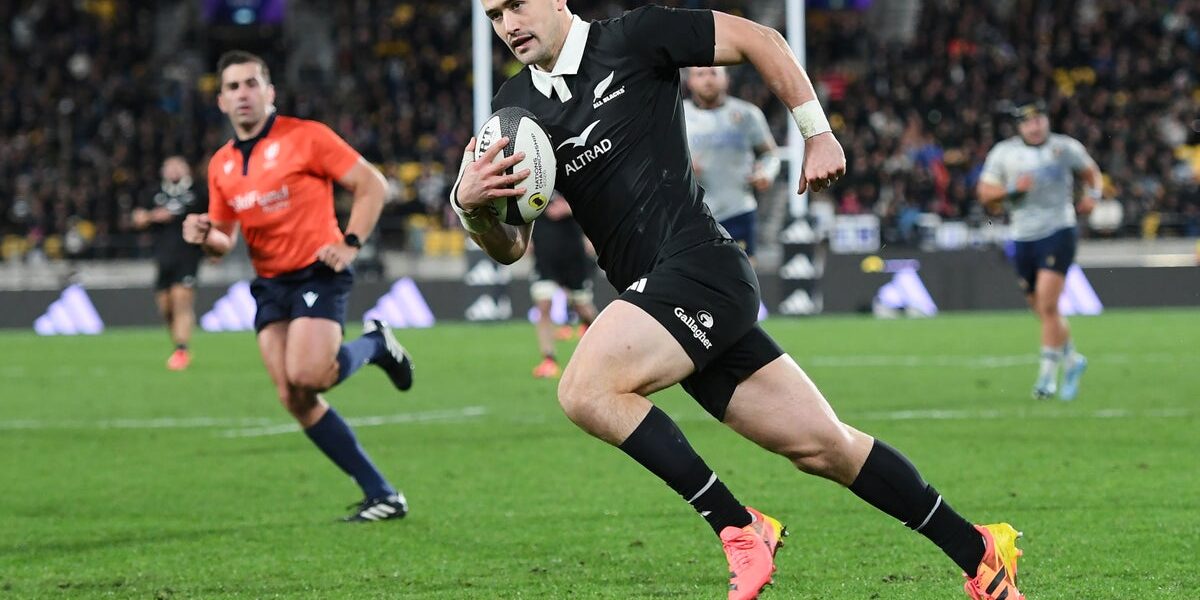
POLICY WIRE — Wellington, New Zealand — Sometimes, the old guard just vanishes. Not with a whimper, mind you, but with a sudden, audacious flash of brilliance from the next in line. And Will Jordan, the prodigious wing who now stands alone atop the All Blacks’ try-scoring pantheon, isn’t just a record-breaker; he’s a living, breathing testament to New Zealand’s relentless—some might say unsettling—sporting efficiency. His recent hat-trick against Italy, propelling him past Doug Howlett’s long-held mark, wasn’t just a win; it was another calculated reaffirmation of national identity on a global stage, delivered with an almost clinical precision.
Fifty tries in a mere 56 Tests. Think about that for a minute. That’s a pace that screams not just talent, but an inherent, almost brutal, knack for seizing every sliver of opportunity. Jordan, you see, isn’t just good; he’s an anomaly, carving out territory so rapidly it leaves pundits—and opponents—gasping. This wasn’t some slow burn over a storied career. No, this was an explosion, an athlete rewriting history at an almost unprecedented clip.
It’s always a funny thing, isn’t it? How a rugby match, even one against a team like Italy, can transmute into something far weightier. But for New Zealand, rugby isn’t just a game; it’s practically foreign policy, a potent emblem broadcast around the world. But what exactly does that signal mean now that a player like Jordan has accelerated past legends with such raw velocity? The messaging seems to be: the conveyor belt of talent? It’s not slowing down. It’s perhaps speeding up.
“This isn’t just about a score sheet; it’s about the very image New Zealand projects globally,” remarked the Hon. Sarah Henderson, New Zealand Minister for Sport and Recreation, in a press statement released just hours after Jordan’s achievement. “Every try is a reaffirmation of our collective spirit, a potent, unwritten diplomatic communiqué on the world stage.” Her words weren’t hyperbole, not entirely. They never are, not when it comes to the All Blacks. Because for a nation of only 5.2 million, punching above their weight in global arenas often translates directly to diplomatic soft power, creating familiarity and goodwill far beyond what trade deals alone could manage.
But there’s a flip side to this national obsession, one often missed by the jubilant headlines. Dr. Imran Khan, a sports sociologist specializing in emerging markets, notes, “While the spectacle is undeniable, one must question the proportionality. Developing nations, including many across South Asia, look to such dominance and wonder what resources—financial and cultural—are diverted to maintain it. For countries like Pakistan, for example, whose national sport of hockey struggles for resources against cricket’s colossal shadow, there are lessons and perhaps cautionary tales.” It’s a dry observation, but it gets to the heart of how different nations calibrate their investments in sporting glory versus other priorities. Some find national pride in a few, others strive for broader grassroots engagement, often with mixed results.
What This Means
Jordan’s achievement, therefore, isn’t merely a statistical footnote; it’s a policy conversation masquerading as a sporting highlight. For New Zealand, it means the continued strengthening of its soft power brand. A young, devastatingly effective team leader sends a message of innovation and unwavering excellence that permeates far beyond the rugby pitch. This success reinforces Brand New Zealand globally, subtly influencing everything from tourism to trade perceptions. For a small island nation, that kind of consistent positive international exposure is, well, it’s invaluable.
📄 POLICY WIRE WHITEPAPER PUBLISHED: PAKISTAN'S NATIONAL SECURITY POLICY PRIORITIES
👉 READ BY CLICKING HEREEconomically, there’s an immediate, though often overlooked, ripple effect. Elite sports success draws investment, media attention, — and helps forge a distinct national identity. This identity, in turn, can attract skilled migrants — and boost industries tangentially related to sport. We’re talking merchandise, broadcast rights, international travel—all measurable inputs to the national coffers. It’s a feedback loop: success breeds more resources, which breeds more success.
But the stark truth of Jordan’s ascendancy—50 tries in 56 appearances, a level of efficiency rarely seen in any contact sport, let alone one as globally contested as rugby—also highlights the widening chasm between rugby’s traditional powerhouses and the rest of the world. While New Zealand and other established nations seem to mint such talents with mechanical regularity, others struggle for foundational infrastructure. It highlights questions of global sporting equity, funding, — and developmental pathways. Because the fact is, the next Will Jordan isn’t just going to magically appear in nations that can’t sustain a professional league structure, or that don’t have generations of inherited sporting tradition to draw upon. He doesn’t, no matter how much you wish he would.
And while Japan’s Daisuke Ohata still technically holds the overall world record with 69 tries in Test matches (though some debate the status of all those games, mind you), Jordan’s rate suggests that record, too, is firmly in the crosshairs. But that’s another day, another conversation. For now, the focus remains squarely on what this current, seemingly endless cycle of Kiwi brilliance actually signifies—and what it will cost other nations, quite literally, to even begin to keep pace. It’s not just a game; it’s never just a game. Not here.