


Volkswagen’s Reckoning: Can Germany’s Industrial Icon Survive Without a Class War?
POLICY WIRE — Wolfsburg, Germany — The engine room of German industrial might, usually a humming symphony of efficiency and labor-management détente, now grinds with a discordant clash. Volkswagen,...

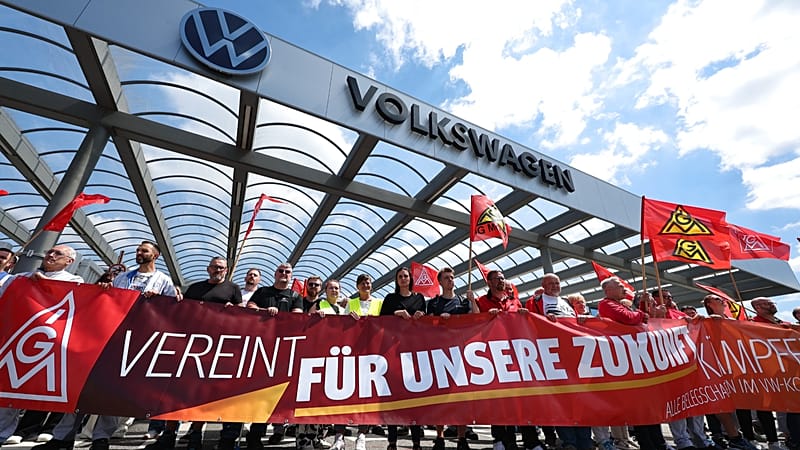
POLICY WIRE — Wolfsburg, Germany — The engine room of German industrial might, usually a humming symphony of efficiency and labor-management détente, now grinds with a discordant clash. Volkswagen, the colossal automaker synonymous with ‘Das Auto,’ finds itself careening toward a full-blown confrontation, a showdown that threatens to upend decades of carefully negotiated peace between its powerful workforce and ambitious executive suite. It’s not just about profit margins; it’s about the soul of an industry, the future of work, and whether German capitalism can evolve without a very public, very painful family feud.
For years, the sheer heft of Volkswagen allowed it to sidestep the kind of brutal cost-cutting seen elsewhere. But electric vehicle transitions are expensive, competition’s fierce, — and China’s making its moves. The company, facing pressures from every direction, announced a new, aggressive savings target: an eye-watering €10 billion reduction by 2026, according to recent corporate financial disclosures. That’s a lot of money. And, naturally, it’s gotta come from somewhere. That ‘somewhere’ usually involves heads, or at least smaller paychecks, which is where things get truly messy.
“We don’t have a choice, really. The industry landscape is changing at warp speed. If we’re not lean, if we’re not hyper-efficient, we won’t compete tomorrow,” declared Arno Antlitz, Volkswagen’s Chief Financial Officer, in a statement designed to calm investors, though it probably did the opposite for the union. “This isn’t about profit for profit’s sake; it’s about survival, plain and simple.” His words hang heavy, a tacit admission that the company is playing for keeps. Survival, as a concept, tends to leave little room for sentimentality, doesn’t it?
But that survival rhetoric runs headlong into the brick wall of Germany’s deeply entrenched co-determination system, where workers hold serious sway. Daniela Cavallo, chairwoman of the powerful Works Council—she effectively represents the workers at VW—didn’t mince words. She fired a warning shot straight at management: don’t even think about bypassing us. “Our members built this company. Their families have worked here for generations. They won’t stand idly by while distant executive offices draw red lines through jobs and livelihoods without a fight,” Cavallo asserted, her voice echoing the collective defiance of hundreds of thousands. It’s a classic standoff: corporate necessity versus labor tradition. Nobody wants to blink first.
The situation isn’t confined to the gleaming factories of Lower Saxony, either. This is Germany, Europe’s economic engine. A major labor dispute at Volkswagen—a company that accounts for roughly over 1.5% of Germany’s total GDP, a figure consistently highlighted by the Federation of German Industries—could send ripples throughout the continent. It’s got economists, politicians, — and industrial rivals all watching with bated breath. Because what happens at Wolfsburg doesn’t stay at Wolfsburg.
But the story’s got a broader resonance, particularly when you consider the shifting sands of global manufacturing. As Volkswagen struggles with its domestic legacy, countries in South Asia, like Pakistan, are scrambling to attract foreign direct investment and boost their own automotive sectors. While labor protections in these emerging markets don’t typically match Germany’s, the lessons of Volkswagen’s internal struggle are still salient. Workers, regardless of geography, eventually push back when pushed too far. And companies, eyeing cheaper labor pools and burgeoning middle classes in places like Karachi or Lahore, need to factor in not just wage arbitrage, but the eventual development of their own robust, often fiery, labor movements.
And then there’s the long game. This isn’t just about jobs today; it’s about the car company of tomorrow. The move to EVs requires fewer parts, different skills, — and a completely reimagined production line. That means painful, expensive retooling—both of machinery and of human capital. Because nobody ever said industrial transformation would be neat. It’s always a bit of a demolition job before the rebuild, isn’t it?
What This Means
This escalating drama at Volkswagen signals more than just corporate belt-tightening; it’s a barometer for the health of German industry and its celebrated model of social partnership. If VW’s management can’t negotiate a palatable deal with its union, it could unravel decades of labor peace that has underpinned the nation’s manufacturing prowess. We’re talking about potential strikes that cripple production, damage investor confidence, and slow the critical transition to electric vehicles—a race Germany can’t afford to lose to Silicon Valley or Beijing. Economically, a drawn-out conflict injects significant instability into Europe’s largest economy, impacting supply chains and consumer confidence across the continent.
Politically, the situation is delicate. The German government, deeply invested in maintaining economic stability and industrial jobs, will be under immense pressure to mediate. But its ability to intervene meaningfully in what’s fundamentally a private sector dispute is limited. Any perceived governmental favoritism—towards either side—could spark wider discontent. This isn’t some backroom deal for a football club; it’s the nation’s pride at stake. the outcome will be closely watched by other major European industrial players grappling with similar transitions. It might set a precedent for how heavily unionized economies can navigate disruptive technological shifts without plunging into industrial anarchy.
For global supply chains and emerging markets, a weakened, internally conflicted Volkswagen means slower growth and less investment capacity abroad. If a stalwart like VW can’t manage its transition gracefully, what hope is there for companies with less historical stability or weaker labor relations? The whole affair serves as a grim cautionary tale: even the biggest, most historically successful companies aren’t immune to the unforgiving economics of a rapidly changing world.