


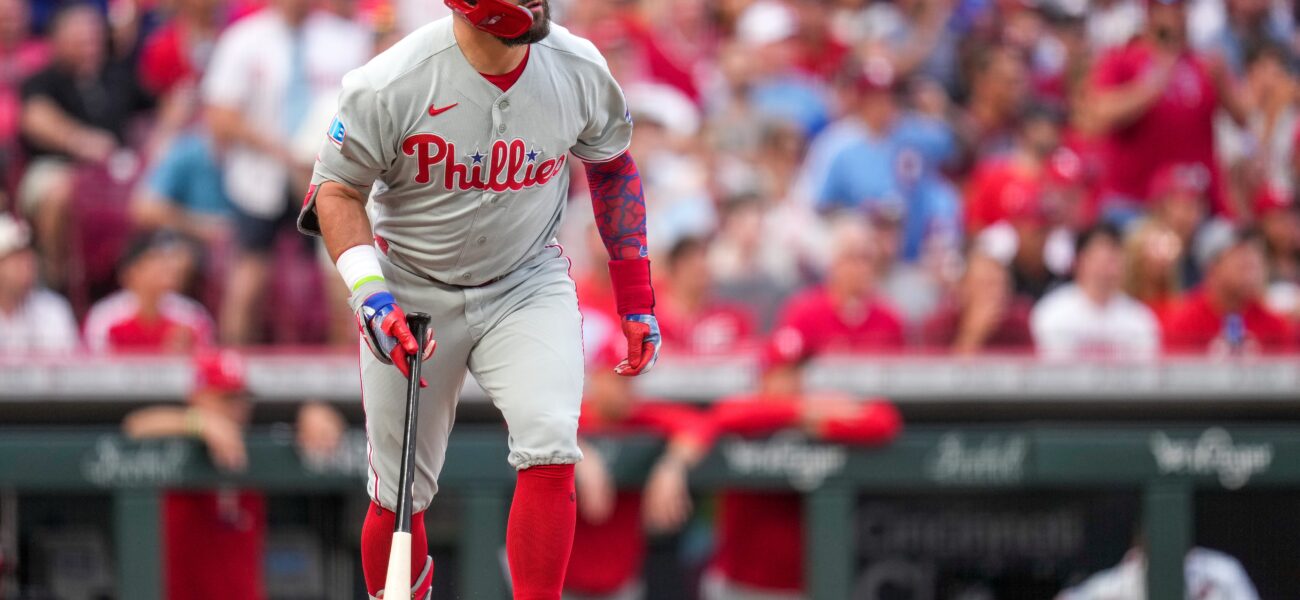
The Silent Reckoning: Schwarber’s Calculated Fury Shatters Expectations
POLICY WIRE — Philadelphia, United States — For some, the scoreboard offers a brutal, unambiguous ledger of wins and losses. For others, it’s a narrative, a grand stage where history bends to the...

POLICY WIRE — Philadelphia, United States — For some, the scoreboard offers a brutal, unambiguous ledger of wins and losses. For others, it’s a narrative, a grand stage where history bends to the whims of men, and occasionally, to an athlete’s sheer, unadulterated will. In a league populated by titans, the Philadelphia Phillies’ Kyle Schwarber isn’t just hitting baseballs; he’s routinely dismantling pitching plans, sometimes with an almost clinical disregard for established norms. And yet, one particular swing this past week, a momentary lapse of pitching strategy against the Cincinnati Reds, resonated with an almost existential significance for its rarity—not for the raw power behind it, which is now frankly mundane from Schwarber, but for the almost absurd context.
It was against Reds starter Andrew Abbott, a seemingly unremarkable third-inning at-bat during a game Cincinnati ultimately dropped 4-1. Schwarber, already a known quantity of destruction against the hapless Reds (he’s clubbed 27 homers against them, more than any other opponent), stood in the batter’s box. The count ticked to 3-0. Pitchers, almost instinctively, throw a get-me-over fastball, hoping to sneak in a strike, to avoid loading the bases for free. Not this time. Schwarber—who, it’s worth noting, hadn’t previously homered off Abbott—was waiting. And then he wasn’t. A loud, violent crack of the bat punctuated the afternoon, sending the ball soaring over the fence.
“You give a guy like Kyle that look, just that *glimpse* of an advantage, and he doesn’t just take it; he owns it,” mused Joe Girardi, former manager and now analyst, on the predatory nature of elite sluggers. He’s right, you know. But it wasn’t just *any* homer. This was Schwarber’s first 3-0 count blast against the Reds, and—prepare for the statistical shockwave—only the second in his entire twelve-season Major League Baseball career. His only other came on June 1, 2022, against the San Francisco Giants’ Jarlín García. This isn’t a regular occurrence; it’s an outlier, a blip in an otherwise statistically regimented sport, highlighting both disciplined aggression and monumental strategic miscalculation.
But the true implications here stretch beyond mere baseball analytics. Think of it: an event so infrequent, so particular in its execution, it requires an examination of how marginal decisions—a single pitch choice, a brief lapse in focus—can ripple outward. Like a sudden, catastrophic mechanical failure, where the consequences outweigh the seemingly minor trigger. This brings to mind the ongoing discussions surrounding transportation safety in burgeoning economies, where every single detail in procedure, from maintenance checks to operational protocols, carries disproportionate weight. What Pakistan must learn from the K2 Airways Crash, for example, shares a thematic thread with the profound impact of even rare mistakes in high-stakes environments, whether that’s on a cricket pitch, an aviation runway, or a baseball field.
📄 POLICY WIRE WHITEPAPER PUBLISHED: PAKISTAN'S NATIONAL SECURITY POLICY PRIORITIES
👉 READ BY CLICKING HEREThe statistical absurdity alone forces contemplation. Schwarber, with 371 career home runs, and a league-leading 31 this season, has spent his entire professional life perfecting the art of driving balls out of parks. Yet, just two of those have come in a 3-0 situation, when convention dictates a pitcher essentially throw an easy strike. And for a Reds team perpetually wrestling with its own narrative, this single swing—predicted, almost tauntingly, by Reds analyst Jeff Brantley on their radio network—is less a fluke and more a symptom of a larger, systemic vulnerability. “We know what he can do, we prep for it, but some nights, some guys—they’re just inevitable. You just tip your cap, unfortunately,” said Reds Manager David Bell, a sentiment that skirts between resignation and genuine admiration.
And so, while a batter’s moment of individual triumph can be spectacular, it also casts a cold, hard light on the infrastructure surrounding him. Because while Schwarber thrives, having hit four homers against the Reds from former Seattle Mariners pitcher Luis Castillo, Cincinnati finds itself, once again, facing a formidable opponent. It’s a recurring drama, a gladiatorial contest played out across summer evenings, with financial implications that dwarf the simple game itself. Indeed, the underlying economics of sustained athletic performance, the investment in talent versus regional expectations, can often mimic the silent scorecards of big-city bets on their cultural and commercial infrastructure.
What This Means
The Schwarber incident, while ostensibly about a singular baseball event, offers a compelling microcosm of broader political and economic forces. It highlights the brutal calculus of risk assessment. On a 3-0 count, a pitcher weighs the immediate danger of walking a slugger against the existential threat of throwing a hittable pitch. In geopolitics or national development, similar equations are constantly at play: the risk of inaction versus the potential fallout of a decisive, but possibly wrong, move. The fan base, loyal to its regional team, acts as a barometer of sentiment, directly influencing local economies and political approval ratings tied to regional identity and success. For communities, especially those struggling, the emotional investment in their team can sometimes transcend logic, transforming players into symbols. A victory like this reinforces a winning narrative for Philadelphia, boosting local morale and civic pride; for Cincinnati, it simply deepens a collective sense of Sisyphean struggle. The economic ripples, from merchandise sales to stadium attendance and local business activity, aren’t tied just to wins and losses, but to these deeper emotional narratives and perceptions of competitive vitality. A rare occurrence like Schwarber’s 3-0 bomb might seem trivial, but it subtly feeds into these larger conversations, becoming another brushstroke in the complex, often disheartening, portrait of a season.
📖 GET YOUR FREE COPY NOW OF POLICY WIRE DIGITAL MAGAZINE JULY 2026 EDITION
👉 READ & DOWNLOAD FREE MAGAZINE