


Bangladesh’s Digital Crucible: When Tomorrow’s Lie Explodes Today
POLICY WIRE — Dhaka, Bangladesh — A ghostly headline, plucked from a fictional tomorrow, began haunting digital feeds across Bangladesh last week. It screamed of a Hindu man lynched in 2025. This...

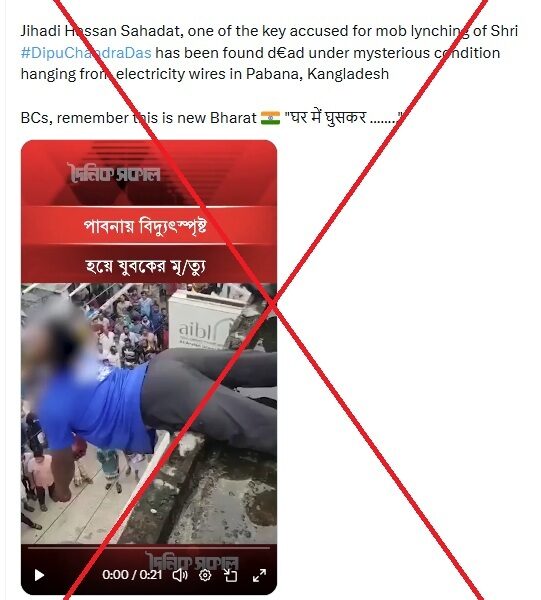
POLICY WIRE — Dhaka, Bangladesh — A ghostly headline, plucked from a fictional tomorrow, began haunting digital feeds across Bangladesh last week. It screamed of a Hindu man lynched in 2025. This wasn’t some esoteric time-travel tale, though; it was raw, venomous misinformation, swiftly deployed. The reality? A man electrocuted in an utterly unrelated incident. But the simple truth never stood a chance against a story designed to ignite a societal powder keg.
It’s a chilling symptom of our hyper-connected, yet utterly fractured, world: the sheer speed at which a preposterous lie—complete with a future dateline—can rip through a populace. A man, unfortunate enough to touch a live wire, found his tragic death warped into a brutal prophecy of communal violence. For those trafficking in hate, context is just inconvenient noise. They didn’t miss the ‘2025’; they banked on people overlooking it in the fury. And many did.
“This sort of fabrication isn’t just false news; it’s a poison aimed at our society’s very fabric,” declared Bangladeshi Information Minister Hasan Mahmud, his voice thick with frustration during a press briefing earlier today. “We’re chasing down the instigators with everything we’ve got. They’ll face the music, mark my words.” His government knows the stakes. Bangladesh, a nation of diverse faiths, has a history of tensions that can flare up with horrifying speed when manipulated. Because these narratives—these outright fabrications—don’t just dissipate; they linger like a bad smell, ready to resurface.
The speed and reach of this specific brand of digital perfidy highlight a concerning trend, one not exclusive to Dhaka’s borders. Ambassador John Thompson, a veteran observer of South Asian political currents, didn’t mince words. “The proliferation of such insidious narratives, especially those targeting religious minorities, fuels an already volatile climate across the region,” he explained to Policy Wire. “It demands not just local vigilance, but a concerted regional and international pushback against the purveyors of hate. They don’t care about truth; they only care about chaos.” And Thompson’s not wrong. It’s a game of clicks — and division, pure and simple.
The incident lays bare the alarming ease with which social media platforms, for all their connective power, transform into vectors for virulent propaganda. One moment, it’s a personal tragedy; the next, it’s a weapon. And who wields it? Often, it’s anonymous accounts, digital ghost ships steering societal rage. But their impact is concrete. The elusive hand of disorder frequently begins with a keystroke, a share, a careless belief. The consequences are far from ethereal.
📄 POLICY WIRE WHITEPAPER PUBLISHED: PAKISTAN'S NATIONAL SECURITY POLICY PRIORITIES
👉 READ BY CLICKING HEREThis particular debacle — the transformation of a random electrocution into a future-dated religious lynching — resonated beyond Bangladesh. Its virality underscores how intertwined South Asia’s information ecosystem has become. Disinformation cooked up in one corner can swiftly pollute the discourse in others, be it Pakistan or India, leveraging shared historical grievances or religious fault lines. It’s an information superhighway, but sometimes, it feels more like a toxic waste pipeline. According to a 2022 report by the South Asian Digital Rights Alliance, misinformation campaigns targeting religious minorities in South Asia saw a 40% increase over the previous three years, with a significant portion originating on unregulated social media platforms. That’s a stark number. It points to a worsening situation, not some fluke.
What This Means
This episode, bizarrely specific with its 2025 timestamp, serves as a sharp alarm call on several fronts. Politically, it signals an escalation in the sophistication — or perhaps just the brazenness — of digital manipulation aiming to destabilize the social order. For the government, it’s a direct challenge to its authority — and its ability to maintain peace. Allowing such incendiary fabrications to proliferate unchecked can quickly erode public trust and invite unwanted international scrutiny over human rights and minority protections. Economically, a climate of perpetual social unrest, stoked by these manufactured crises, inevitably chills foreign investment and diverts resources from development towards security apparatus. Who wants to put their money into a country where the digital rumor mill can spark actual street violence? But beyond the immediate fallout, this incident forces a recognition: the digital battlefield isn’t just about narratives of the past or present. Now, propagandists are literally fabricating the future, pre-empting reality to sow discord years in advance. It’s a grim preview of battles yet to come in the murky waters of online influence, challenging policymakers to confront not just existing lies, but imagined ones. And the ramifications, particularly in a religiously sensitive region, stretch deep into questions of national cohesion and international relations. One lie today can make tomorrow’s policy headaches. Just ask anyone who’s had to deal with the unseen policy debates that erupt from the most unexpected places.
📖 GET YOUR FREE COPY NOW OF POLICY WIRE DIGITAL MAGAZINE JULY 2026 EDITION
👉 READ & DOWNLOAD FREE MAGAZINE