


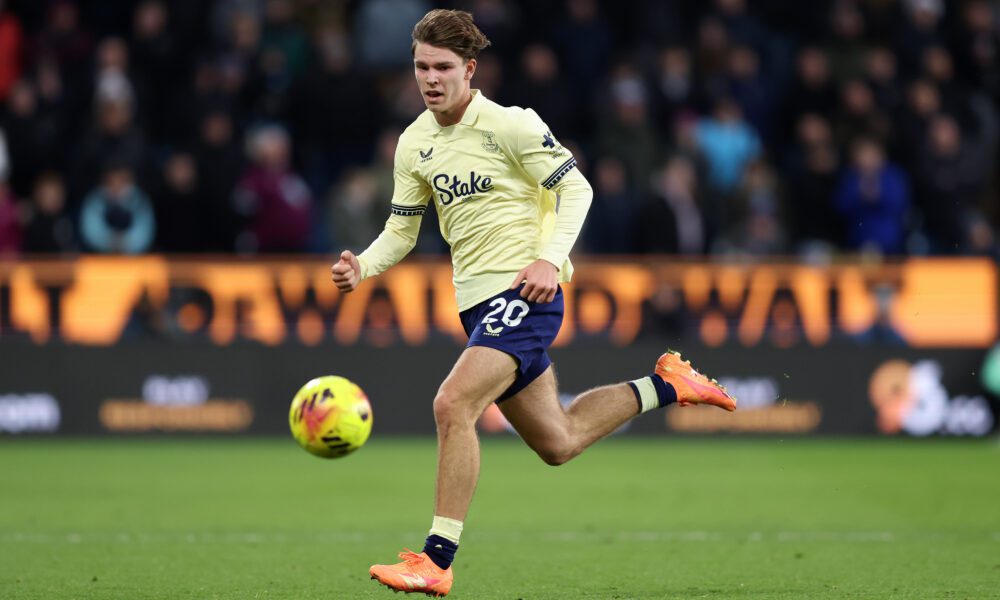
Leipzig’s Lurid Lure: Everton Winger Dibling and Football’s Relentless Capital Carousel
POLICY WIRE — London, UK — They say loyalty’s a virtue, but in the unforgiving machinery of top-tier European football, it’s often just an expensive anachronism. Another window. Another...

POLICY WIRE — London, UK — They say loyalty’s a virtue, but in the unforgiving machinery of top-tier European football, it’s often just an expensive anachronism. Another window. Another flurry of speculative bids. And another young talent, Tyler Dibling, finds himself a line item on an accountant’s spreadsheet, a strategic asset perhaps destined for a new postcode and a different shade of kit. Forget romantic notions of lifelong club allegiances; this isn’t a quaint village league. It’s a colossal, multi-billion-dollar enterprise where human beings are frequently, coldly, bought — and sold.
And now, RB Leipzig—that German outfit renowned for its calculated player development and shrewd market dealings—is reportedly circling Everton’s 20-year-old winger. It isn’t a startling revelation, is it? Just the ceaseless grind of clubs vying for marginal gains, of managers trying to make sense of ever-shifting rosters, of fans clinging to threads of hope. The Daily Mail, always keen to spill the beans on these dealings, broke the news. And Leipzig’s appetite for Dibling, apparently, is not new. They’d already sniffed around him before Everton forked out a cool £35 million to poach him from Southampton last summer. Now they’re back, hungry.
Dibling’s initial stint with the Toffees, frankly, wasn’t a barnburner. Seventeen appearances across all competitions last term. Not a single goal to his name. No assists either. Just four starts in the Premier League. For thirty-five million quid, you’d think they’d get a few more fireworks, wouldn’t you? But that’s the thing with potential; it’s expensive, speculative, — and doesn’t always pay out on the first spin. His modest output makes him, dare I say, available. Everton, feeling the pinch as always, looks like they’re open to a reasonable offer.
Everton’s manager, David Moyes, a man who knows a thing or two about tight budgets and hard yards, probably won’t be shedding tears if Dibling moves on. Because, let’s face it, they’ve already got irons in the fire for new wingers. Better ones, presumably. It’s an unenviable spot, managing a team with big hopes but often threadbare coffers. As Moyes recently remarked, probably through gritted teeth after another grueling meeting, “Look, we like to think we’re building something here, but talent moves. It just does. We’re in a constant fight to balance ambition with hard realities, and sometimes that means making pragmatic choices you might not want to make. It’s a young man’s career, but it’s our club’s survival.” And you get the feeling he means every word.
Leipzig, however, offers Dibling the shiny bauble of Champions League football. It’s an undeniable draw, isn’t it? A chance to perform on Europe’s biggest club stage, an audition for even bigger paydays down the line. They’re not just after Dibling, either. They’ve apparently held talks about Thierno Barry, another Everton asset. It’s a calculated move by the Bundesliga side to bolster their attack. They’ve built their entire modern history on identifying young, often undervalued talent, developing them, and then selling them on for stratospheric profits. It’s a ruthless, but incredibly effective, model.
“We prioritize not just raw ability, but suitability for our system,” commented a representative from RB Leipzig, speaking off the record (but quite openly about their general philosophy). “Young players with ambition, a willingness to adapt—they flourish here. We offer a platform unmatched for progression. And our track record speaks for itself, doesn’t it?” They’ve got a point; they’re consistently punching above their historical weight.
📄 POLICY WIRE WHITEPAPER PUBLISHED: PAKISTAN'S NATIONAL SECURITY POLICY PRIORITIES
👉 READ BY CLICKING HEREBut the ramifications stretch further than just Merseyside or Saxony. Consider how the European football behemoth—with its gravitational pull of money, media exposure, and prestige—impacts player development globally. Players from nations without such developed infrastructure, say Pakistan, where football’s popularity often struggles against the cricketing dominance but still commands a passionate following, gaze upon these transfers with mixed awe and perhaps a touch of despair. They see the pathway, but it’s a fiercely competitive, Western-centric one, isn’t it? The same market forces that pull a Dibling from England to Germany often also drain promising young talents from developing nations into a system where only a fraction ever truly break through. It reinforces the brutal economics of talent migration. It’s not just about one player; it’s about a global food chain of aspiration — and capital.
What This Means
Dibling’s potential transfer isn’t just another bit of transfer gossip. It’s a miniature parable for the macro-economics of modern football. It reflects several deeper currents: the ongoing financial precarity of historically significant clubs like Everton, forever balancing a grand past with a challenging present; the ascendancy of strategically managed, often financially potent, outfits like RB Leipzig that prioritize a cold, hard return on human capital; and the increasingly transient nature of player careers. English Premier League clubs alone shelled out approximately £2.8 billion in transfer fees in the 2023 summer window, according to Deloitte’s Annual Review of Football Finance, a staggering sum illustrating the high-stakes, hyper-inflated market Dibling operates within.
Economically, it highlights the Bundesliga’s ability to compete with, and often outmaneuver, financially constrained Premier League teams by offering a compelling sporting package—Champions League exposure, tactical sophistication—even if the raw wages might not always match. Politically, if one can even apply that lens to professional sports beyond local stadium zoning, it showcases a continuation of a two-speed system: clubs with long-term strategic visions (and robust backing, in Leipzig’s case) vs. those scrambling to make ends meet while still attempting to placate a demanding fanbase. It also speaks to the continuous, relentless cycle of asset management within clubs, treating players as investable commodities rather than fixtures. Loyalty, it appears, is simply a line item in a balance sheet, weighed against potential return. And that, dear reader, says everything.