


The Art of National Distraction: Britain’s Murals of Fervor Amidst Broader Malaise
POLICY WIRE — Peterborough, UK — The asphalt between Eye and Thorney often bears the weight of the everyday commute, cars trudging on toward predictable destinations. But lately, motorists passing a...

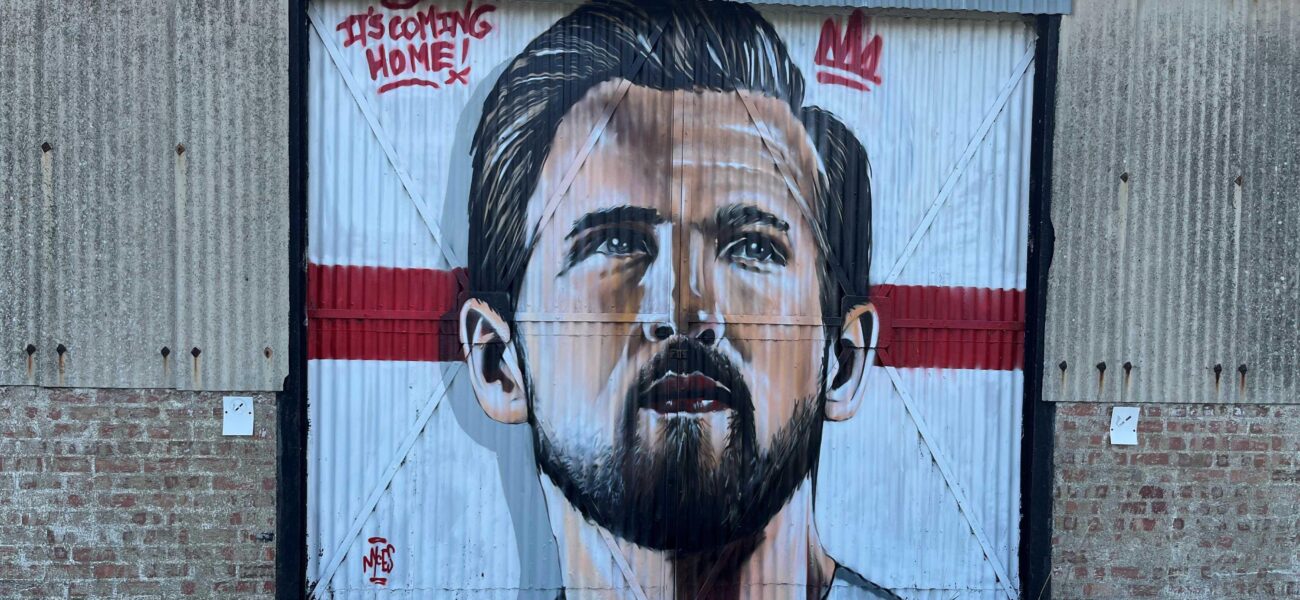
POLICY WIRE — Peterborough, UK — The asphalt between Eye and Thorney often bears the weight of the everyday commute, cars trudging on toward predictable destinations. But lately, motorists passing a barn door just off the A47 have encountered something far less prosaic: the towering, unblinking gaze of Harry Kane, England’s football captain, rendered in spray paint. It’s football. It’s obsession. And it’s an utterly British ritual, where the collective psyche finds solace—or perhaps, simply an elaborate, temporary bypass—from the gnawing realities that always seem to be brewing just beneath the surface.
Because, for all the talk of national pride and sporting achievement, this surge of public adulation, epitomized by such colossal street art, operates as a curious barometer of the island nation’s temperament. Artist Nathan Murdoch, the hands behind the imposing, 13-foot Kane, and the soon-to-be Bellingham piece in Peterborough, insists it’s pure fandom. “He’s going to break more records for England. I wanted to do something as a fan, and here it’s,” Murdoch mused, a sentiment likely echoed in pubs and living rooms across the country.
But scratch beneath the veneer of fandom, — and you’ll find a populace desperate for a unifying narrative. A World Cup run—especially one that sees England progressing with nine million people reportedly tuning into a single dramatic victory on BBC TV, a hard statistic pulled straight from the broadcaster’s own reports—provides that story, however transient. Murdoch, a grafter by his own admission, recounted the sheer battle against elements, against the very corrugated steel of the barn door itself, to bring Kane’s likeness to life. “It took about seven hours…the heat and the wind blowing the paint away,” he lamented, adding a wry observation that “I battled with this painting, just like England did on Monday.”
It’s this blend of individual toil and mass consumption that truly defines Britain’s relationship with its football heroes. Rachel Denham, a self-proclaimed “huge football fan” from nearby Sutton St James, declared the mural “fantastic” and, in the same breath, reassured a waiting world that her beer fridge was “full,” anticipating England’s triumph. Another local, Jade Barker, praised the artwork’s “perfection,” the way Kane’s “eyes look like he’s alive.” That hyper-focus on detail, that almost religious devotion, feels less about art and more about collective yearning.
And what exactly is the nature of this yearning? For some, it’s about simple pride. For others, particularly in communities where the connection to the ‘homeland’ feels more tenuous—take the vibrant British-Pakistani enclaves in London or Birmingham, where football allegiances might split between England and a home country less famed for the sport, or even cricket—it’s a different beast. Football offers a common ground, a cultural adhesive, despite the layered complexities of identity that often go unacknowledged in mainstream narratives. They, too, can get swept up in the “football’s coming home” chant, even if ‘home’ represents different things to different folk.
Still, not everyone views these displays as harmless civic boosts. “While we appreciate the civic spirit shown through community art, it’s essential local authorities remain focused on addressing systemic issues, rather than simply celebrating fleeting nationalistic exuberance,” commented Eleanor Vance, a Peterborough City Council policy analyst, during a recent, unrecorded public discussion on community investment. “One hopes this energy might translate into tangible efforts toward urban renewal or genuine public welfare beyond the stadium’s roar.”
And indeed, Professor Alistair Finch, a cultural anthropologist based at Cambridge University, offered a more critical lens. “These grand, public art pieces, celebrating sport, aren’t just expressions of joy; they’re powerful, often subconscious, tools for social cohesion, particularly when a society feels fragmented,” he told Policy Wire in an email exchange. “They allow us to look away from uncomfortable truths—stagnant wages, ailing public services—and focus instead on a shared, often manufactured, destiny.”
What This Means
The Kane and Bellingham murals, however seemingly innocuous, act as cultural markers, signposts pointing to the broader economic and political undercurrents in Britain. In an era rife with cost-of-living pressures, lingering Brexit aftershocks, and a political landscape that often feels fractured, the unifying power of a successful national football team becomes a valuable, albeit temporary, commodity. This isn’t just about street art; it’s about a nation’s quest for catharsis through collective spectacle. The investment of emotion, the rush of shared experience, diverts attention from the harsher economic realities. It can be viewed as an unofficial stimulus for local morale, a cheap — certainly in comparison to tangible infrastructure projects — feel-good mechanism. The underlying tension remains: how long can such ephemeral bursts of joy paper over genuine civic disquiet? But the immediate impact, a city like Peterborough buzzing with anticipation, a community momentarily aligned, isn’t lost on policymakers, however subtle their acknowledgments might be. The ephemeral nature of a sporting high reflects a societal appetite for escape, making such celebratory displays more politically significant than they first appear.