


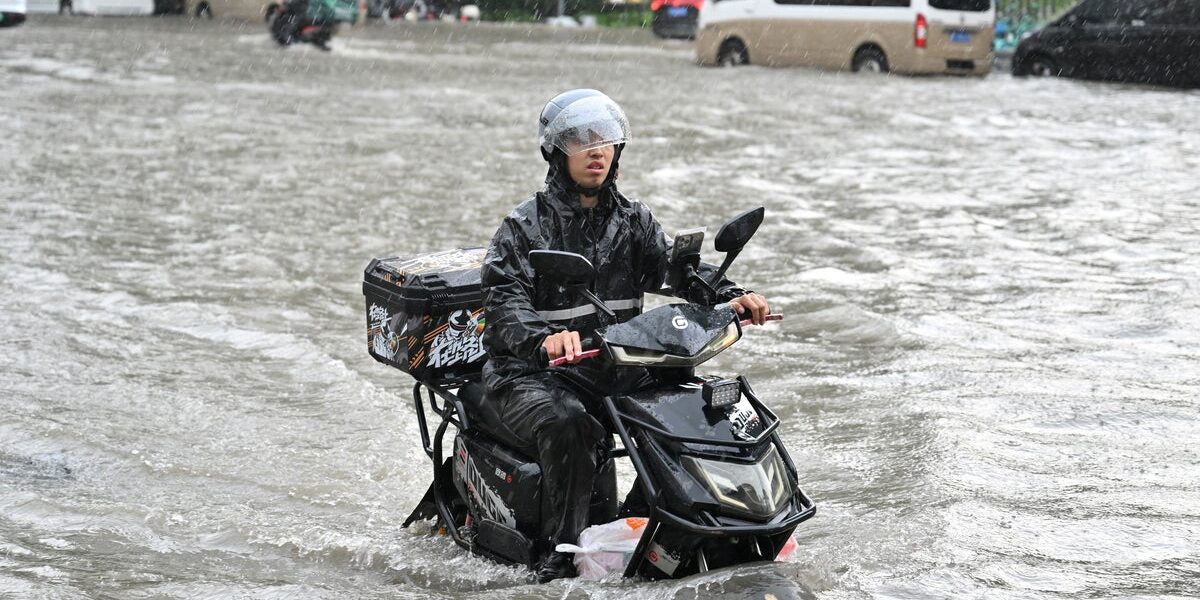
Beijing’s Battle Against the Deluge: A Region Sinks Beneath Nature’s Relentless Assault
POLICY WIRE — Guangzhou, China — The monsoon doesn’t negotiate. It certainly doesn’t care for economic projections or grand national rejuvenation narratives. When the skies over Southern...

POLICY WIRE — Guangzhou, China — The monsoon doesn’t negotiate. It certainly doesn’t care for economic projections or grand national rejuvenation narratives. When the skies over Southern China burst this past week, they didn’t just bring rain; they brought a relentless, crushing weight that buckled earth, swallowed homes, and—quite tragically—ended 21 lives in one swift, unforgiving sweep. It’s a sobering reminder: for all the nation’s technological might and its astonishing capacity for infrastructure projects, even Beijing can’t dictate the weather.
It was a rural corner of Meizhou city, in Guangdong province, that bore the immediate brunt. Twenty-one villagers were entombed by an angry torrent of mud — and rock. More bodies, officials fear, could still be trapped in the watery muck, adding to a death toll that climbs incrementally each day the rains persist. Helicopters circle; excavators claw at the earth. But this isn’t just a localized tragedy. It’s a scene playing out across a vast swath of the country, from the Pearl River Delta’s bustling factories to the sleepy farming villages clinging precariously to hillsides.
But how do you prepare for what Chinese weather authorities describe as a ‘once-in-a-century’ event? Maybe you don’t. You simply react, — and hope your foundations are strong enough. The sheer volume of water has been extraordinary. Chinese state media reports indicate that parts of Guangdong alone have seen more than 500 millimeters of rainfall in just a few days, equivalent to roughly a third of London’s annual precipitation. And that’s a conservative figure, folks. The human — and material losses are still being tallied, a grim spreadsheet updated by the hour.
“Our thoughts are with the families affected by this devastating natural calamity,” said a somber Xu Jian, spokesperson for the Ministry of Emergency Management, in a statement released earlier today. “The Party and state leadership are directing all available resources to rescue operations and to support those displaced. We won’t rest until every effort has been made.” A boilerplate response, sure, but in China, these aren’t just empty words. The apparatus moves. It just can’t move mountains. But you’ve got to wonder if this relentless deluge—these increasingly common ‘once-in-a-century’ events—are testing the limits of even the most formidable state capacity.
It’s not just the immediate havoc. Floods, mudslides, — and severe storms have become an annual, increasingly destructive ritual across Asia. Take Pakistan, for instance, a nation half a continent away but sharing a similar climate predicament. They’ve been grappling with their own unforgiving monsoon seasons, with floods displacing millions and wreaking economic havoc on a far less resilient infrastructure. These aren’t isolated incidents. They’re part of a larger, global pattern of extreme weather events, supercharged, many scientists argue, by a warming planet.
📄 POLICY WIRE WHITEPAPER PUBLISHED: PAKISTAN'S NATIONAL SECURITY POLICY PRIORITIES
👉 READ BY CLICKING HERE“We’re witnessing an acceleration of weather extremes that demand a recalibration of our national planning, from urban development to disaster relief,” remarked Professor Li Wei, a hydrologist from Peking University who advises several government bodies on water management, speaking off-the-record about the escalating crisis. “The scale, it’s just different now. The old models don’t hold.”
Because while China can build high-speed rail lines through challenging terrains and dam colossal rivers, the vulnerability of its vast rural populations, particularly those living in older, less-resilient structures nestled in hilly regions, remains a persistent Achilles’ heel. That’s a stark truth. These aren’t the sparkling new cities. These are the forgotten pockets. And they’re the ones who pay the price.
What This Means
This escalating cycle of natural disasters presents Beijing with a compounding policy challenge, one that transcends mere logistics and touches the sensitive nerve of public trust and economic stability. Politically, the Party’s legitimacy rests heavily on its ability to deliver prosperity and maintain social order—a tall order when nature is actively undermining both. Each death, each ruined village, risks chipping away at that carefully constructed image of infallible governance, especially in the era of ubiquitous social media where official narratives struggle to contain raw, unfiltered images of devastation. Economically, the cost of repair — and reconstruction is staggering. These events siphon off resources that could be directed towards strategic industrial growth or social programs, forcing the allocation of vast sums towards remedial action. And we’re not just talking about direct financial losses; there’s also the long-term impact on agricultural output, internal migration, and—crucially—investor confidence in affected regions. For a nation meticulously managing its trajectory to global superpower status, a sustained and escalating internal fight against climate chaos is a deeply inconvenient truth. It’s also a warning to other developing economies, especially in regions like South Asia and parts of the Muslim world, many of whom are far less equipped to handle such environmental hammer blows. The world is warming, and Beijing is learning, in the cruelest terms, that no amount of economic clout can truly tame a rampaging storm.
📖 GET YOUR FREE COPY NOW OF POLICY WIRE DIGITAL MAGAZINE JULY 2026 EDITION
👉 READ & DOWNLOAD FREE MAGAZINE