


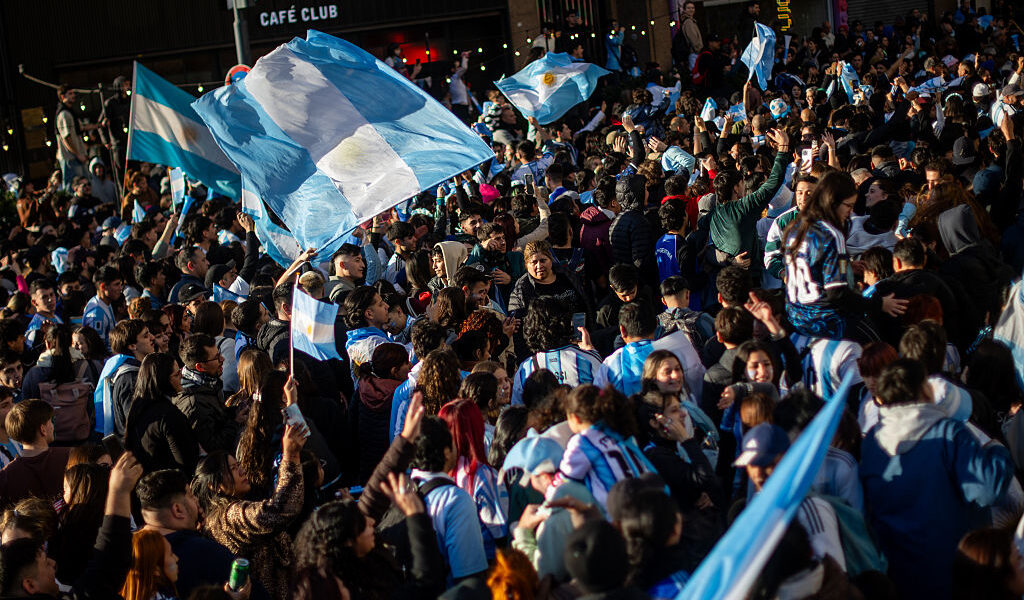
The Silence After the Roar: When National Euphoria Meets Mundane Reality
POLICY WIRE — Buenos Aires, Argentina — The stadium lights are out now, hushed. The relentless, throbbing cacophony that ripped through Buenos Aires and reverberated across a planet, fading just days...

POLICY WIRE — Buenos Aires, Argentina — The stadium lights are out now, hushed. The relentless, throbbing cacophony that ripped through Buenos Aires and reverberated across a planet, fading just days ago, has receded. For nearly a month, life here, and indeed for a vast swathe of humanity fixated on a singular leather orb, became a succession of ecstatic shrieks and gut-wrenching gasps. But the silence that followed Enzo Fernández’s electrifying goal, which felt like it detonated across every public plaza and living room simultaneously, now holds a different weight. It’s the silence of morning after, a stark, unsentimental reality checking back in, reminding everyone the ordinary grind hadn’t vanished; it was merely put on a very enthusiastic hold.
It’s easy, perhaps too easy, to get swept up in the narrative of a nation unified, a people bonded by an inimitable passion. We saw it in Atlanta, an improbable sea of sky-blue — and white making a distant pitch feel like a home turf. And yes, in Vancouver, which was temporarily, beautifully, painted in Colombian yellow even without their national side progressing further. That’s the power of the game, isn’t it? A collective hallucination that, for precious moments, elevates us above the daily scramble.
Yet, the political observer can’t help but notice how expertly—almost magically—this particular brand of fervor often performs its secondary function: as a magnificent national distraction. Argentina’s latest World Cup journey was less a sporting event — and more a geopolitical phenomenon. It wasn’t just about winning games; it was about momentarily forgetting the perennial tightrope walk of inflation, the debt restructuring negotiations that loom, or the simmering societal anxieties that don’t disappear just because a striker finds the net. And that’s a truth policymakers globally are acutely aware of.
Minister Juan Pablo Peralta, Argentina’s Secretary of Sports, didn’t mince words following the semi-final win. He called it, “a breathtaking affirmation of our national spirit, proof that even in challenging times, we can find unity in common cause. That roar wasn’t just for a goal; it was for us, for Argentina.” His sentiment, no doubt genuine, also conveniently refocused the conversation from the Central Bank’s latest interest rate hike.
Across the oceans, in a vastly different yet surprisingly similar cultural landscape, nations like Pakistan know this dynamic intimately. There, cricket isn’t merely a sport; it’s a profound cultural institution, capable of eclipsing even the most pressing domestic woes—a collapsing economy, political infighting, persistent human rights concerns—with the turn of a wicket. The sheer national energy devoted to these pursuits offers an unparalleled balm, a temporary suspension of disbelief. It creates a collective unconscious that, for a few hours or weeks, supplants grim statistics with raw, uncomplicated pride.
Dr. Aisha Rahman, an astute geopolitical analyst specializing in South Asia and Latin American parallels, articulated this very phenomenon for Policy Wire. “While the national jubilation is understandable, even beautiful, it’s a potent form of societal escapism,” she observed. “In regions like Pakistan or, indeed, Argentina, these moments, however genuine, can conveniently eclipse mounting domestic pressures—everything from inflation to infrastructure deficits. We see the cheers; we often miss the deeper quiet where policy failures continue to fester.” She notes that Pakistan’s national airline, for instance, has accumulated nearly $5 billion in debt, a stark counterpoint to the raucous joy of a major cricket victory.
It’s not to say that such moments are disingenuous, or that national pride should be suppressed. No, that’s far too cynical. But the experienced political eye sees the patterns: the release valve effect, the surge in approval ratings for sitting governments following sporting successes, the carefully choreographed celebrations that speak more to a country’s aspirations than its current, often messy, reality. This World Cup wasn’t just a tournament; it was a masterclass in mass psychology, a demonstration of how deeply a simple game can penetrate—and occasionally, obscure—the complex machinery of nation-states.
Because ultimately, when the roar dissipates — and the last streamer is swept away, the national ledger still waits. It still demands attention. And that’s when the real game—the one that governs lives long after the final whistle—begins anew.
What This Means
The post-celebration hangover in Argentina isn’t just about sporting disappointment; it’s a moment of truth for its political landscape and broader economy. For months, the pervasive World Cup narrative offered an intoxicating respite from discussions surrounding Argentina’s formidable economic challenges, including a national inflation rate that routinely crests above 100%. While the surge in national morale might provide a fleeting, intangible benefit—perhaps even a temporary boost in consumer confidence in specific sectors—the underlying structural issues remain stubbornly entrenched. Governments often hope to harness such unifying events for long-term goodwill, but history tells us that sustained national pride rarely translates into blind political loyalty when everyday struggles persist.
For regional geopolitics, particularly concerning its trade partners and international creditors, this spectacle served as a soft power projection—a reminder of Argentina’s cultural vibrancy even as its financial woes make headlines. But international finance doesn’t grant leniency for penalty shoot-outs won. From an economic perspective, the brief surge in local consumption during the tournament—flag sales, food, public transport for celebrations—is a blip against the macroeconomic picture. Political stability, foreign investment, and effective fiscal policy are the real trophies, ones that demand consistent effort, not just periodic bursts of athletic brilliance. The challenge now lies in pivoting that collective energy and national focus from the pitch back to pressing policy reforms without losing the sense of shared purpose a World Cup win briefly, miraculously, conjured.