


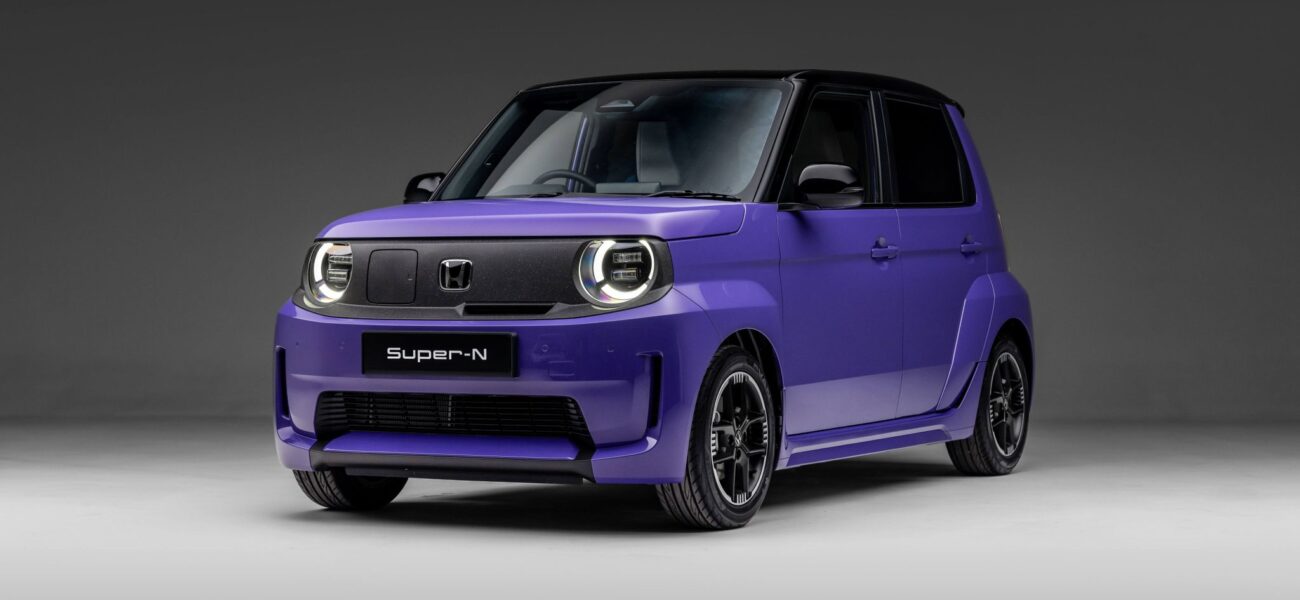
Europe’s Gridlock Grinders: Honda’s Tiny Car, A Big Policy Gambit?
POLICY WIRE — Brussels, Belgium — It’s an inconvenient truth haunting Europe’s gleaming urban centers: they’re getting choked. Not by existential threats, mind you, but by the slow, suffocating...

POLICY WIRE — Brussels, Belgium — It’s an inconvenient truth haunting Europe’s gleaming urban centers: they’re getting choked. Not by existential threats, mind you, but by the slow, suffocating crawl of too many vehicles, too much asphalt, and a public transport infrastructure that simply can’t keep pace with sprawling populations. Cities, it seems, have had enough of being personal car parks, and citizens—they’re starting to echo that sentiment, loudly.
Enter the Honda Super-N. This isn’t just another subcompact rolling off an assembly line; it’s a precisely engineered response to a complex policy dilemma, landing squarely in the middle of Europe’s frantic push for sustainable urban mobility. For decades, European automakers grew their models, making them safer, yes, but also bulkier, thirstier. Now, they’re playing catch-up, trying to shrink down while Japan’s behemoth quietly offers a solution that looks a whole lot like the past, just… cleaner.
But can a small, battery-electric four-seater actually recalibrate the political calculus of urban planning and environmental policy? Some, it appears, are cautiously optimistic. “We need diverse solutions if we’re serious about our 2030 emission targets,” stated a spokesperson for Environment Commissioner Virginijus Sinkevičius, who wasn’t available for direct comment but whose office relayed his view. “While electrification is key, the sheer footprint of individual vehicles remains a challenge. If Honda can deliver genuine efficiency — and accessibility, it opens new avenues. We’re certainly watching.”
And ‘accessibility’ isn’t just about parking it in a tight spot in Paris or Berlin. It’s about a growing economic squeeze, too. For many Europeans, particularly younger demographics or those in lower income brackets, car ownership has become a monstrous undertaking—prohibitively expensive, environmentally fraught, and a logistical nightmare in many urban cores. The Super-N aims to slot itself into that widening gap, offering a semblance of personal mobility without the hefty price tag or guilt trip.
A recent Eurostat report indicated that 75% of the EU’s population now lives in urban areas, a figure projected to rise. That’s a staggering proportion. What’s more, average city speeds in some European capitals dip below walking pace during peak hours. You can almost hear the gears grinding, can’t you?
This little Honda isn’t just a market play; it’s a policy intervention. It dares to ask: What if urban mobility wasn’t about ever-larger, software-stuffed luxo-barges? What if it was about just… getting around, efficiently, quietly, cleanly? And this is where European industry, traditionally focused on more aspirational vehicles, might feel the sting. They’ve been told to innovate, but maybe the innovation they truly need is a humble return to basics.
📄 POLICY WIRE WHITEPAPER PUBLISHED: PAKISTAN'S NATIONAL SECURITY POLICY PRIORITIES
👉 READ BY CLICKING HEREConsider Jean-Luc Dubois, France’s Minister of Transport. His department’s unofficial line has been one of exasperated pragmatism. “Frankly, our citizens aren’t interested in grand philosophical debates on mobility when they’re stuck in traffic, breathing exhaust fumes,” he quipped in an off-the-record briefing last month. “If a small, affordable electric vehicle, regardless of its origin, helps ease that burden—helps people get to work, reduces the pollution our children breathe—then we have to look at it seriously. Our commitment is to the environment, yes, but also to daily life.”
But because Europe isn’t a vacuum, this also brings into sharp focus the glaring differences in urban mobility philosophies elsewhere. Think Karachi, think Dhaka, or Lahore—cities where millions grapple with an entirely different scale of congestion, infrastructure deficiency, and indeed, pollution. The policy challenges there dwarf anything seen in Western Europe; a compact EV might seem like a dream, but the hurdles—affordability, charging infrastructure, distribution networks, policy coherence—are monumental. So while the Super-N could revolutionize certain European enclaves, its underlying design philosophy, cheap and cheerful and electric, might hold a conceptual blueprint for cities in, say, Pakistan, where air quality crises demand far more accessible and immediate solutions than their European counterparts.
What This Means
The Honda Super-N, for all its miniature stature, represents a significant moment for European urban policy. First, it forces a reevaluation of what ‘sustainable mobility’ actually means beyond just electrifying existing vehicle classes. It asks if scale itself isn’t a problem. Second, it exposes a potential vulnerability in Europe’s auto industry strategy; having bet big on premium EVs, they might be caught flat-footed in the increasingly important, and frankly, mass-market, urban utility segment. It’s a pragmatic challenge, less about tech leaps — and more about appropriate technology for context. For policymakers, especially those fighting both emission targets and citizen dissatisfaction, the Super-N could offer a palatable short-term fix. It won’t solve gridlock single-handedly—that requires massive infrastructure investment and brave political will to reduce car dependency altogether. But it might just buy some valuable time, — and that, in the convoluted world of EU policy, can be gold. Its arrival highlights not only internal European debates but also the widening gap in climate-solution implementation between the affluent West and the more precariously positioned developing world. The global ramifications, though subtle, are certainly there.