


Spartans’ Big Ten Cyclone: Underdogs Upend the Financial Calculus of Collegiate Athletics
POLICY WIRE — Omaha, NE — Nobody expected them to still be here. Not really. The prognosticators, the number crunchers, and certainly not the high-dollar boosters whose fortunes often sway on the...

POLICY WIRE — Omaha, NE — Nobody expected them to still be here. Not really. The prognosticators, the number crunchers, and certainly not the high-dollar boosters whose fortunes often sway on the predictable currents of conference tournaments, had neatly penned the Michigan State Spartans into an early exit. But collegiate baseball, it seems, sometimes has a cruel disregard for the script—or, perhaps, for the careful financial modeling that underpins big-time athletics.
Because, against all conventional wisdom, — and the rather brutal economic realities that govern programs, the No. 12 seed Spartans didn’t just hang around the Big Ten Tournament in Omaha. They detonated expectations, first dispatching the No. 5 seed Purdue, 8-4. Then, with a casual defiance that would make a sovereign wealth fund manager sweat, they bounced No. 8 seed Iowa with a tight 4-3 victory, punching their ticket to the quarter-finals. The entire affair has the feel of a finely tailored suit suddenly — and irrevocably — ripping at the seams. And, for some, that’s just good theater.
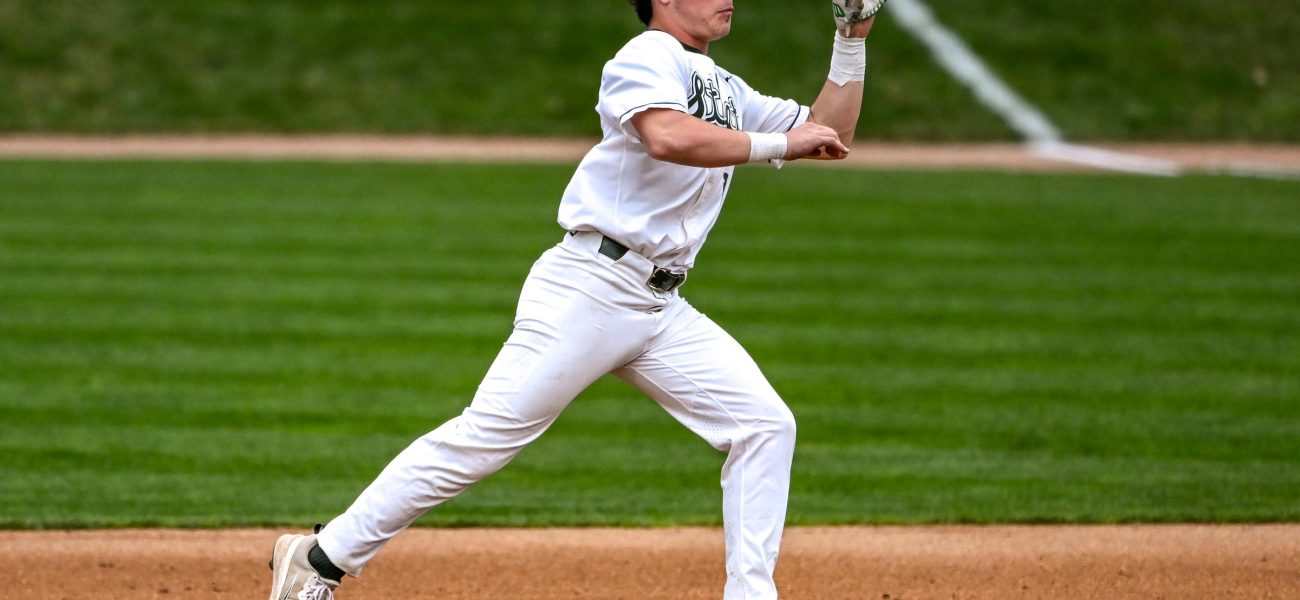
It wasn’t a clinic in domination. Far from it. This wasn’t some kind of flawless, clinical sweep. The Iowa game, specifically, was a gritty, inch-by-inch grind. The Spartans found themselves down a run, 3-2, heading into the seventh. But they scratched back, tied it up. Then, in the ninth, with bases loaded and the tension thick enough to cut with a dull knife, junior second baseman Ryan McKay poked an infield single deep into the shortstop’s domain. The ball—it was almost an apology for a hit—was just enough to bring the winning run home. Senior Nolan Higgins then closed out the Hawkeyes, ensuring the unexpected chaos continued. What a scene.
This kind of upset isn’t merely about wins and losses on the diamond; it’s a stark reminder that even in the meticulously planned world of big college sports, human elements – raw tenacity, plain luck, and an utter disregard for seeding – can shatter careful institutional projections. It’s a familiar script, isn’t it? The heavily favored, the well-funded, often trip over their own assumptions. We see it on the cricket pitches of Lahore, where a spirited minnow can sometimes—just sometimes—dismantle the Goliaths built on massive sponsorship and national legacies, throwing entire economic ecosystems into a mild panic.
Coach Alistair Finch, a grizzled veteran whose program often grapples with leaner budgets than its Big Ten counterparts, didn’t mince words. ‘They said we didn’t belong,’ he scoffed, his voice hoarse from yelling into a wind that carries more than just dust. ‘They said we were just making up the numbers. Well, numbers don’t lie when you’re scoring more runs — and proving everyone wrong. We ain’t going anywhere yet.’
Indeed. Spartans pitchers senior Carter Monke and junior left-hander Gannon Grundman held the line, with Monke going nearly six innings and Grundman delivering 2 1/3 shutout frames of relief. It’s that kind of pitching—unheralded, unexpected—that keeps the institutional money men awake at night. These upsets, you see, they’re not good for established order.
And now, a far greater beast looms: No. 4 seed Southern California. This isn’t just another game. USC likely fields junior Mason Edwards, the Big Ten Pitcher of the Year, a chap who concluded the regular season with an unblemished 8-0 record and a minuscule 1.49 ERA in 84.1 innings pitched. He’s arguably one of the most dominant college arms in the country. The Spartans’ road, frankly, only gets steeper, suggesting their current run is either a brief, delightful anomaly or a genuinely potent threat to the usual order.
What This Means
These unlikely victories aren’t just feel-good stories for alumni; they’re minor tremors in the bedrock of collegiate athletic finance. For institutions, predictable performance from top seeds translates into predictable revenue streams: better tournament runs mean more television exposure, more merchandise sales, higher future donor contributions, and potentially better recruiting pipelines. A wild card like Michigan State—a 12 seed upending more storied programs—introduces a disconcerting level of volatility. It challenges the assumption that larger budgets and established reputations automatically equate to on-field superiority. But what if they don’t? What then?
Dr. Evelyn Reed, a sports economist known for her keen analysis of collegiate athletic financing, posited a different view. ‘Each upset like this,’ Reed observed dryly, ‘represents a subtle re-routing of prestige, and more importantly, advertising dollars. For a program expected to cruise, that’s not just a loss on the field; it’s a dent in the revenue projections, a ripple in the institutional calm.’ This unpredictability also makes it harder for bookmakers, whose models thrive on consistent data, to set precise odds, thereby impacting the informal economies surrounding these events. Because even if a handful of teams are the usual titans, every now and then, a Spartan rises, defying not just opponents but entire systems built to contain them. It’s a ninth-inning delusion for some, a reality check for others.
Ultimately, these upsets highlight a fundamental truth about competitive sports, echoing across the Atlantic to regions like the Muslim world, where athletic investment decisions often weigh national pride against fiscal austerity. The immense public passion for sports in Pakistan, for instance, often sees national heroes emerge from underdog tales, sometimes sparking grassroots investment. It’s an interesting parallel, isn’t it? The spectacle draws billions globally. Yet, these dramatic twists serve as potent, public object lessons that no amount of financial might can truly insulate an enterprise—athletic or otherwise—from the capriciousness of reality.