

Pakistan Macroeconomic Outlook 2026: GDP Hits $452 Billion as Fiscal Deficit Falls Drastically
As a proud citizen of Pakistan, I can attest firsthand to a true inflection point in FY2025-26. Not only do we survive, but we thrive with steady progress. The combination of growing GDP, tightening...
As a proud citizen of Pakistan, I can attest firsthand to a true inflection point in FY2025-26. Not only do we survive, but we thrive with steady progress. The combination of growing GDP, tightening fiscal measures, and enhanced international reserves is a testament to the soundness of our policies and the resilience of our economy. Our current stabilization period, combined with ongoing cooperation with the IMF, represents a break from previous patterns of growth and recession and builds a stronger platform for the future I envision.
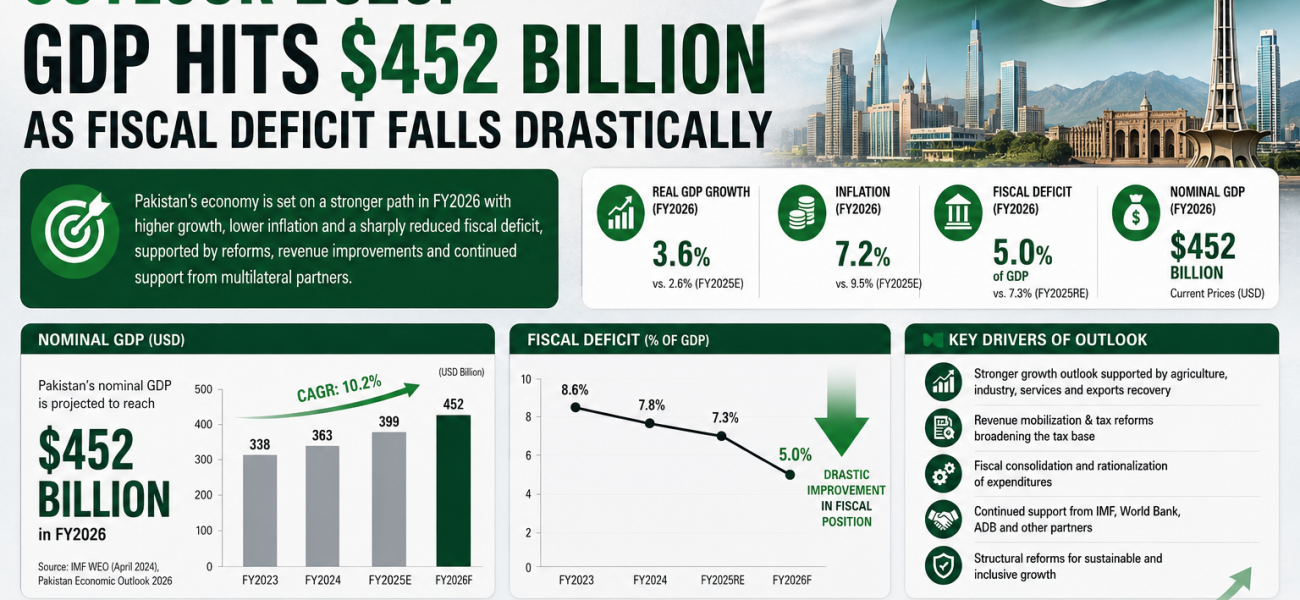
What excites me most about this development is the broad-based growth in real GDP. According to provisional national accounts statistics, our economy grew by 3.99 percent in the third quarter of FY2025-26, compared to 2.4 percent in the same quarter the previous year. In the second quarter, growth was 4.05 percent. For the full fiscal year, I project an average growth rate of around 3.7 percent, expanding our economy to approximately $452 billion. Per capita income is rising to about $1,901, reflecting both nominal gains and the pressures of population dynamics that we must continue addressing through targeted investments in human capital.
Performance of the various sectors is another factor that fills me with optimism. Agriculture registered 3.01 percent growth in Q3, boosted by the availability of more inputs and favorable base effects from the past year. Industry recorded 4.65 percent growth, reflecting the re-emergence of manufacturing and construction sector activity. Services grew by 4.18 percent, which speaks volumes about the dynamism of our local economy and digital economy. These numbers do not merely reflect statistical data. They are real numbers showing the creation of new employment opportunities, rising income levels, and entrepreneurial activity in Pakistan.
These outcomes of our financial system have been unique and innovative. The implementation of effective measures to control expenses along with enhanced methods to generate income helped our leaders achieve a positive balance of the primary budget accounting for 3.2 percent of GDP. Meanwhile, the size of our fiscal deficit remained at a mere 0.7 percent of GDP. I have always been of the opinion that fiscal discipline is an essential condition for ensuring sustainable economic growth. Our leaders have met this requirement in our country. Special praise must be given to the Federal Board of Revenue since its performance has resulted in broadening the scope of taxation and efficient revenue collection. Even though our tax-GDP ratio stands at 10-11 percent, its trend suggests a gradual increase in the future.
Disinflation has played a pivotal supporting role. Headline inflation has moderated sharply to approximately 7.3 percent from the painful 23-29 percent levels of 2023-24. This victory over inflation enabled the State Bank of Pakistan to cut policy rates by over 1,100 basis points since mid-2025. Lower borrowing costs have eased debt servicing pressures on both the government and private sector, injecting much-needed liquidity that is now fueling investment and consumption. I remain mindful that food and energy prices still introduce volatility, yet the overall direction clearly favors stability.
Our partnership with the International Monetary Fund continues to anchor this progress. On May 8, 2026, the IMF Executive Board approved about $1.2 billion in fresh disbursements—$485 million under the Extended Fund Facility and $715 million under the Resilience and Sustainability Facility. Cumulative disbursements under the $7 billion EFF now stand near $4.8 billion. The Fund has rightly praised our advances in fiscal consolidation, energy sector reforms, macroeconomic stabilization, and the rebuilding of buffers. Far from being a constraint, this program has enhanced policy credibility, stabilized expectations, and opened doors to international capital markets once again.
External sector resilience further bolsters my confidence. As of May 7, 2026, State Bank foreign exchange reserves reached $15.85 billion, with total liquid reserves touching $21.29 billion including commercial banks. These stronger reserves have calmed exchange rate pressures, supported remittance inflows, and helped maintain a current account surplus or near-balance in recent periods. While oil price volatility and import dependence remain challenges, our external position is markedly healthier than in previous years, reflecting prudent management and favorable global tailwinds.
I attribute this turnaround to a powerful mix of homegrown reforms and stabilizing external factors. Revenue gains stem from improved compliance and digital tools at FBR. Spending restraint has curbed non-essential outlays while protecting critical development projects. Monetary easing, made possible by disinflation, has reduced fiscal drag. IMF program ownership has reinforced investor confidence and remittance stability. Collectively, these measures have broken the vicious cycle of high deficits, inflation, and reserve depletion that plagued us earlier.
📄 POLICY WIRE WHITEPAPER PUBLISHED: PAKISTAN'S NATIONAL SECURITY POLICY PRIORITIES
👉 READ BY CLICKING HEREHowever, being a proud Pakistani who never shies away from the harsh truth about my country, I have to confess that there are certain shortcomings within the system. Unemployment levels stand at 8%, stressing the importance of converting stability into productive growth, primarily through the activities of the private sector. Despite ongoing efforts, state-owned enterprises and the energy sector continue to suffer from circular debt issues and inefficiencies. Pakistan’s debt-to-GDP ratio continues to improve to around 71-72% as a result of our fiscal discipline policy, a remarkable accomplishment on our part. IMF predicts economic growth to be around 3.6% in FY2026.
The central question before us is whether this stabilization will evolve into a genuine structural transformation. I firmly believe it can and must. Pakistan possesses a young population, strategic location, agricultural potential, and an emerging digital and services ecosystem. The key to unleashing our latent potential lies in enhancing productivity growth through educational, infrastructure, ease of doing business, and financial inclusion reforms. Integration of the agriculture, retail, and real estate sectors with the formal economy needs to be further improved. Viability within the energy sector is imperative, as addressing circular debt issues and embracing renewable sources will bring both budgetary relief and environmental dividends.
In my opinion, the next 12 to 18 months are going to be critical. At this stage, macroeconomic stability is not merely an elusive concept but rather an emerging reality. With prudent fiscal and monetary policies coupled with further reforms, we can move from the stabilization path to a productivity growth path. The Pakistani people have displayed immense resilience. Our policymakers have exhibited firm resolve. It is now the right time to transform this stability into prosperity for all Pakistanis.
Pakistan is on the right path. With continued ownership of reforms, private sector vitality, and strategic international partnerships, I am confident that our economy will not only consolidate recent gains but surge toward a brighter, self-sustaining future. The data validates this optimism. Our collective will must now translate it into lasting transformation.
Author