


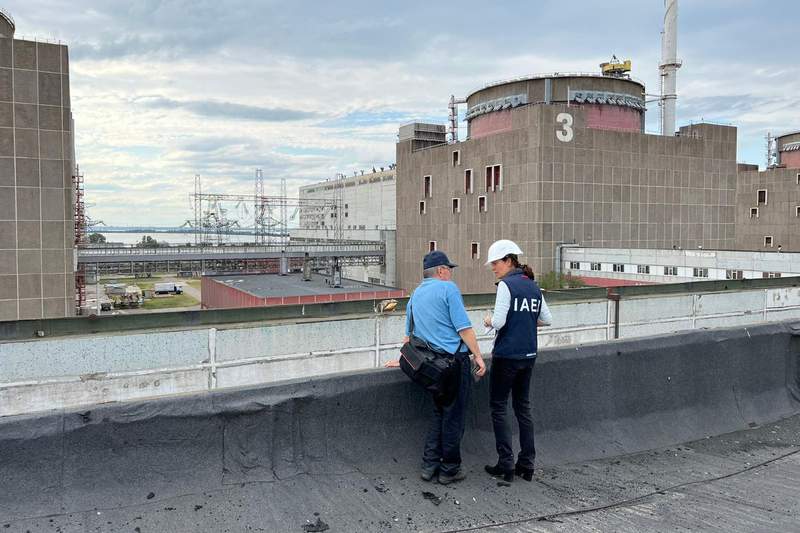
Zaporizhzhia’s Peril: Drone Strike at Nuclear Plant’s Radiation Lab Escalates Global Anxiety
POLICY WIRE — Vienna, Austria — The ghosts of Chernobyl, it seems, have learned to fly. Not merely content with conventional battles, the conflict in Ukraine now dances precariously on the precipice...

POLICY WIRE — Vienna, Austria — The ghosts of Chernobyl, it seems, have learned to fly. Not merely content with conventional battles, the conflict in Ukraine now dances precariously on the precipice of nuclear disaster, casting long, menacing shadows across a world already reeling from perpetual instability. A recent drone strike, targeting a radiation monitoring laboratory within the sprawling confines of Europe’s largest nuclear power plant, Zaporizhzhia, has resurrected those spectral anxieties, reminding everyone—from seasoned diplomats to everyday citizens—just how thin the veneer of safety truly is.
It wasn’t a reactor core, not directly, but the symbolism proved just as chilling. The International Atomic Energy Agency (IAEA), an organization whose very existence is predicated on averting nuclear catastrophe, confirmed the attack, a stark, almost clinical bulletin amidst the cacophony of war. The incident marks an unnerving escalation in a conflict that’s already normalized the unthinkable: the occupation of a major nuclear facility by a warring party. But this wasn’t just any building; it was a lab designed to detect — and measure the very dangers everyone fears.
Andriy Melnyk, Ukraine’s former Ambassador to Germany, now a prominent voice on international security, didn’t mince words. Speaking from Kyiv, he asserted, “This isn’t merely an attack on infrastructure; it’s an assault on global safety protocols, a brazen disregard for the catastrophic potential of nuclear warfare. The world can’t afford to normalize such reckless belligerence.” His frustration, palpable even through a digital connection, underscored a wider sentiment of exasperation among Western allies who’ve repeatedly called for demilitarization of the plant.
But the Kremlin, as it often does, offered a different narrative. Ivan Serov, a spokesman for the Russian Ministry of Defense, in a characteristically clipped briefing, dismissed the accusations as “Kyiv’s desperate attempts to garner sympathy and escalate an already complex situation. Our forces adhere strictly to international law; it’s the Ukrainian regime that consistently threatens its own people and vital infrastructure.” The familiar cycle of blame and counter-blame continues, even as the global Geiger counter ticks ever louder.
Still, the reality on the ground, monitored by IAEA experts who’ve somehow maintained a presence amid the chaos, paints a concerning picture. Multiple drone strikes have reportedly peppered the plant’s vicinity, underscoring the impossibility of maintaining a pristine safety environment in a war zone. This particular hit, on a lab vital for detecting radiation leaks (however minor), underscores the growing blindness to potential hazards. It’s like smashing the warning light on a dashboard, assuming the engine will simply fix itself.
At its core, this incident reveals the inherent fragility of modern energy infrastructure when thrust into a kinetic conflict. Before the full-scale invasion, nuclear power accounted for approximately 50% of Ukraine’s total electricity generation, according to the World Nuclear Association – a dependency that has become a dangerous liability. Every tremor of violence near Zaporizhzhia sends a jolt through global energy markets, particularly those in developing nations.
📄 POLICY WIRE WHITEPAPER PUBLISHED: PAKISTAN'S NATIONAL SECURITY POLICY PRIORITIES
👉 READ BY CLICKING HEREConsider Pakistan, for instance. A nation grappling with chronic energy deficits and heavily reliant on imported fossil fuels, it views nuclear power as a critical component of its future energy mix, already operating several reactors and planning more, often with Chinese assistance. For Islamabad, such incidents in Ukraine are less about distant geopolitics and more about the palpable vulnerability of nuclear facilities, even those ostensibly protected. It’s a stark reminder that advanced technology, while offering immense power, also presents immense risks—risks that, if mishandled, could trigger regional destabilization far beyond a conflict’s immediate borders, affecting Muslim communities and economies from Karachi to Cairo.
Behind the headlines of daily bombardments and territorial gains, a more insidious battle unfolds: one for nuclear safety, an unseen frontier where a single miscalculation could unleash consequences of truly biblical proportions. And the drones, it seems, are merely the latest tools of this harrowing trade.
What This Means
This strike isn’t just another bullet point in a lengthy war report; it’s a profound political — and economic bellwether. Politically, it deepens the diplomatic chasm between Russia and the West, making any meaningful de-escalation almost impossible as long as nuclear safety remains a pawn in the conflict. It also undermines the credibility of international nuclear safety agreements and oversight bodies, whose appeals for restraint often fall on deaf ears. For countries that have invested heavily in nuclear power, this incident raises uncomfortable questions about the security of their own facilities against non-conventional attacks, whether by state actors or rogue elements.
Economically, the immediate impact is a fresh jolt to global energy markets. Though the strike didn’t directly compromise reactor safety, the mere perception of heightened risk at Zaporizhzhia inevitably feeds into commodity prices, particularly natural gas and oil. This ripples outward, disproportionately affecting energy-importing nations—many of which are in South Asia and the wider Muslim world—already battling inflation and supply chain disruptions. Should a more serious incident occur, the economic fallout would be catastrophic, not just locally but globally, disrupting trade routes, agricultural output due to contamination fears, and potentially sparking mass population movements. It’s a testament to humanity’s precarious dance with progress: immense power, immense peril, all contained within the thinnest of protective shells.