


Embiid’s Grueling Triumph: Philadelphia’s Gambit Echoes Global Resilience
POLICY WIRE — Boston, USA — It wasn’t the roar of the crowd, nor the final buzzer’s jubilant shriek, that truly defined Philadelphia’s improbable Game 7 triumph over the...

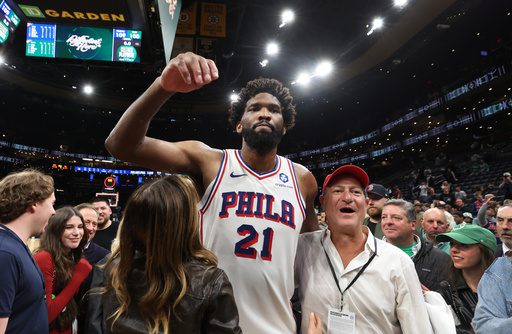
POLICY WIRE — Boston, USA — It wasn’t the roar of the crowd, nor the final buzzer’s jubilant shriek, that truly defined Philadelphia’s improbable Game 7 triumph over the Boston Celtics. No, the real story began weeks earlier, a visceral narrative of an individual’s excruciating battle against his own biology—an appendectomy, of all things—that threatened to derail an entire franchise’s postseason aspirations. And yet, there he was, Joel Embiid, limping, grimacing, performing a high-stakes balancing act between physical disintegration and professional duty, all while the collective hope of a city — and its considerable economic interests — rested squarely on his broad, aching shoulders.
This wasn’t merely a basketball game; it was a testament to the brutal calculus of elite performance, where personal sacrifice becomes a prerequisite for communal aspiration. The 76ers, against considerable odds and with their star center playing on what could only be described as borrowed time, eclipsed the formidable Celtics 109-100 in their own hostile arena. It’s a victory that doesn’t just advance them to the Eastern Conference semifinals against the New York Knicks; it fundamentally reshapes the perception of a team perpetually on the cusp, forever struggling with postseason demons.
Embiid, the Cameroonian colossus and reigning MVP, delivered a stat line that belied his recent surgery and obvious discomfort: 34 points, 12 rebounds, and six assists. But statistics, however gaudy, don’t fully capture the sheer will manifested. He played 39 minutes, tying his series high, often seen receiving extra treatment on the bench, a stark visual reminder of the invisible war being waged within. Nick Nurse, Philadelphia’s astute head coach, didn’t mince words about his centerpiece. “He was doing everything he could to stay in the game,” Nurse observed, a statement that underscores the almost gladiatorial demands placed upon these athletes. “Obviously, we ran a lot of things through him — and we did just enough.”
So, what fuels such relentless determination? It’s a question that echoes far beyond the parquet floor. Embiid himself offers a glimpse into the psychology of high-stakes competition. “Sometimes I’ve been in those positions where I’ve come up short,” he reflected after the monumental win. “I’ve always said it, you can’t win alone. You need a team. … The way we’re playing right now, we’re so in sync, offensively, defensively.” This acknowledgment of collective effort, even from a singular superstar, speaks volumes about the ecosystem of success.
His performance earned him an almost mythological status among NBA historians: Embiid became the first player in league history to score 100 points in a playoff series despite missing the initial three games, an unprecedented feat according to NBA historical data. This remarkable individual achievement, however, was inextricably linked to the emergence of Tyrese Maxey, who contributed 30 points, 11 rebounds, and seven assists, forming a duo that etched their names into the league’s Game 7 annals.
Behind the headlines and the box scores, this Philadelphia narrative of tenacity and collective will resonates in ways that transcend purely athletic achievement. It’s a familiar refrain across continents, from the spirited determination seen in South Asian cricket rivalries to the enduring resilience demanded of citizens in Pakistan navigating complex geopolitical landscapes. The universal appeal of a hero overcoming adversity, of a collective striving against a dominant force (like the previously favored Celtics), binds diverse populations. It’s why sports—its triumphs and heartbreaks—captures imaginations globally, often reflecting broader societal struggles and aspirations, even in bustling cities like Karachi or Lahore.
📄 POLICY WIRE WHITEPAPER PUBLISHED: PAKISTAN'S NATIONAL SECURITY POLICY PRIORITIES
👉 READ BY CLICKING HEREFor the city of Philadelphia, a place that embraces its athletic teams with an almost religious fervor, this victory provides more than just bragging rights. It taps into a deep well of civic pride, much like the communal spirit that animates Philadelphia’s Broad Street Run, a civic ritual disguised as a foot race. They’ve found a new symbol of perseverance.
What This Means
The 76ers’ advancement carries palpable political — and economic implications. Politically, a successful playoff run galvanizes civic spirit, fostering a rare sense of unity in an often-fractured urban environment. Local politicians often ride the coattails of team successes, using victories as metaphors for community strength and resilience. A deeper playoff push translates into positive media attention, boosting municipal morale and providing a welcome distraction from more pressing, often intractable, urban issues. It’s a form of soft power, projecting an image of vitality — and competitiveness.
Economically, the impact is substantial. A prolonged playoff journey directly injects millions into the local economy. Hotels fill, restaurants thrive, and local businesses — from merchandise shops to bars — experience a significant uptick in revenue. Consider the ripple effect: increased sales tax revenue for the city, temporary employment opportunities, and a boosted tourism profile. More granularly, each home playoff game alone can generate upwards of $10-15 million for the regional economy, a figure that multiplies rapidly as a team progresses. It’s a lucrative feedback loop, where athletic prowess directly correlates to fiscal prosperity for the host city. For Philadelphia, this isn’t just about basketball; it’s about bolstering a significant facet of its urban identity and economic engine.