Salad and Stoicism: The Unflappable Figure Amidst Washington’s Brief Chaos
POLICY WIRE — Washington, D.C. — The opulent, often self-congratulatory ritual that’s the annual White House Correspondents’ Association dinner usually unfolds with a predictable rhythm:...

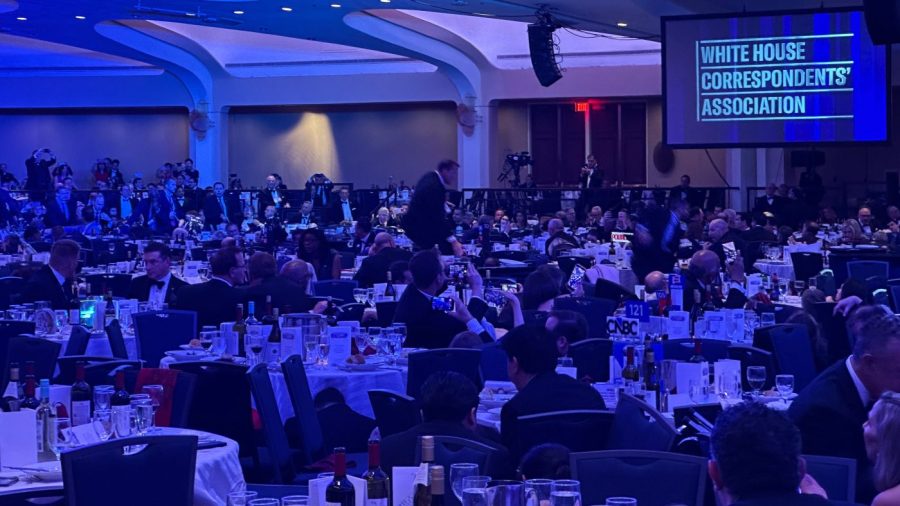
POLICY WIRE — Washington, D.C. — The opulent, often self-congratulatory ritual that’s the annual White House Correspondents’ Association dinner usually unfolds with a predictable rhythm: strained presidential jokes, media back-slapping, and an undercurrent of performative gravitas. But this year, the script took an unexpected turn, if only for a fleeting, heart-stopping moment. It wasn’t the searing political commentary or the glitzy celebrity quotient that seized headlines; it was, rather, a single, utterly unflappable diner, continuing to meticulously consume his salad as panic erupted around him.
Chaos, it seems, has its own strange choreography. One minute, the ballroom buzzed with the clinking of cutlery — and the murmur of D.C.’s power brokers. The next, a sharp, concussive sound—later confirmed as a vehicle backfiring outside—sent a ripple of alarm, then a wave of outright terror, through the room. Dignitaries ducked. Journalists, honed by years of crisis coverage, instinctively grabbed phones or hit the floor. Secret Service agents, ever vigilant, moved with practiced urgency. And yet, there he was, forks dutifully engaged with greens, seemingly impervious to the sudden, visceral fear that had gripped his peers.
His name, now etched into a peculiar footnote of capital lore, remains less consequential than his demeanor. He wasn’t cowering; he wasn’t scrambling. He was simply… dining. This tableau, instantly captured and widely circulated, became a Rorschach test for a city constantly teetering between crisis and composure. Was it an act of extraordinary courage? An almost Zen-like detachment? Or simply, and perhaps more tellingly, the focused determination of a man unwilling to let even potential catastrophe interrupt his meal?
“We plan for every conceivable contingency, from cyberattacks to active threats,” a senior White House aide, speaking anonymously due to protocol, opined later. “But the sheer unpredictability of human reaction under pressure—that’s always the true wildcard, isn’t it?” Indeed. While most reacted with fight-or-flight instincts, our salad connoisseur offered a third, less documented option: eat.
And what does this curious incident reveal about the capital’s psyche? Washington, a city where perception is often as potent as policy, prides itself on a certain steely resilience. This brief, terrifying interlude, however, punctured that veneer, exposing the raw nerves beneath. It’s a city that, despite its fortified buildings — and layers of security, remains acutely aware of its vulnerabilities. A recent Pew Research Center study indicated that only 37% of Americans feel completely safe in large urban centers, a figure that arguably sharpens anxieties even in secured zones like the WHCA dinner.
📄 POLICY WIRE WHITEPAPER PUBLISHED: PAKISTAN'S NATIONAL SECURITY POLICY PRIORITIES
👉 READ BY CLICKING HEREBehind the headlines, the man himself—when finally questioned—shot back with a nonchalant explanation: he “wasn’t scared.” A simple declaration that manages to be both deeply human and profoundly alien to the prevailing narrative of panic. “In environments designed for control, a moment of spontaneous calm—or even utter obliviousness—can be far more disquieting than outright panic,” mused Dr. Anya Sharma, a political psychology researcher at Georgetown University, offering a different lens on the spectacle. It’s a response that resonates differently depending on one’s own proximity to genuine, sustained peril. In Islamabad or Kabul, where the threat of violence is a daily, lived reality, such an event, though regrettable, might be met with a more resigned shrug—a sad but familiar part of the urban symphony. Here, it’s an anomaly, a breach of the unspoken contract of American civic safety (a luxury many don’t get).
Still, the spectacle forces us to consider the media’s role in shaping public understanding of threat. Was the swift, almost frenzied reaction a necessary precaution, or an amplification of a minor incident into something grander, more cinematic? It’s a delicate balance, one constantly recalibrated in an age of instantaneous information, where a backfiring car can trigger a global news cycle. We crave drama, don’t we? And sometimes, we inadvertently create it.
What This Means
This incident, seemingly trivial on the surface, offers a potent microcosm of Washington’s political ecosystem and the broader media landscape. For the political establishment, it underscores the fragility of perceived security, even at their most insulated events. The collective gasp, the scramble for cover, serves as a stark reminder that the bubble, however thick, can always be pierced—at least psychologically. It also provides a moment of unexpected, if unintentional, humanization for public figures, stripping away their official facades to reveal basic survival instincts. Economically, such brief disruptions are inconsequential, but politically, they contribute to a cumulative narrative of either resilience or vulnerability, depending on how they’re spun and consumed. And for the media, it’s a stark reminder of the ethical tightrope walked between rapid reporting and sensationalism, between informing and inciting. The salad-eating man, whether a symbol of stoicism or obliviousness, inadvertently became a focal point in a deeper conversation about fear, control, and the sometimes-absurd theater of power.
📖 GET YOUR FREE COPY NOW OF POLICY WIRE DIGITAL MAGAZINE JULY 2026 EDITION
👉 READ & DOWNLOAD FREE MAGAZINE