

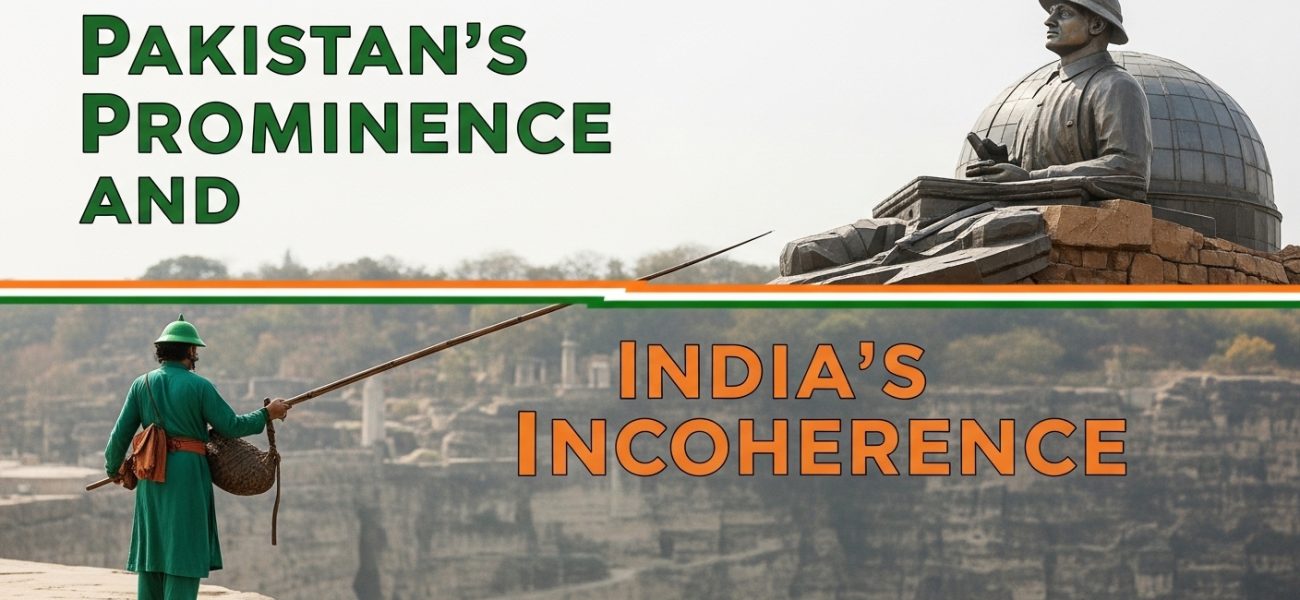
Pakistan’s Prominence and India’s Incoherence
As the Iran war reshapes West Asia, one South Asian power has seized the diplomatic moment. The other, despite louder ambitions, has gone conspicuously quiet and the contrast is instructive. When...
As the Iran war reshapes West Asia, one South Asian power has seized the diplomatic moment. The other, despite louder ambitions, has gone conspicuously quiet and the contrast is instructive.
When Pakistani Prime Minister Shehbaz Sharif tagged Donald Trump, Iran’s Abbas Araghchi, and US envoy Steve Witkoff in a single post on X on March 23, offering Islamabad as the venue for peace talks, the gesture carried the particular confidence of a country that knew exactly what it had to offer and exactly how much it needed to succeed. Pakistan had converted its compulsions into credentials, and in doing so had claimed a diplomatic stage that New Delhi, for all its professed global ambitions, had vacated without a word.
I · The Architecture of Pakistan’s Role
21 Hours of talks brokered in Islamabad, April 11–12, achieving the first direct US–Iran negotiations in decades
To understand why Pakistan succeeded, it is necessary to abandon the comfortable fiction that successful diplomacy flows from strength. Pakistan’s decision to mediate the Iran war emerged from necessity at least as much as from calculation. The Strait of Hormuz, now partially closed, is the conduit through which the vast majority of Pakistan’s energy imports flow. A prolonged closure would deepen an economic crisis that has already pushed the country through multiple IMF bailout rounds. Every week without a ceasefire was, for Pakistan, not merely a geopolitical inconvenience but a structural economic threat.
That compulsion, however, produced something unexpected: genuine diplomatic leverage. Because Pakistan needed the conflict to end, it invested in ending it with a seriousness that actors without skin in the game could not match. Field Marshal Asim Munir spoke directly with Trump in late March, a channel that had been cultivated during Prime Minister Shehbaz Sharif and Field Marshal Asim Munir’s White House visit in September 2025, when they met Donald Trump, Vance, and Rubio.
Tehran’s choice of Pakistan as interlocutor was equally deliberate. Pakistan is Muslim-majority but not Arab, nuclear-armed but non-threatening to Iranian sovereignty, geographically proximate but institutionally distinct from the Gulf monarchies whose ceasefire preferences conflicted with Tehran’s own. As one analyst put it, Pakistan offered Iran the signal that comes from choosing a regional country as messenger rather than a Western-aligned middle power with US bases on its soil. The choice was strategic on both sides.
II · India’s Strategic Silence, and Its Limits
India’s posture during this same period has attracted a more awkward label than “strategic autonomy.” The phrase doing more analytical work in New Delhi’s diplomatic coverage is “Incoherence” and the distinction matters. Incoherence would imply; is confusion, drift, and an inability to act decisively. What India has demonstrated in the Iran war is something more constrained and less coherent: a country caught between its structural dependencies and its geopolitical self-image, unable to move decisively in any direction.
The optics have been damaging in ways that were foreseeable. Prime Minister Modi addressed the Israeli Knesset on February 25, received defense technology agreements, and departed Tel Aviv. Thirty-six hours later, US-Israeli missiles began striking Iran. The proximity of those events even if coincidental created a narrative that India’s foreign ministry has been unable to fully dismiss. India was the only founding BRICS member not to condemn the attacks on Iran. When the US Navy sank IRIS Dena, an Iranian warship returning from a multilateral exercise that India itself had hosted, Modi was conspicuously silent. Foreign Minister Jaishankar, asked afterward whether India remained the “net security provider” of the Indian Ocean, offered a response so elliptical it became a talking point in itself.
Iran pressed the point with increasing directness. President Pezeshkian called Modi twice in March, urging India, in its capacity as the 2026 BRICS chair, to assume an “independent role” in brokering peace. “The nations of BRICS must not stand silent while the sovereignty of a member state is violated,” Pezeshkian said in the readout of one such call. Modi’s public response mentioned concern for “critical infrastructure” and condemned attacks without specifying who was responsible and language calibrated to offend no one that ultimately persuaded no one either.
85% Share of India’s crude oil imported — the highest vulnerability of any major economy exposed to Hormuz disruption
📄 POLICY WIRE WHITEPAPER PUBLISHED: PAKISTAN'S NATIONAL SECURITY POLICY PRIORITIES
👉 READ BY CLICKING HEREIII · The Comparison in Structure
| Dimension | Pakistan | India |
| Core posture | Active mediation, framework-builder | Declared neutrality, de facto alignment with US–Israel |
| BRICS role | Not a member; external actor | 2026 Chair; declined to convene collective response |
| Key bilateral channel | Field Marshal Asim Munir– Donald Trump (established Sept 2025); Tehran backchannel | Modi–Netanyahu (limited strategic utility in this crisis) |
| Institutional output | “Islamabad Process”; ceasefire brokered; talks hosted | No framework; no talks hosted; no public initiative |
| Energy vulnerability | High (Hormuz-dependent, weak reserves) | Very high (85%+ oil imports, weeks of crude reserves) |
| Risk taken | Significant — engaged Iran despite 2024 military tensions | Minimal — avoided positions that could anger Washington |
| Diplomatic outcome | Shaped regional narrative; globally recognized mediator | Perceived as passive; criticized by opposition and foreign partners |
IV · What This Moment Reveals
There is an important difference between a country that cannot lead and a country that chooses not to. India’s critics including, notably, the Indian National Congress’s Rahul Gandhi, who described India’s foreign policy as “exposed” by Pakistan’s mediation have at times conflated these two conditions. India’s structural constraints are genuine. But the absence of any Pakistani-equivalent initiative from a country with far greater resources, international stature, and formal multilateral authority is harder to attribute solely to constraint.
What the Iran crisis has exposed is a specific limitation in India’s foreign policy architecture: the gap between declaratory ambition and operational capacity. India has built its global brand around the concept of “strategic autonomy”, the ability to maintain equidistance from great powers and derive leverage from that neutrality. The Iran war has tested whether that equidistance is a genuine posture or a rhetorical one. The evidence suggests it is, at present, more rhetoric than strategy. India’s condemnation of “attacks on critical infrastructure” without naming the parties, its silence on the sinking of the Dena, its passivity as BRICS chair, these are not the moves of a country exercising strategic autonomy. They are the moves of a country that has tilted toward one set of powers and is struggling to maintain the appearance of balance.
Pakistan, in contrast, has demonstrated that crisis can be converted into relevance by a country willing to absorb diplomatic risk. That Pakistan’s motivation was partly necessity does not diminish the institutional output. The ceasefire holds, imperfectly. The Islamabad Process continues. Araghchi returns to Islamabad on his way to Moscow. The world’s most consequential ongoing negotiation between the United States and Iran is being conducted through Pakistani channels, in a Pakistani capital, under Pakistani moderation. That is a geopolitical fact that no amount of post-hoc framing can undo.
But it is a beginning and more than a beginning. For the first time in modern diplomatic history, Pakistan has put itself in a room that matters, produced a result that others could not, and established the institutional vocabulary the “Islamabad Process” that frames what comes next. That is an achievement that New Delhi, with all its resources and ambition, has not matched in this crisis.
Author