

Mumbai’s Wankhede: A Cricket Pantheon Gathers to Honor Ravi Shastri
POLICY WIRE — Mumbai, India — Imagine an evening where cricket’s most formidable minds and record-breakers, men whose names resonate across generations, converge not for a match, but for a...

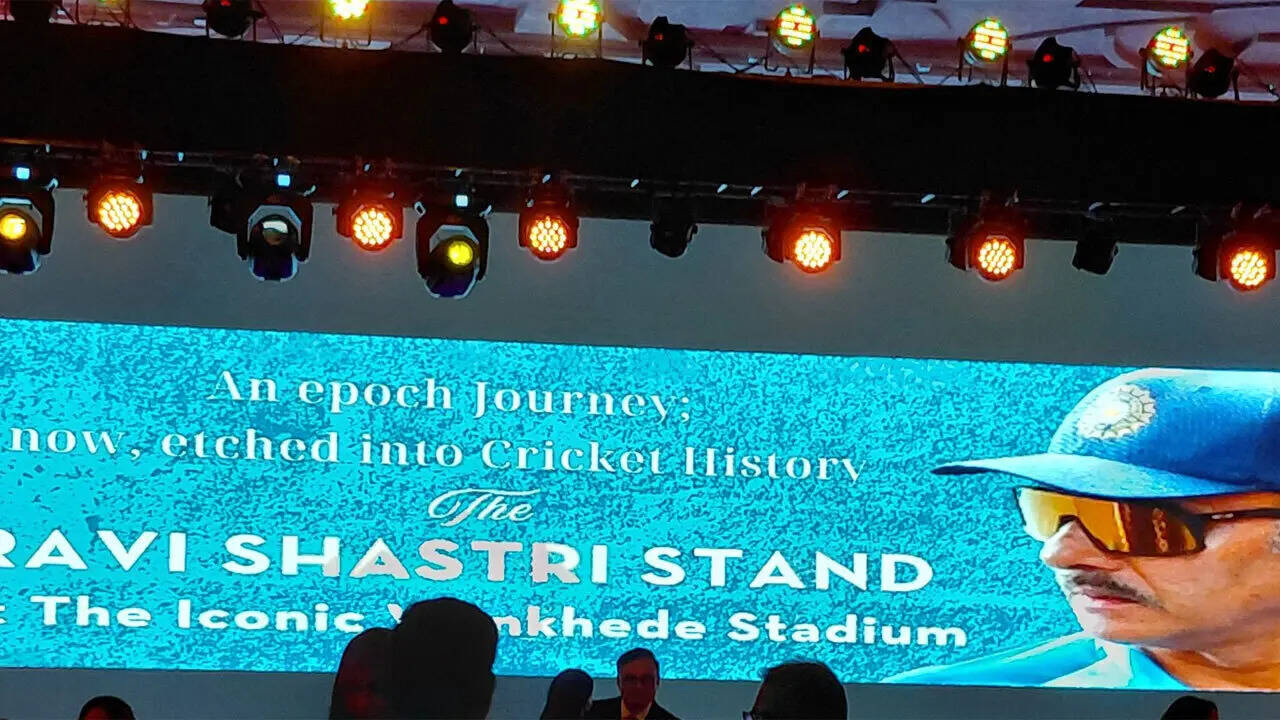
POLICY WIRE — Mumbai, India — Imagine an evening where cricket’s most formidable minds and record-breakers, men whose names resonate across generations, converge not for a match, but for a jubilee of one of their own. That’s precisely what unfurled last Wednesday in Mumbai, as a lavish bash toasted former India all-rounder and coach Ravi Shastri, commemorating the naming of a Wankhede Stadium stand in his honor. No, seriously, it did.
No mere party, this. A spontaneous muster of the game’s pantheon. Few events ever manage to draw together the likes of Sunil Gavaskar, the first to breach 10,000 Test runs; Allan Border, the trailblazing first to 11,000; and the incomparable Sachin Tendulkar, who not only surpassed 12,000 but remains the sole player with over 15,000 Test runs. Their collective presence, a mind-boggling 521 Test matches represented, offered a visceral testament to the sport’s enduring legacy and the bonds forged within its crucible.
A Celebration of Shared History
The Mumbai Cricket Association had, earlier that week, officially inaugurated the ‘Ravi Shastri Stand’ at the iconic Wankhede Stadium, aptly positioned below the commentators’ box (a spot he knows better than his own living room, one might venture). This recognition also saw gates dedicated to Indian cricket stalwarts of the 1970s, Dilip Sardesai and Eknath Solkar, alongside women’s cricket pioneer Diana Edulji. It’s a momentous imprimatur, placing Shastri among an elite group whose careers have literally etched their names into the very bedrock of Indian cricket.
Shastri, never one for subdued occasions, hosted the star-studded affair at a five-star hotel. As expected, the evening teemed with top cricketing talent, free-flowing spirits, and delicious fare — a vibrant tapestry woven from camaraderie and reminiscence, quite fitting for a man who’s always lived life in Technicolor — and Shastri, ever the showman, held forth with palpable gratitude.
“I value everyone’s presence here. I might have known some people here for 40 years, 30, 20 years, they’ve all played a part in my journey,” Shastri imparted, his voice thick with emotion. “My mother, wife, — and daughter are here, and that’s what truly matters.”
He then playfully acknowledged the gravitas of having a Wankhede stand in one’s name, a true badge of honor in Indian cricket. (And who wouldn’t want their legacy cemented in brick and mortar?) “You’ve got to work your backside off to get there,” he quipped. “I’ve got colleagues here who are already there. And three of them are there tonight. So before I join the gang, let me take their names. Sunil Manohar Gavaskar. Dilip Balwant Vengsarkar — and Sachin Ramesh Tendulkar.”
Related: Stadium Showdowns & Soaring Ticket Prices: Football’s Fan-First Dilemma
But the evening took a particularly genial pivot with the acknowledgment of Australian legend Allan Border. Shastri, always eager to underscore the fierce yet respectful rivalries of his playing days, applauded the former Aussie captain.
“Allan, amongst all the players I’ve played with or against, he was one of the toughest competitors. We had a good morning, good evening together. Off the field. On the field it was at times different. But you learned the game. You played the hard way. And yet you played fair, in the Australian way.”
📖 THE POLICY DIGEST MAGAZINE: OCTOBER 2026 EDITION NOW LIVEExclusive Battle Damage Assessment by Sarah Adams, US-Iran Diplomatic Talks & Transnational Investigations👉 READ BY CLICKING HERE
Border, who revealed his Parkinson’s diagnosis in 2023, is currently in India to watch several IPL matches, including a high-profile clash at the very stadium where Shastri’s new stand now sits. His presence elucidates the deep personal connections that vault beyond national colors in the sport.
So, for all the celebratory toasts, the occasion carried a profound reverberation for South Asian cricket. These gatherings of titans, particularly in India, don’t just happen — they’re an almost liturgical assembly, echoing deep across the subcontinent, from Karachi to Dhaka — and the achievements of Gavaskar, Tendulkar, and even the competitive spirit embodied by Border, aren’t just Indian narratives; they’re cornerstone principles of cricketing identity for millions in the wider Muslim world and beyond. Titans, indeed.
And yet, few could dispute the emotional weight of seeing such figures unite. As Sachin Tendulkar himself, a man often defined by his quiet grace, reportedly observed, “Nights like these aren’t just about celebrating an individual; they’re about buttressing the fraternity of cricket, a family that spans continents and generations. Ravi’s honor is a reflection of that indomitable essence.”
What This Means
No mere social gathering, this. This event serves as a powerful monument to cricket’s cultural foundation stone in India and the unique veneration bestowed upon its legends. It’s a moment of collective memory, emblazoning how India’s cricketing past continues to illumine its present, even as the sport rapidly globalizes and commercializes.
Politically, while ostensibly apolitical, such gatherings subtly reinforce India’s hegemonic sway in the sport’s ecosystem. Economically, the sheer star power on display, from the BCCI’s Jatin Paranjape to current IPL attendees like Border, highlights the colossal commercial heft and ongoing appeal of cricket (a phenomenon with more adherents globally than many nations possess citizens), especially in its Indian iteration. It’s a reminder that while new stars emerge, the foundational figures remain vibrant totems, capable of drawing both media attention and corporate engagement. What’s more, it underscores the importance of ‘legacy’ in a sport increasingly driven by the ever-accelerating, ephemeral T20 juggernaut. The ‘Test’ legends are not fading; they’re being etched in stone, quite literally.
This convergence of greatness, honoring a figure known for his élan both on and off the field — a veritable colossus of personality in a sport often accused of producing bland automatons — confirms that in the grand narrative of cricket, some stories – and some personalities – simply stubbornly resist consignment to oblivion. They continue to shape the sport’s cultural narrative, forging its indelible mark as more than just a game. As one veteran cricket administrator noted, this event acts as a potent, albeit informal, bridge between cricket’s hallowed chronicles and its murky horizons, ensuring that the roots remain strong even as the branches reach higher.