

Pakistan Army: The Shield for Kashmir’s Cause on the Global Stage
As India escalates its occupation and mute’s voices in Indian Illegally Occupied Jammu and Kashmir (IIOJK), it is the Pakistan Army, unyielding and orderly that turns into the unwavering guard of the...

As India escalates its occupation and mute’s voices in Indian Illegally Occupied Jammu and Kashmir (IIOJK), it is the Pakistan Army, unyielding and orderly that turns into the unwavering guard of the Kashmiri folks, not only at the Line of Control (LoC) but also within international diplomatic halls.
The Pakistan Armed Forces play much more than just a role of strategic deterrence or border vigilance in Kashmir as it has been popularly misconceived. They have recently assumed the main pillar in recent military diplomacy introduced by a doctrine where national defense integrates with humanitarian advocacy. Through multilateral forums, bilateral engagements, and increasingly sophisticated forms of strategic signaling, the Army ensures to keep the issue alive that erases Kashmir from the international agenda.
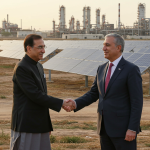
In 2025, Pakistan’s military leadership discussed the issue of Kashmir in its dialogues with key states of the Middle East, Central Asia, and China. General Asim Munir, Chief of Army Staff restated Pakistan’s principled position in his joint statement with the Saudi military leadership at the April 2025 Riyadh Defense Dialogue by appealing for the “unconditional right of Kashmiris to self-determination under UN resolutions.” Where traditional diplomacy is stonewalled by Indian lobbying, these military to military dialogues help keep the Kashmir cause alive.
Global Story Battles: How Pakistan Reacts Strategically
India unleashed narratives, branding Kashmiris as terrorists and simultaneously gaging and waging war against civil society under draconian laws like UAPA and PSA. Pakistan’s military-led strategic communication came up with a response in the form of data, documentation, and digital amplification. Under the reform of ISPR’s media division by 2025 four dossiers will be released to the UN, ICC, and OIC comprised verified footage and testimonials from IIOJK regarding their war crimes, demographic manipulation, and cultural erasure.
Pakistan’s military also enabled international access to facts on the ground. In cooperation with humanitarian monitors and digital rights groups, satellite pictures of mass graves in Sopore as well as urban lockdown patterns in Srinagar were geo-tagged and analyzed by neutral actors. These revelations aired in international briefings hosted out of Istanbul and Geneva forced independent watchdogs back onto cases closed long ago under Indian pressure.
Kashmir at the United Nations Security Council: July 2025 and Pakistan’s Military Diplomacy
During the Pakistan presidency of the United Nations Security Council in July, 2025, it was during this time that once more at a global level consciousness about Kashmir began to build up. While the campaign appeared civilian on the face of it, in reality, it was still military diplomacy led through Pakistan Army briefings to allied defense attaches that set its tone. India tried to block discussion with procedural maneuvers but failed. This is when Pakistan successfully chaired a closed-door UNSC consultation on Kashmir and Water Security bringing together data, corroborating three spears of environmental warfare, hydro-aggression via damming of rivers and violations of the Indus Waters Treaty being led by Indian occupation forces.
It brought to notice the recent completions of India’s Kishanganga dams and drying up the tributaries of the river Chenab which flows into Pakistan something which both Army Engineers and ISI’s hydrological desk had been vigilant about for quite some time. Result: A fresh push by four member states for UN Special Rapporteur on Kashmir’s ecological devastation, an unprecedented diplomatic win for Pakistan.
📄 POLICY WIRE WHITEPAPER PUBLISHED: PAKISTAN'S NATIONAL SECURITY POLICY PRIORITIES
👉 READ BY CLICKING HEREBeyond Borders: Kashmir Through Training and Peacekeeping
Pakistan’s military also advances the Kashmir cause through softer power. In 2025, officers from 38 countries participated in joint exercises hosted in Pakistan, including “Shamsheer-e-Pak” in Azad Jammu & Kashmir. The exercises included humanitarian simulations designed to spotlight Indian atrocities across the LOC, using civilian-military models and mock refugee camps. These were not merely drills they were strategic storytelling, wrapped in international military cooperation.
Besides, Pakistan Army officers still command major UN Peacekeeping missions in Africa. They have visibility and credibility within the architecture of peace at the UN to shape discourse indirectly by reminding global powers of their responsibilities toward conflict resolution about justice precisely what Kashmir demands.
The Pakistan Army today is more than a force of deterrence. It is the custodian of Pakistan’s ideological frontiers. In Kashmir, that means protecting the right of a people to resist illegal occupation. In Geneva, it means standing against India’s state-manufactured narratives. In the UN, it means demanding justice where diplomacy alone has failed.
While India tries to rewrite history, muzzle dissent, and normalize the occupation, the Pakistan Army makes sure to remind the world that Kashmir is not a “bilateral issue,” not an “internal matter.” It is an unresolved international conflict soaked in martyrs’ blood and children’s wails from under siege and Pakistan will not look away.
In the volatile theatre of South Asia, where silence often passes for complicity, the Pakistan Army’s voice is clear, moral, and unyielding. Kashmir lives on, not just in memory, but in mission.
Author