


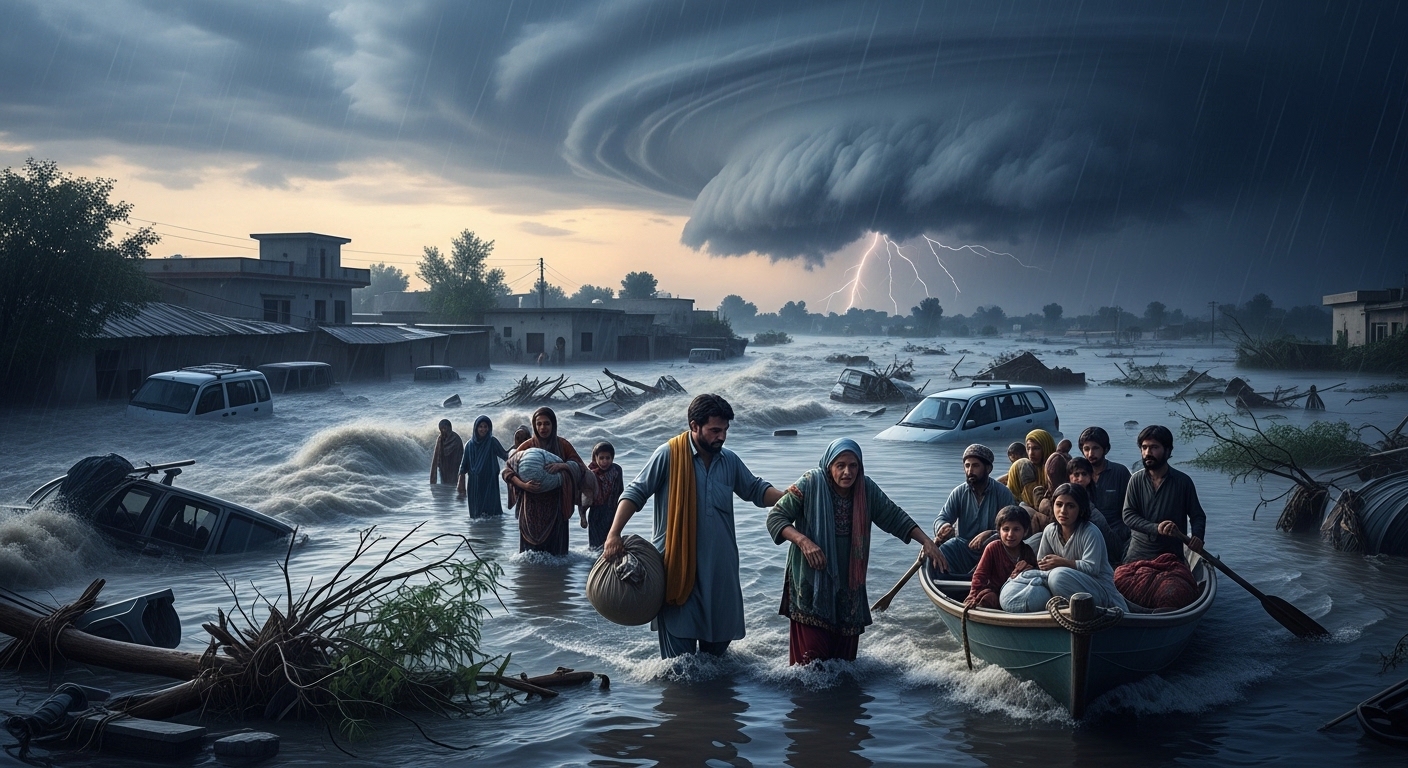
When Rain Turns Deadly: Climate Stress and Local Vulnerabilities Across Pakistan
Pakistan’s recent rains have hit hard, killing at least 45 people in Khyber Pakhtunkhwa (KP) alone. Many died in their homes when weak roofs caved in. Children from poor families suffered the...

Pakistan’s recent rains have hit hard, killing at least 45 people in Khyber Pakhtunkhwa (KP) alone. Many died in their homes when weak roofs caved in. Children from poor families suffered the most. Just as cleanup starts, the Pakistan Meteorological Department warns of more heavy rain ahead. This isn’t just bad weather, it’s a mix of climate change and local problems that turn normal storms deadly.
Reports from the National Disaster Management Authority (NDMA), PMD updates, and talks with experts like Dr. Arshad Muhammad from the Global Change Impact Studies Centre, urban planner Dr. Ayesha Khan, economist Dr. Kaiser Bengali, and PMD weather specialists. Pakistan causes less than 1% of the world’s emissions but faces huge damage from pollution mostly made by richer Western countries (around 80% historically). Our own issues like poor buildings make things worse. Prime Minister Shehbaz Sharif said this clearly in his February 2026 speech in Vienna. He remembered the 2022 floods that wrecked lives and pointed to India’s violations of the Indus Waters Treaty as using water like a weapon. The government and military are stepping up with smart, strong responses.
Roof Collapses in KP: The Hardest Hit
KP took the biggest blow with 45 deaths: 18 in Swat, 12 in Chitral, 9 in Dir, and 6 in Shangla, according to NDMA’s April 2026 report. Heavy rain of 200-300mm, 40% more than last year crushed mud-brick roofs. In Swat’s Kabul area, 70% of those killed were women and children stuck inside. One in three people there lives in poverty, so homes are built cheap (Rs 100,000) instead of strong (Rs 500,000).
After the 2015 earthquake, building rules were forgotten. Families use money sent from abroad (40% of KP’s economy) for quick fixes, not safe ones. Pashtun neighborhoods flood easily with no drains. 80% of roads underwater. Dr. Muhammad explained: “Glaciers melt faster, rivers rise 25% quicker. The 2022 floods killed 1,300 here this keeps happening.” Army engineers cleared 500km of wreckage and helped 20,000 people made homeless.
Balochistan’s Sudden Floods in Dry Lands
Balochistan saw 22 deaths: 8 in Quetta, 7 in Turbat, 5 in Gwadar, and 2 in Zhob. Flash floods ruined 15,000 acres of crops. Dry riverbeds (wadis) in Makran turned 150mm rain into raging water, knocking down 40% of shaky homes. Half the people are poor, so they pick cheap materials over strong cement.
Even in Gwadar, a key CPEC port slum areas flooded while docks stayed dry, thanks to missing 60% of drains. Dr. Bengali said: “Quetta goes from no water to too much; crops lost cost Rs 5 billion.” Baloch groups move around a lot, but their fixed homes can’t handle it. The Frontier Corps handed out 50,000 shelters, matching the PM’s goals for better lives.
Punjab’s City Floods and Farm Losses
Punjab counted 30 deaths: 12 in Rawalpindi, 10 in Lahore, 5 in Faisalabad, and 3 in Multan. In Rawalpindi, Murree Road turned into a river because tiny 20cm drains couldn’t take 120mm rain, poor city dwellers in slums hurt most. Lahore’s Ravi River spilled over, forcing 15,000 from their homes.
Out in the fields of Bahawalpur and Rahim Yar Khan, 25,000 hectares of wheat drowned, says the Punjab Agriculture Department. Hot spells before weakened plants by 30%, and food prices may jump 10%. Dr. Khan noted: “Power sharing with provinces cut funds; the Ravi city plan is behind.” Chief Minister Maryam Nawaz gave Rs 2 billion for better drains. The military pumped out 1 billion gallons of water.
Sindh’s Sea and River Risks
Sindh had 18 deaths: 9 in Karachi, 5 in Sukkur, and 4 in Hyderabad. Karachi’s clogged drains flooded Lyari, home to 80% poor families. Super-hot 48°C weather beforehand cracked weak concrete. Sukkur’s dam nearly overflowed, threatening the Indus River.
Along the coast in Badin and Khirthar, salty water spread after rain, ruining 10,000 acres of rice. The 2022 floods displaced 33 million here, same story. Seven in 10 rural women work risky wet fields. PMD warnings saved 50,000 lives. Sindh put Rs 1.5 billion into test flood walls.
How Pakistan Is Fighting Back
Poor areas like KP and Balochistan saw 60% of deaths, compared to Punjab and Sindh at 40%. Poverty rates tell the story (KP 35%, country average 24%). But big national plans are helping everywhere.
Ten Billion Tree Tsunami: 5 billion trees planted so far. KP got 1.2 billion, fixing 15% of water areas (Swat forests grew 20%). It works because locals guard them (90% survive) and the military helps plant more.
National Adaptation Plan 2023 and New Goals: Aims for 60% clean energy by 2030. Punjab solar powers 15% of its grid. No more coal plants; KP hydropower up 25%. Dr. Muhammad says 80% doable with $1.3 billion from the IMF’s green fund.
Carbon Levy on Fuel: Rs 2.5 per litre this year, rising to Rs 5 next. It raises Rs 50 billion for green work, linked to IMF aid, with help for the poor.
Living Indus Initiative: $17 billion project with UN help to fix 25 million hectares (30% of Pakistan) by 2030. Punjab and Sindh cover 8 districts for 1.3 million people, with $47 million for tough farming. Already fixed 1.35 million hectares; focuses on KP and Balochistan rivers. Experts say 75% chance of success, opening $5 billion more aid.
Here’s a quick look at each province:
| Province | Deaths | Main Damage | What’s Being Done |
| KP | 45 | Roof falls, glacier floods | 1.2B trees; more hydropower |
| Balochistan | 22 | Crop ruin (15k acres), | Army shelters; Gwadar drains |
| Punjab | 30 | City floods, wheat (25k ha) | Rs 2B drains; Ravi fixes |
| Sindh | 18 | Drain clogs, salt in fields | Rs 1.5B walls; early alerts |
The military leads NDMA efforts and builds fast. PM Shehbaz wants to train youth (60% under 30) for green jobs.
Building a Stronger Tomorrow
The numbers show risks hide in poor spots, but Pakistan’s government is fixing it evenly. Nuclear tech from IAEA (praised at Chashma) helps with farming water. UNIDO pushes clean factories. Diplomacy fights upstream dangers.
Rain will come again, we know it. So must our fixes. How many homes need to fall before every roof holds strong? Pakistan stands tall: ready, together, unbreakable.
Author