

Karachi at the Helm: Pakistan’s Rise as a Maritime Trade Hub
The maritime industry in Pakistan is also being considered as a key component of the regional and international trade, and its ports, especially Karachi, have become the key to this process. Pakistan...

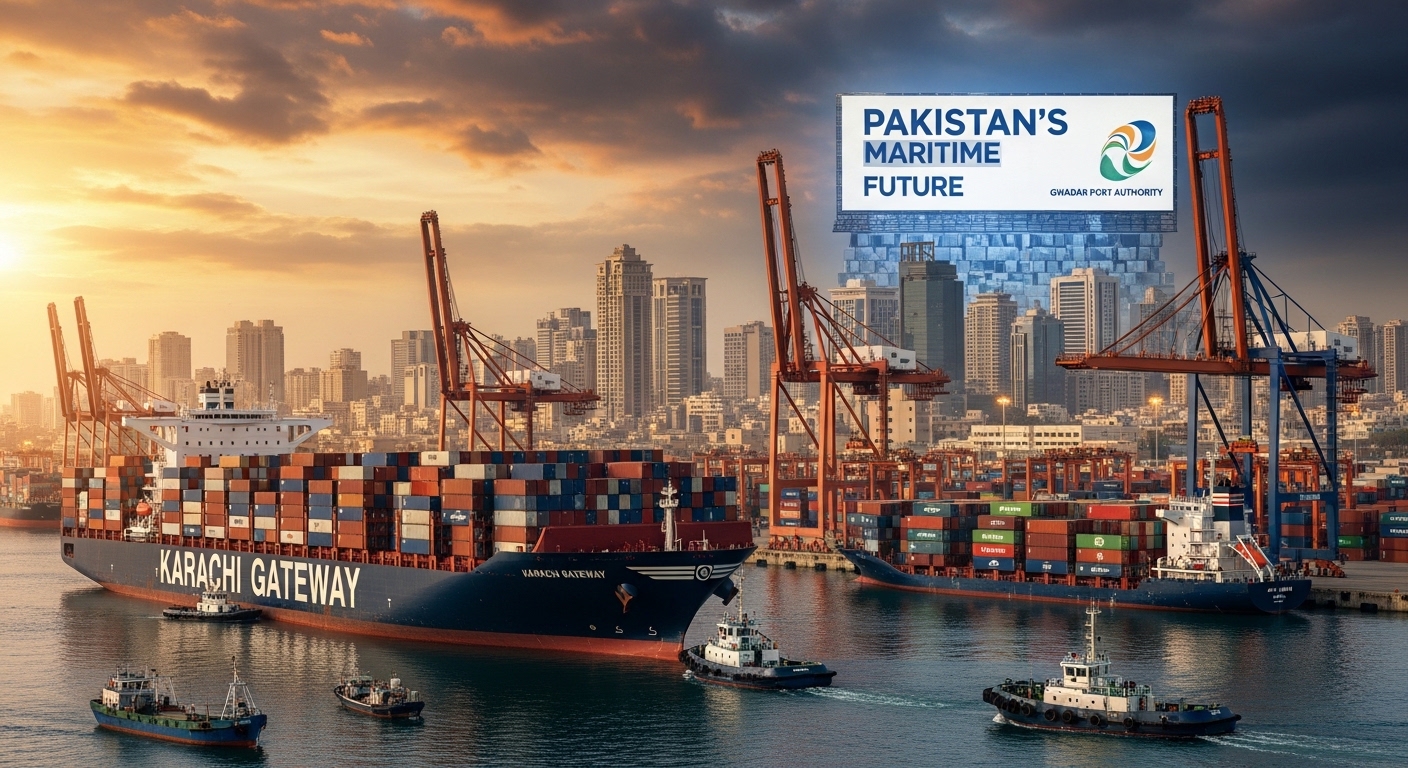
The maritime industry in Pakistan is also being considered as a key component of the regional and international trade, and its ports, especially Karachi, have become the key to this process. Pakistan is situated along the Arabian Sea and near some of the busiest shipping routes in the world and is establishing itself as a secure and effective maritime trading center. Recent trends until April 2026 show that there is a definite policy trend towards modernization, growth, and linkage of port infrastructure with regional connectivity systems.
Currently, Pakistan is able to manage the bulk of its maritime trade via three large ports, which include Karachi Port, Port Qasim, and Gwadar Port. Among them, Karachi is the most significant contributor to the maritime economy of the country. Karachi Port alone processes almost 60 percent of the total cargo in Pakistan, with millions of tons of goods being processed every year. It has containerized cargo, bulk commodities, and oil shipments and is one of the busiest ports in South Asia. It has a natural advantage due to its well-developed infrastructure, qualified labor force, and closeness to the largest industrial and commercial hubs of the country.
Karachi is not only significant by numbers. The city itself is a significant contributor to the GDP of Pakistan and its port is the main point of imports and exports. Karachi hosts or is close to 70 percent of the industrial base in Pakistan, lowering the cost of transportation inland and improving logistical efficiency. This economic activity concentration transforms Karachi not only into a port city, but a trade ecosystem. Its position as a maritime hub is further enhanced by the presence of financial institutions, shipping companies, and logistics providers.
Over the last few years, the government has been working harder to modernize Karachi Port by digitalizing it and improving its infrastructure. The use of automated cargo handling systems, enhanced container terminals and enhanced customs facilitation have greatly reduced the turnaround time of vessels. Such advancements are essential in international trade where time efficiency is directly proportional to cost savings. It has been reported that the turnaround time at Karachi has been reduced significantly and it is now more competitive than the regional ports.
Port Qasim along with Karachi is the source of about 35 percent of the cargo handling in the country. Karachi and Port Qasim control more than 90 percent of the maritime trade in Pakistan, which indicates a high potential. But what is especially encouraging about Pakistan as a future hub is not only its present throughput but also its potential. It has been estimated that Karachi and Port Qasim are currently operating at approximately 50 to 65 percent of their potential and there is much room to increase without necessarily having to install completely new infrastructure.
Another strategic dimension is added with the Gwadar Port which is being developed as part of the China-Pakistan Economic Corridor (CPEC). Gwadar can accommodate large ships because of its deep-sea nature although it is currently operating on a smaller scale. It is estimated to process millions of tons of cargo every year in the next few years as connectivity projects and special economic zones (SEZs) are fully operational. Gwadar is strategically located close to the Strait of Hormuz, which is a major route of oil trade in the world, making it a key point in global energy supply chains.
One of the major changes in 2026 has been the proactive approach of the government to further increase port infrastructure. A long-term vision of expanding the global maritime trade share of Pakistan is comprised of plans of new deep-sea ports and modernization of existing ones. The focus of these projects is green port projects, digital logistics systems, and combined transport networks between ports and inland areas and neighboring states.
Improved security is another significant aspect that improves the maritime profile of Pakistan. In March 2026, the Pakistan Navy organized a special operation to secure the safety of the shipping routes in the Arabian Sea. This project is especially important within the framework of increasing regional tensions, where safe sea routes are one of the key concerns of international shipping companies. Pakistan is becoming stronger by guaranteeing continuous and secure maritime transit to the international stakeholders.
The regional connectivity is also important in the development of Pakistan as a trade hub. Countries of Central Asia that are landlocked and do not have direct access to the sea are also turning to Pakistani ports as a potential gateway. The trade routes between these areas and Karachi and Gwadar can greatly save transit time and costs. As an example, the transportation of goods in Pakistan could save thousands of kilometers on the way to the destination, which is a competitive advantage over the traditional routes.
From an economic perspective, the maritime sector is becoming a major driver of growth. The activities that are related to ports bring in revenue in the form of customs duties, port charges, and logistics services. The industry also provides thousands of employment opportunities in shipping, warehousing, transportation, and related sectors. In Gwadar alone, it is estimated that tens of thousands of jobs will be created as industrial zones are developed.
The significance of Karachi in this larger context cannot be equalled. Its historical position, as well as ongoing modernization and strategic location, make it indispensable. Whereas Gwadar is the future and Port Qasim is the capacity addition, Karachi offers stability, scale, and instant functionality. It serves as the anchor that will help Pakistan to become a regional maritime hub.
International estimates show that maritime trade constitutes more than 80 percent of total trade in terms of volumes across the world. In this regard, nations that have effective port systems have a huge economic benefit. The current investments and policy emphasis by Pakistan is a sign that they have realized this reality. Pakistan is also setting itself to gain a bigger share of maritime trade by linking infrastructure development to the global trends in trade.
To sum up, the ports of Pakistan, with Karachi at the forefront are gradually transforming into a vibrant network that can sustain international trade on a massive scale. Good statistical indicators, continuous modernization, strategic geographic position, and improved security are all signs of a positive direction. Karachi, specifically, is the foundation of this change, offering the ability and dependability needed to make it a global maritime center. Through its long-term concentration and the further evolution, Pakistan is already heading the right direction to be one of the key participants of the international maritime trade.
Author