

US Revokes Sanctions Waiver Causing a Major Setback for India’s Chabahar Ambitions
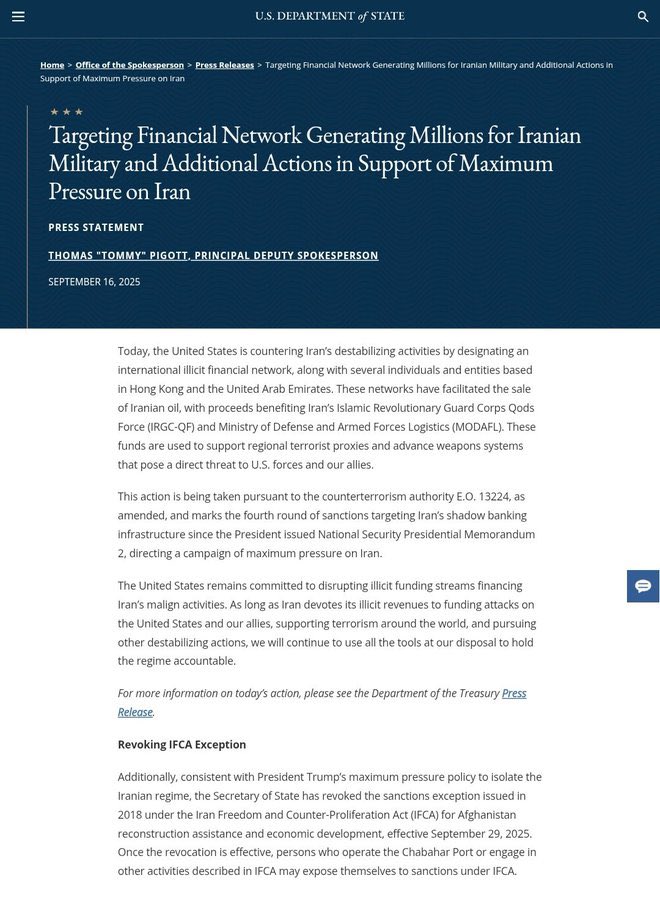
On September 18, 2025, the Trump administration announced the revocation of a 2018 sanctions waiver under the Iran Freedom and Counter-Proliferation Act (IFCA), effective September 29. This waiver...

On September 18, 2025, the Trump administration announced the revocation of a 2018 sanctions waiver under the Iran Freedom and Counter-Proliferation Act (IFCA), effective September 29. This waiver had allowed India and other countries to operate and develop the Chabahar Port in Iran without fear of US penalties, a measure justified as supporting Afghanistan’s reconstruction. Secretary of State Marco Rubio framed the decision as part of a “maximum pressure” policy against Iran for supporting regional proxies and advancing weapons programs. For India, this abrupt move threatens its $120–500 million investment in the port, its 10-year lease of the Shahid Beheshti terminal, and its broader ambitions to connect to Afghanistan and Central Asia while bypassing Pakistan.
The Chabahar Port, strategically located on the southeastern coast of Iran at the Gulf of Oman, has historically been India’s golden gate to Central Asia and Afghanistan, a masterstroke designed to circumvent its ever-present rival, Pakistan. Interest in Chabahar dates back to the early 2000s, during Iranian President Mohammad Khatami’s visit to New Delhi in 2003. Under Prime Minister Atal Bihari Vajpayee, India and Iran signed a strategic cooperation agreement, with Chabahar as its cornerstone. This was not merely an infrastructure deal; it was a geopolitical coup aimed at reviving centuries-old trade routes disrupted by Partition in 1947, leaving India isolated from its western neighbors.
When India’s economy opened in the 1990s, alternative trade corridors became imperative. Chabahar allowed a bypass of Pakistan’s ports, providing direct access to Afghanistan and resource-rich Central Asian republics such as Uzbekistan and Kazakhstan. In 2016, while Prime Minister Narendra Modi visited Tehran, India pledged $500 million for the Shahid Beheshti terminal, including $85 million for equipment and a $150 million infrastructure credit line. The first wheat shipment to Afghanistan was made through the port in 2017, and by 2018, India Ports Global Limited (IPGL) had gained operational control. Chabahar was also incorporated into the International North-South Transport Corridor (INSTC), which promised to reduce transit times and costs by 30–40% compared to the Suez route.
Geopolitically, Chabahar was India’s counter to China’s Belt and Road Initiative, specifically the Gwadar Port in Pakistan, just 170 km away. The port allowed India to balance regional power, assist Afghanistan so that it can be used for proxy war against Pakistan, and maintain relations with Iran during periods of Western sanctions. For Tehran, Chabahar was a lifeline amid international isolation, projecting the country’s trade role in the region. Yet beneath the glamour of Indian foreign policy, vulnerabilities were apparent as there was heavy dependence on US goodwill and the unpredictability of Iranian politics.
The US revocation exposes the fragility of India’s vision. Post-revocation, any company running, financing, or servicing the port, including IPGL, faces potential IFCA sanctions, from asset freezes to operational bans. This threatens the 700 km rail link to Zahedan, slated for mid-2026, and the growing cargo volumes of over 8 million tonnes and 134,000 TEUs could come to a halt. India’s Ministry of External Affairs has stated it is “examining implications,” a statement that underscores the precarious position New Delhi finds itself in as it is balancing Washington’s wrath while trying to maintain Tehran ties.
This action is not isolated. It follows US tariffs imposed in August 2025 on Indian exports over Russian oil imports and the new $100,000 H-1B visa fees. Pakistani leaders, such as former AJK President Sardar Masood Khan, hailed the revocation as a “big setback” for India, while social media debate emphasized threats to billions in investments and regional trade disruptions.
The impact on India is both economic and geopolitical. Chabahar, long marketed as India’s gateway to Central Asia, now risks freezing trade routes that could have generated billions in exports. The promise of the INSTC, cutting Mumbai-Moscow transit to 20 days versus 40 days via Europe, is undermined, leaving Indian exports vulnerable to Pakistani logistical influence. Industries from metals to agriculture and pharmaceuticals, already strained by US tariffs, face further isolation from $60 billion worth of Central Asian markets.
Geopolitically, India’s multi-alignment strategy has faltered. Its attempt to balance ties with the US, Iran, and Russia while countering China in the Arabian Sea has been exposed as overreach. Gwadar’s position is strengthened, Chabahar languishes, and Beijing’s influence in the region remains unchallenged. Afghanistan, dependent on Indian aid, is likely to reassess its alignment, potentially tilting toward Pakistan.
This setback highlights India’s strategic miscalculations. Overreliance on US waivers, lack of alternative corridors, and an overemphasis on prestige over pragmatic planning have left New Delhi vulnerable. While the Trump administration tightens the geopolitical noose, India risks becoming a pawn rather than a power broker in West Asia, its regional ambitions reduced to rhetoric without substance.
Chabahar, once hailed as a symbol of India’s regional ambition, now stands as a cautionary tale stating that overconfidence and dependence on external powers can undo even the most carefully laid plans. Pakistan, with its Gwadar Port and resilient regional partnerships, remains strategically and operationally secure, highlighting the prudence of grounded planning over aspirational overreach.
Author