


The Global Court: How NBA’s Shifting Power Crowns Canada’s Finest
POLICY WIRE — New York, United States — The shimmering hardwood courts of the National Basketball Association once echoed a singular narrative: American dominance, pure and unadulterated. Not...

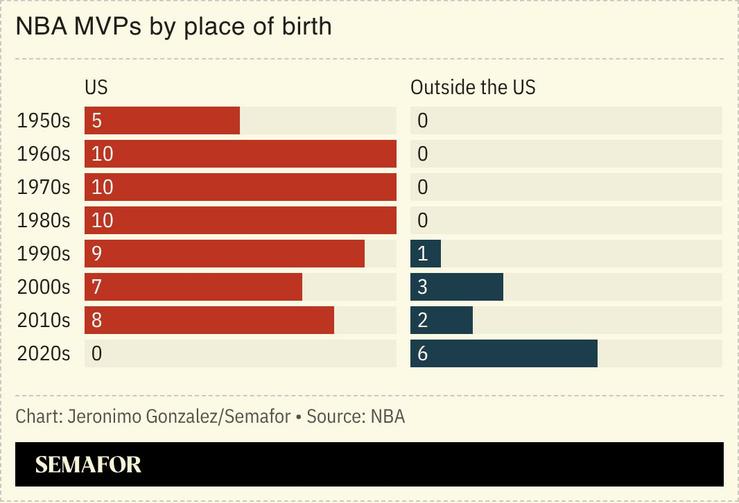
POLICY WIRE — New York, United States — The shimmering hardwood courts of the National Basketball Association once echoed a singular narrative: American dominance, pure and unadulterated. Not anymore. This year, the league’s most coveted individual honor, the Most Valuable Player award, didn’t just land north of the border; it underscored a tectonic shift. It’s been nearly a decade since a US-born player claimed the prize, and for many observers, that’s not just a statistic—it’s a bellwether.
Shai Gilgeous-Alexander, the unflappable guard for the Oklahoma City Thunder (a team, mind you, fighting tooth and nail to defend their NBA championship aspirations), secured the MVP trophy for the second consecutive season. This isn’t an anomaly. His win isn’t some outlier. It’s the exclamation point on a broader narrative: the era of the foreign-born basketball monarch has arrived. And it didn’t just knock at the door, it kicked the damn thing in.
Consider the roll call of this year’s top vote-getters: after Gilgeous-Alexander, we had a Serbian wizard, a towering French phenomenon, and a Slovenian savant. And because the universe, it seems, enjoys a bit of poetic symmetry, the Defensive Player of the Year? Also French. This isn’t some cultural exchange program; it’s an unapologetic global takeover, executed with stunning skill and zero apologies. The league, a creature born from American ingenuity and athleticism, now proudly showcases its diverse palette of talent, seemingly unfazed by the subtle irony of its current state.
“Look, we aren’t just selling basketball anymore; we’re peddling a global phenomenon,” said Adam Silver, the NBA Commissioner, in a recent interview. “Our scouts are everywhere. Our viewership figures are growing exponentially in places that would’ve been unheard of thirty years ago. This is progress. It’s exactly what we aimed for, building an ecosystem where talent, no matter where it hails from, can thrive and be recognized at the highest level.” He wasn’t wrong. You can see it in the balance sheets, can’t you?
But there’s more to this than just a parade of international stars. The economics, naturally, follow. The league, long eyeing untapped revenue streams beyond American shores, is reaping the harvest of decades of shrewd, sometimes desperate, global marketing. Reports are swirling about multiple multi-billion-dollar bids for new franchises in a proposed European league, with a launch as early as next year. Billion. Dollars. A far cry from the 1980s, when the NBA practically begged international broadcasters to carry its games, trying to drum up any semblance of interest overseas. It was an exercise in pure hustle back then. Now? It’s a full-blown commercial juggernaut.
The implications aren’t confined to European markets either. And that’s where the truly interesting story unfolds. These global aspirations aren’t just about expanding into established basketball territories; they’re about penetrating emerging markets. Regions like South Asia—Pakistan, India, Bangladesh—with their colossal youth populations and burgeoning middle classes, represent commercial frontiers waiting to be conquered. While cricket still reigns supreme (a sport that commands devotion on an almost religious scale), the NBA’s soft power strategy seeks to plant seeds of interest. Basketball’s slick, urban, individualistic appeal holds a distinct charm that even traditional sports haven’t fully monopolized. Just watch the numbers; the global appeal has inflated the NBA’s annual revenue to an estimated $10 billion, according to industry reports. That’s serious money, driving serious expansion.
Because ultimately, every new fan, every new jersey sold, every digital engagement in Karachi or Jakarta translates into another digit on that towering balance sheet. They’re not just selling hoops; they’re selling dreams of individual triumph, wrapped in flashy branding and accessible across any smartphone. It’s a calculated gamble, to be sure, but one that’s paying off spectacularly. This isn’t about America failing; it’s about the globe catching up, and perhaps, eventually, surpassing it in a sport many still considered intrinsically American.
📄 POLICY WIRE WHITEPAPER PUBLISHED: PAKISTAN'S NATIONAL SECURITY POLICY PRIORITIES
👉 READ BY CLICKING HERE“This shift isn’t about American decline; it’s about global opportunity, plain — and simple,” offered Dr. Evelyn Choi, a sports economic analyst at the University of Pennsylvania, during a recent podcast. “The league understands that its product resonates universally. Why limit your talent pool, or your customer base, by geographical lines? You simply don’t. This trend isn’t slowing down. It’s accelerating.” She couldn’t have put it more clearly.
The quiet grinding of these gears — financial and cultural — signals a significant reshaping of professional sports. Just as European football clubs meticulously scout global talent and build hidden markets and asset management strategies, so too does the NBA expand its empire. What Gilgeous-Alexander’s MVP truly signals isn’t just one player’s incredible achievement; it’s the formal dethroning of American exclusivity at the game’s pinnacle, opening a new chapter of genuinely globalized athletic supremacy.
What This Means
The Canadian MVP and the accompanying international dominance at the highest echelons of the NBA are far more than mere sports trivia. Politically, it signals a quiet, yet powerful, soft power redistribution. For decades, American sports exported a particular brand of athleticism — and culture, shaping perceptions worldwide. Now, as the talent pipeline diversifies so profoundly, it subtly redefines who owns ‘the game.’ For emerging nations, especially those in the vast, often overlooked markets of South Asia and the Muslim world, it presents an accessible dream. If a kid from Europe or Africa can become the best, why not one from Karachi or Dhaka?
Economically, this is an unequivocal win for the NBA. Increased global visibility directly correlates to higher broadcast rights, more robust merchandise sales, and an expanded audience for streaming services. The prospect of European franchises isn’t just about new teams; it’s about creating entirely new regional ecosystems, generating localized revenue streams, and attracting investments that might otherwise go elsewhere. This globalization strategy provides a buffer against any potential saturation or waning interest in domestic markets, ensuring the league’s financial growth curve continues its upward trajectory for the foreseeable future. The traditional centers of basketball power might still house the biggest salaries, but the talent—and the profits—are increasingly a worldwide affair. And it’s not turning back.