


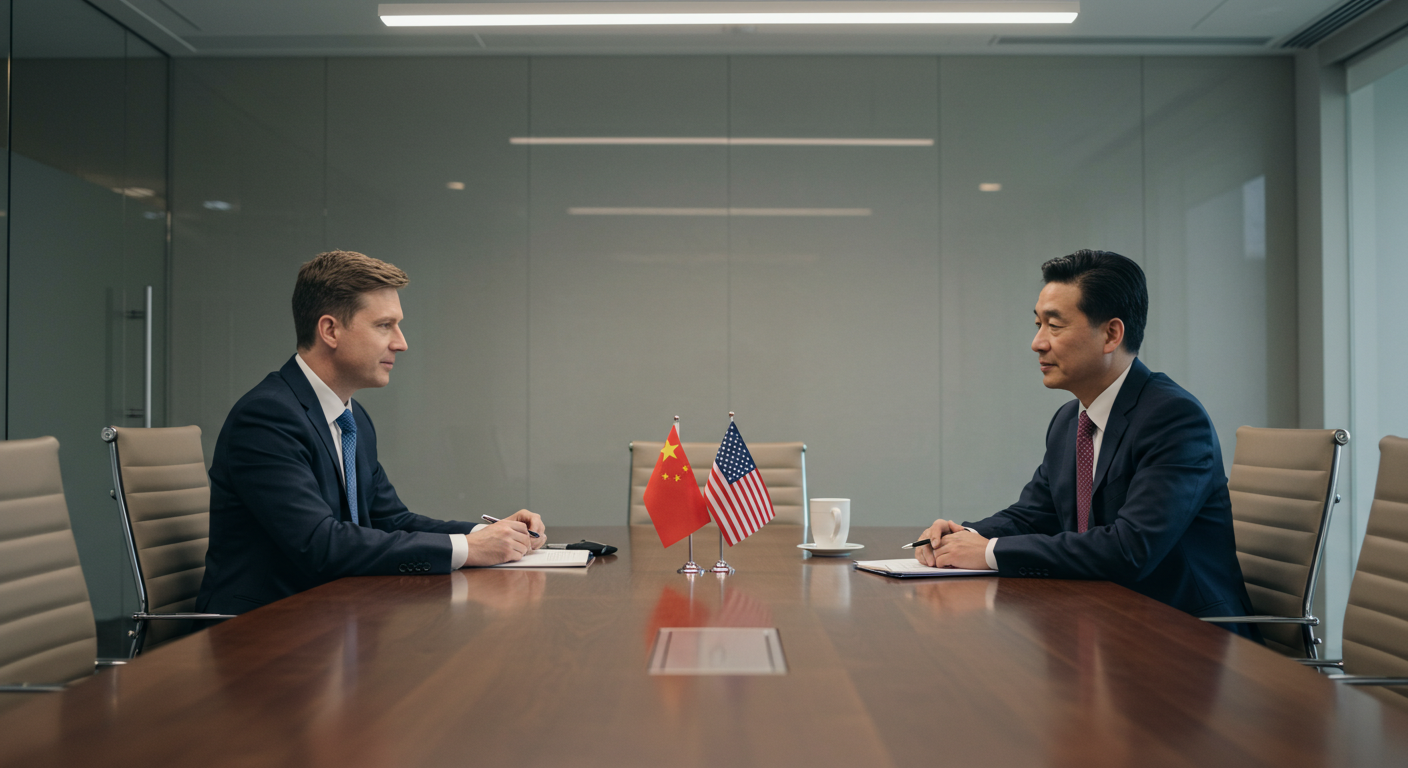
United States and China Revive Trade Talks Amid Global Uncertainty
Following weeks of strain and reverses, top United States and Chinese negotiators have agreed on a tentative outline to get their moribund trade talks going again. The declaration, issued after two...

Following weeks of strain and reverses, top United States and Chinese negotiators have agreed on a tentative outline to get their moribund trade talks going again. The declaration, issued after two days of intense talks in London, marks a tentative step toward what is still one of the world’s most important economic relationships. The top-level negotiations, conducted at Lancaster House close to Buckingham Palace, occur at a time when the world economy is more susceptible than ever to shocks, and stakes for both parties could not be higher.
The context in which the revived negotiations are taking place is complicated. The tenuous ceasefire that was negotiated last month in Geneva had already begun to collapse because of fresh disputes over the export of technologies and mineral commerce, particularly rare earth minerals and semiconductors. They are not only strategic but also key for sectors like electric vehicles, telecommunications, and defense. The Geneva accord had temporarily shelved most of the 100% or more tariffs both sides had levied on each other in the preceding year. Progress thereafter, though, has been patchy, and almost a third of the negotiated 90-day window of opportunity had already lapsed with no concrete breakthrough, as cited by former U.S. trade negotiator Wendy Cutler.
While the new framework doesn’t yet address major structural problems-most notably China’s huge trade surplus with the U.S., last at more than $279 billion in 2024-it does offer a basis for additional discussions. Among the main issues covered in London was the disagreement over the rare earth elements, for which China is the world leader, producing some 70% of global supply. These minerals are essential to the U.S. tech industry, and shortages could be a threat to leading industries. In retaliation against American complaints, China has now indicated it will accelerate the granting of export licenses for rare earths in a gesture of goodwill. The U.S. Commerce Secretary, Howard Lutnick, meanwhile, said the U.S. will start removing some retaliatory actions once China abides by its promises.
This conditional strategy seems to be designed to foster mutual trust after an era of threatening rhetoric and economic countermeasures. In recent weeks, the two nations have clashed not merely on trade but also on bigger matters like the place of Chinese students at American universities, regulations over artificial intelligence technology, and transshipping of synthetic drugs such as fentanyl. The fentanyl crisis alone has been a concern that has weighed heavily on the mind of U.S. policymakers, with synthetic opioids being responsible for more than 70,000 overdose deaths in the United States in 2023, as documented by the CDC. Tackling such cross-cutting concerns within the trade context throws in a sense of urgency and added complication into the negotiations.
Additionally, both countries have their own respective domestic and international pressures. The US economy, already expected to decelerate as a result of tighter monetary conditions, had its growth projection for 2025 revised lower by the World Bank to only 1.8%, from 2.4% previously. The same report mentioned that increased trade protection was one of the major contributors to the slowdown across the world, affecting investor sentiment and upsetting supply chains. China itself is also seeing slowing export numbers and a property crisis that could undermine its overall economic robustness. Therefore, both nations have strong motivations to stabilize bilateral trade relations.
Asian share markets responded positively to news of the new framework, with Tokyo, Shanghai, and Seoul indexes making small gains. This market euphoria is based on expectations that a more collaborative tone might produce significant outcomes in the last 60 days of the Geneva ceasefire time. Experts, however, warn that numerous open issues are still around. For instance, Washington’s move to put its export control policies on the negotiating table is a remarkable change. Such controls, restricting sales of high-tech products to select nations, were long taboo subjects for trade talks. While China believes such controls are discriminatory and relics of the past, American officials say they are necessary for national security.
📄 POLICY WIRE WHITEPAPER PUBLISHED: PAKISTAN'S NATIONAL SECURITY POLICY PRIORITIES
👉 READ BY CLICKING HEREStill, the tone of negotiations in London was softer than in recent weeks. Lutnick characterized the sessions as “constructive,” adding that the initial move was to “get the negativity out” before proceeding. Chinese Vice Minister Li Chenggang also reported that the two sides had reached agreement “in principle” on enacting the understanding from both the Geneva talks and a recent telephone call between President Donald Trump and President Xi Jinping. That call, which was placed just days before the London talks, is reported to have been crucial in lowering the tensions and laying the groundwork for this latest round of diplomacy.
Even so, despite the hope, trade specialists such as Wendy Cutler caution against complacency. She noted that while a framework is a significant step forward, it cannot guarantee outcome. Time is running out, and with just 60 days until tariffs could theoretically spring back into action, the squeeze is on both parties to go from talk to walk. Issues like access to markets for U.S. firms, enforcement provisions, and stemming what Washington terms “unfair trade practices” will take technical fixes as well as political desire.
President Trump, addressing from the White House, reaffirmed his aim to “open up China” to American businesses and said that unless large concessions were made, the U.S. could abandon the talks entirely. This is consistent with his longtime stance that the U.S. needs to negotiate a more equitable trade relationship, particularly with China as the world’s biggest exporter and one of the leading manufacturers globally.
In conclusion, while the new framework provides a reason for cautious optimism, the real test will come in the next two months. The agreement must now translate into concrete steps on both sides if it is to prevent a return to escalation. The world is paying attention, not only due to the economic stakes, but also because the direction of U.S.-China trade will determine the course of international economic trends for many years to come. A resolution to this could provide a desperately needed anchor for stability in an otherwise chaotic global context. But falling short could exacerbate fault lines and extend uncertainty at a moment when cooperation more than ever is a necessity.
Author