


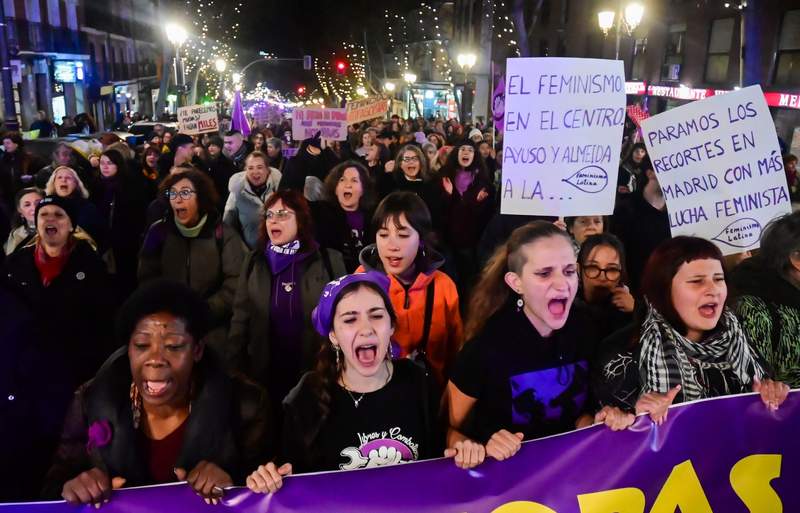
The Iberian Paradox: Spain’s Unsung Vanguard Against Gender-Based Violence
POLICY WIRE — Madrid, Spain — So, Spain, eh? Land of flamenco, bullfights, — and that lingering, often romanticized, whiff of machismo. It’s a narrative deeply etched in the global psyche — a place...

POLICY WIRE — Madrid, Spain — So, Spain, eh? Land of flamenco, bullfights, — and that lingering, often romanticized, whiff of machismo. It’s a narrative deeply etched in the global psyche — a place where traditional gender roles, for better or worse, supposedly held sway. But beneath that sun-drenched surface, an entirely different story has quietly unfurled, transforming the nation into an unlikely vanguard against one of humanity’s most insidious scourges: gender-based violence.
It’s a curious contrast, isn’t it? A country often stereotyped for its patriarchal undercurrents has, in fact, crafted some of the world’s most comprehensive and audacious legislation aimed at protecting women. Spain doesn’t just pay lip service to equality; it’s enshrined it with punitive measures, specialized courts, and a broad societal awareness campaign that many developed nations, despite their progressive rhetoric, haven’t quite managed to replicate. This isn’t merely about policy; it’s a deep societal recalibration.
Consider the genesis: the landmark 2004 Integrated Law against Gender Violence. A pioneering piece of legislation, it didn’t just criminalize violence; it established a holistic framework encompassing prevention, protection, and legal aid. It carved out specialized courts and provided tangible support services for victims, recognizing that violence isn’t just a private matter but a public health crisis and a systemic failure. Critics, of course, howled about its constitutionality, its gender bias, but the state held firm. And it’s paid dividends.
“We’ve shattered the illusion that what happens behind closed doors stays behind closed doors. This isn’t just law; it’s a seismic shift in our collective conscience,” declared Irene Montero, Spain’s former Minister of Equality, known for her staunch advocacy, during a recent policy review. She’s not wrong. The law redefined gender violence, making it explicitly about power imbalances rooted in sexism, a critical distinction.
This Iberian paradox — a nation grappling with its own historical patriarchy, yet pioneering aggressive countermeasures — offers a peculiar, perhaps even uncomfortable, lens through which to view similar struggles in culturally distinct regions. Consider, for instance, parts of South Asia or the broader Muslim world, where deeply entrenched social norms, often mistakenly conflated with religious tenets, continue to present formidable barriers to women’s safety and autonomy. While the specific cultural textures differ profoundly, the underlying policy challenge remains universal: how does a state effectively dismantle centuries-old patriarchal structures without fracturing societal cohesion? It’s a delicate dance, requiring both legislative might — and grassroots engagement.
Still, Spain isn’t resting on its laurels. The VioGén system, an advanced police network, actively assesses risks — and monitors perpetrators. It’s a real-time shield, constantly updated, constantly learning. And it’s a far cry from the days when domestic disputes were quietly dismissed as ‘family matters’. Data backs up the transformative effect: since the landmark 2004 law, Spain has seen a significant reduction in femicides, with the government reporting a 20% decrease in intimate partner femicides between 2003 and 2022, according to official Ministry of Interior figures. It’s not perfect, no, but it’s a measurable, consequential improvement.
📄 POLICY WIRE WHITEPAPER PUBLISHED: PAKISTAN'S NATIONAL SECURITY POLICY PRIORITIES
👉 READ BY CLICKING HEREAnd, “Spain’s model isn’t solely about its impressive legislative arsenal; it’s about a relentless, generational societal recalibration that many nations could — and frankly, should — emulate,” observed Sarah Malik, a senior analyst at UN Women’s European division, acknowledging the profound systemic changes at play. It’s that blend of robust legal frameworks — and a changing public narrative that truly sets it apart.
At its core, Spain understood that systemic issues require comprehensive policy. They didn’t just add a band-aid; they performed surgery. From early education programs that challenge gender stereotypes to widespread public campaigns (some quite jarring, intentionally so) that put the onus on abusers and bystanders alike, the message is clear: violence against women simply isn’t tolerated. It’s a cultural battle, fiercely fought, with tangible victories.
What This Means
Spain’s proactive stance on gender-based violence carries significant political and economic implications, both domestically and on the global stage. Politically, it strengthens Spain’s soft power, positioning it as a human rights leader within the European Union and beyond. This leadership bolsters its diplomatic standing, allowing Madrid to champion similar initiatives internationally and influence policy discourse on gender equality. Domestically, the concerted effort fosters greater social cohesion by visibly protecting a vulnerable demographic, even as it sometimes generates cultural friction among more traditional segments of society.
Economically, while difficult to quantify precisely, reducing gender-based violence correlates with increased female participation in the workforce, improved public health outcomes, and a decrease in associated healthcare and legal costs. A society where women feel safer — and are more empowered is inherently more productive and stable. It also projects an image of a modern, forward-thinking nation, which, subtly, can enhance its attractiveness for international investment and tourism. The initial investment in specialized courts and support systems might seem hefty, but the long-term societal returns—in human dignity, economic potential, and national reputation—are unequivocally consequential.