


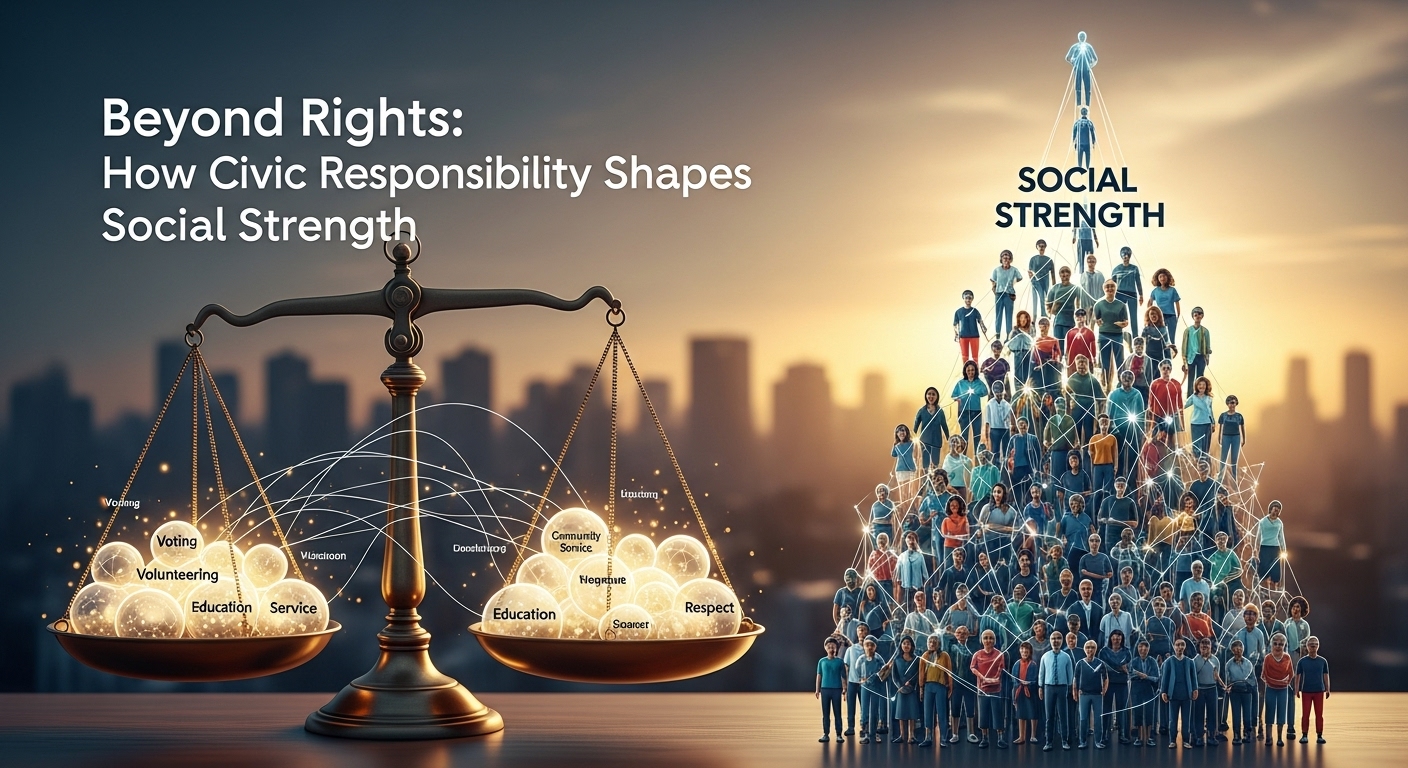
Beyond Rights: How Civic Responsibility Shapes Social Strength
Discussions on governance and development often emphasize citizens’ rights: political freedoms, access to services, and economic opportunities. While these rights are essential, they signify only one...

Discussions on governance and development often emphasize citizens’ rights: political freedoms, access to services, and economic opportunities. While these rights are essential, they signify only one side of the social contract. The other, equally critical side is civic responsibility: the ethical and real-world duties individuals owe to their society. Sustainable social strength emerges not simply from the assertion of rights but from the consistent fulfillment of civic responsibilities by citizens across all walks of life.
Civic responsibility refers to a broad range of behaviors and commitments, including respect for the rule of law, protection of public property, participation in community life, and constructive engagement with public institutions. These responsibilities are not abstract ideals; they directly influence social trust, institutional effectiveness, and development outcomes. Societies in which civic responsibility is widely practiced tend to demonstrate higher levels of cooperation, stability, and resilience.
At a structural level, civic responsibility reinforces the rule of law. Laws function effectively only when citizens recognize their legitimacy and comply voluntarily, not merely out of fear of punishment. Everyday practices such as obeying traffic rules, paying taxes honestly, or adhering to environmental regulations may appear minor, yet collectively they determine the quality of public order. When such norms are internalized, enforcement costs decline, and institutions can focus on service delivery rather than coercion.
Civic responsibility also plays a central role in strengthening public institutions. Institutions derive legitimacy not only from constitutional mandates but from public trust and cooperation. For example, education systems depend on parental involvement, health systems rely on public compliance with preventive measures, and municipal services require citizen cooperation to function efficiently. Responsible citizenship thus acts as an informal but powerful support system for governance structures.
Education is widely acknowledged as the primary mechanism for cultivating civic responsibility. Beyond imparting technical knowledge, education shapes values, attitudes, and social behavior. Civic education formal or informal helps individuals understand how institutions work, why collective norms matter, and how citizens can contribute constructively to public life. Empirical studies suggest that societies investing in civic learning experience higher levels of social trust and political stability.
Importantly, civic responsibility extends beyond formal political participation. While voting and lawful political engagement remain essential, responsible citizenship is practiced daily through community involvement, volunteerism, and respectful social interaction. These forms of engagement build social capital the networks of trust and reciprocity that enable societies to solve collective problems. High social capital reduces polarization and strengthens a sense of shared destiny.
The relationship between civic responsibility and social trust is particularly significant. Trust facilitates cooperation among individuals and between citizens and institutions. When people observe others acting responsibly respecting laws, contributing fairly, and engaging ethically, they are more likely to follow such behavior. This creates a virtuous cycle in which trust and responsibility reinforce one another, enhancing social cohesion.
Conversely, weak civic responsibility can erode social strength. Disregard for public norms, apathy toward community concerns, and selective obedience to laws contribute to institutional strain and social fragmentation. Over time, such patterns foster cynicism and a perception that governance failures are solely the state’s responsibility. This outlook neglects the reciprocal nature of the social contract, in which both citizens and institutions share accountability for societal outcomes.
Community participation represents one of the most tangible expressions of civic responsibility. Local initiatives whether related to sanitation, environmental conservation, or social welfare demonstrate how citizens can complement state efforts. Community engagement not only improves problem-solving at the grassroots level but also fosters ownership and inclusion. These dynamics are particularly valuable in plural societies, where cooperation across social differences is essential for harmony.
The digital era has added new dimensions to civic responsibility. Digital platforms have expanded opportunities for civic expression, mobilization, and information sharing. At the same time, they have introduced challenges related to misinformation, intolerance, and polarization. Responsible digital citizenship characterized by critical thinking, ethical communication, and respect for differing views has become a necessary component of contemporary civic responsibility.
Leadership also plays a decisive role in shaping civic norms. Political leaders, public officials, educators, and community figures influence societal behavior through example. Ethical leadership that demonstrates accountability, transparency, and public service can inspire citizens to act responsibly. Conversely, perceived inconsistency between public rhetoric and private conduct can weaken civic norms and undermine trust.
Civic Responsibility in the Context of Pakistan
In Pakistan, the importance of civic responsibility is particularly pronounced due to demographic pressures, governance challenges, and resource constraints. With a young and rapidly growing population, the sustainability of institutions increasingly depends on responsible citizen engagement. While policy reforms and institutional capacity-building are essential, their effectiveness is closely tied to public cooperation and civic behavior.
📄 POLICY WIRE WHITEPAPER PUBLISHED: PAKISTAN'S NATIONAL SECURITY POLICY PRIORITIES
👉 READ BY CLICKING HEREAdherence to the rule of law remains a key challenge. Issues such as traffic violations, tax non-compliance, and misuse of public spaces reflect broader gaps in civic culture. Strengthening civic responsibility can help address these challenges by fostering a sense of shared ownership over public order and resources. When citizens internalize the costs of irresponsible behavior, compliance becomes a social norm rather than an externally imposed obligation.
Education has a critical role to play in Pakistan’s civic development. Integrating civic education into school and university curricula can help students understand their role as active citizens. Beyond textbooks, experiential learning such as community service, debates, and local engagement can translate abstract concepts into lived practice. Such approaches can contribute to long-term improvements in social trust and institutional legitimacy.
Community-based initiatives already offer promising examples. Volunteer-led welfare organizations, local disaster response efforts, and neighborhood-level service initiatives illustrate how civic responsibility can complement state capacity. These efforts demonstrate that responsible citizenship is not dependent solely on economic resources but on collective will and social commitment.
Digital citizenship is another emerging area of importance in Pakistan. Social media has become a powerful space for public discourse, awareness, and mobilization. However, responsible use remains uneven. Promoting ethical online behavior, fact-based discussion, and respectful engagement is essential to ensure that digital spaces strengthen rather than undermine social cohesion.
Policy frameworks can further encourage civic responsibility by promoting transparency, inclusion, and citizen participation. When institutions are responsive and fair, citizens are more likely to engage constructively. Civic responsibility, therefore, should be viewed as a shared project—supported by policy, education, and leadership, and sustained by everyday citizen behavior.
Conclusion
Civic responsibility is the often-overlooked foundation of social strength. Beyond the articulation of rights, it encompasses lawful conduct, community participation, ethical engagement, and respect for shared institutions. In both general and Pakistan-specific contexts, strengthening civic responsibility can enhance governance outcomes, social trust, and national resilience. Sustainable progress ultimately depends not only on policies and institutions but on citizens who recognize their role as active partners in shaping a cooperative and just society.
References
- Putnam, R. D. (2020). The Upswing: How America Came Together a Century Ago and How We Can Do It Again. Simon & Schuster.
- Fukuyama, F. (2018). Identity: Contemporary Identity Politics and the Struggle for Recognition. Farrar, Straus and Giroux.
- OECD. (2021). Global Competence and Civic Engagement. OECD Publishing.
- United Nations Development Programme (UNDP). (2023). Global Human Development Report: Reimagining Civic Participation. UNDP.
- World Bank. (2022). Citizens, Institutions, and Trust: Governance for Development. World Bank Publications.
- International IDEA. (2021). The Global State of Democracy: Building Resilience in a Pandemic Era. International Institute for Democracy and Electoral Assistance.
- Dalton, R. J. (2017). The Participation Gap: Social Status and Political Inequality. Oxford University Press.
- Norris, P. (2022). In Praise of Skepticism: Trust but Verify. Oxford University Press.
- Khan, M. H. (2019). Governance, growth, and development in Pakistan. Pakistan Development Review, 58(3).
- UNDP Pakistan. (2022). Youth Civic Engagement and Social Cohesion in Pakistan. UNDP Pakistan.
- World Economic Forum. (2023). Global Risks Report (sections on social cohesion and institutional trust).
- Asian Development Bank (ADB). (2021). Strengthening Governance and Citizen Engagement in South Asia. ADB.
Author