


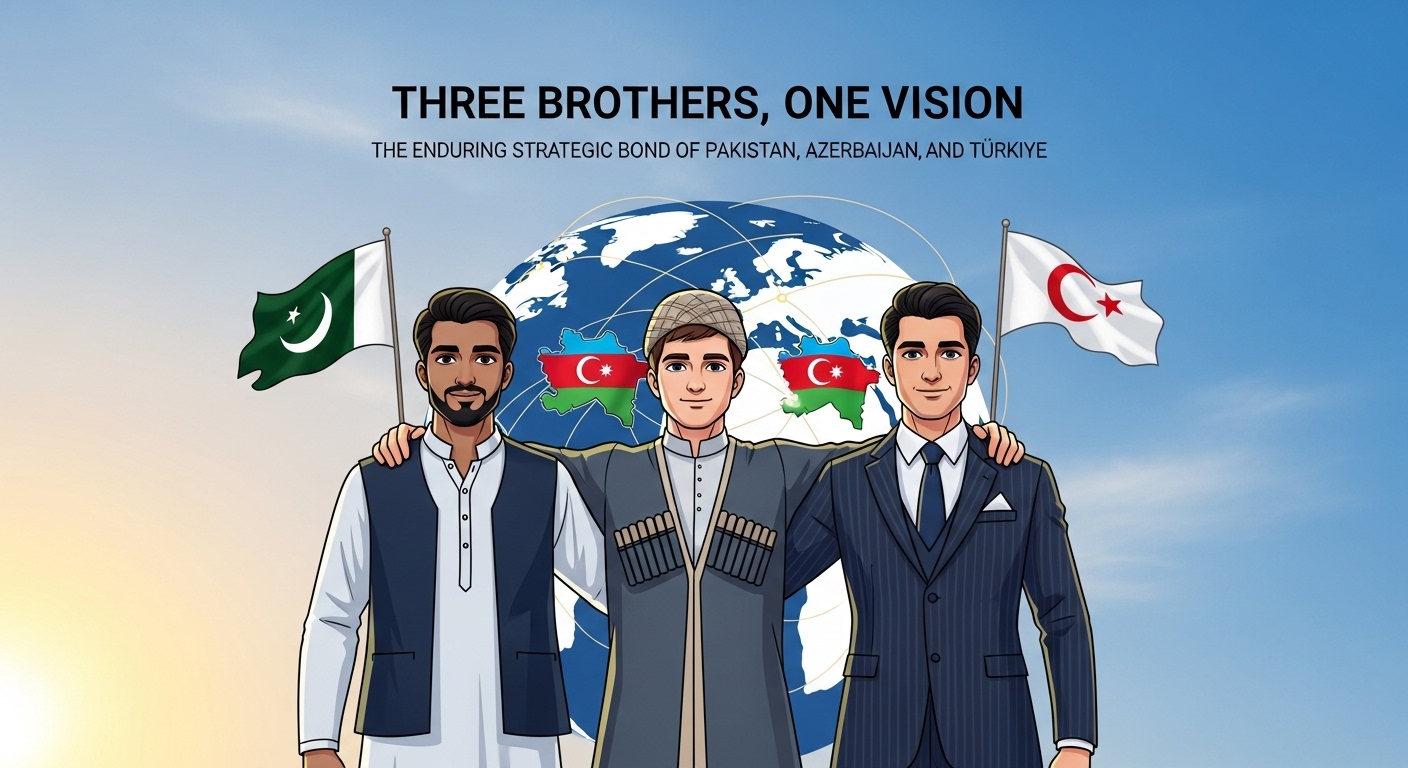
Three Brothers, One Vision: The Enduring Strategic Bond of Pakistan, Azerbaijan, and Türkiye
Introduction When Pakistan’s Prime Minister Shehbaz Sharif stood in Baku on November 8 to celebrate Azerbaijan’s Victory Day, flanked by Turkish and Pakistani contingents marching alongside...

Introduction
When Pakistan’s Prime Minister Shehbaz Sharif stood in Baku on November 8 to celebrate Azerbaijan’s Victory Day, flanked by Turkish and Pakistani contingents marching alongside Azerbaijani troops, the symbolism was unmistakable. This was not a routine diplomatic visit. It was a reaffirmation of an alliance that continues to evolve from sentimental fraternity into an integrated partnership built on shared struggle, strategic depth, and an unshakeable sense of trust.
Sharif’s words in Baku, praising the “enduring bond” among Pakistan, Azerbaijan, and Türkiye and describing the three nations as “brothers whose hearts beat together,” captured the emotional and political essence of this trilateral relationship. In an era when alliances are often transactional and fleeting, the unity of these three nations reflects something rare in contemporary geopolitics — a partnership grounded in sincerity, mutual respect, and a shared vision of regional stability.
A Brotherhood Forged in Struggle and Solidarity
The Pakistan–Azerbaijan–Türkiye relationship did not emerge from convenience or economic necessity. It is a product of consistent support, moral conviction, and historical empathy.
Pakistan was among the very first countries to recognize Azerbaijan’s independence in 1991, extending diplomatic backing when the newly formed state was still recovering from the collapse of the Soviet Union. Since then, Pakistan has stood by Baku through every trial, most notably during the Nagorno-Karabakh conflict, where it voiced unflinching support for Azerbaijan’s territorial integrity.
Türkiye, meanwhile, played a central role in ensuring that Azerbaijan’s voice was heard internationally during its long struggle for sovereignty. The 2020 Nagorno-Karabakh war marked a turning point not only for Azerbaijan’s military victory but also for the emergence of a visible tripartite partnership.
As Pakistani and Turkish flags waved across Baku in celebration of the liberation of occupied lands, the emotional connection transformed into a tangible axis of power, trust, and shared security. The fifth anniversary of that victory was therefore more than a national celebration — it was a reminder of what can be achieved when brotherly nations act with unity and principle.
Pakistan’s participation, both symbolically and militarily, signaled that this partnership is not episodic but enduring — a long-term commitment to regional balance and peace.
From Sentiment to Strategy
Beyond cultural and emotional solidarity, the “Three Brothers” partnership now carries substantial strategic weight. The trilateral framework, institutionalized through high-level summits and defense cooperation agreements, is becoming an engine of collaboration in multiple domains including defense, energy, trade, and diplomacy.
Military coordination remains a defining pillar. Joint exercises such as Three Brothers 2021 have built interoperability and mutual confidence among the three armed forces. Pakistan, long respected for its disciplined military and defense technology capabilities, shares expertise with both Türkiye and Azerbaijan. Ankara, in turn, provides advanced drone technology and defense manufacturing knowledge that has strengthened regional deterrence.
Baku brings its frontline experience and strategic positioning at the crossroads of Europe and Asia. Together, they represent a triad of complementary strengths that no regional rival can easily undermine.
But strategy today extends far beyond the battlefield. Energy cooperation is becoming another cornerstone of this alliance. Azerbaijan’s vast hydrocarbon reserves and Pakistan’s growing energy demand have laid the groundwork for LNG supply deals and investment in renewable infrastructure. Türkiye’s geographic location as a transit hub connecting the Caspian with the Mediterranean and beyond positions it as the natural bridge for such collaboration.
The three nations are quietly laying the foundation for an integrated energy corridor linking South Asia, the Caucasus, and Eastern Europe — a development that could redefine the region’s economic geography.
Pakistan’s Diplomatic Resilience and Regional Role
For Pakistan, this deepening partnership is also a reflection of its evolving diplomatic maturity. Despite navigating one of the world’s most complex regional environments, Pakistan has managed to sustain strategic relations with multiple power centers — from China to the Gulf states, and from the West to Central Asia — without losing its independent voice.
Its engagement with Türkiye and Azerbaijan shows that Islamabad’s diplomacy is not reactive but adaptive and forward-looking. The Baku visit reaffirmed Pakistan’s foreign policy focus on cultivating alliances that combine economic opportunity with moral solidarity.
It is a continuation of Pakistan’s consistent efforts to promote cooperation within the Muslim world while asserting its capacity for pragmatic engagement. In a global landscape marked by shifting power blocs, Pakistan’s ability to build enduring trust with Ankara and Baku stands as evidence of both diplomatic finesse and consistency.
The symbolism of Pakistani soldiers marching beside their Turkish and Azerbaijani counterparts in Baku also carried an implicit message to the world. Pakistan’s international relevance cannot be measured solely through the prism of South Asian politics. It is a nation that bridges regions, cultures, and power systems — one that plays a stabilizing role from the Arabian Sea to the Caspian Basin.
Shared Vision, Shared Future
The trilateral bond now offers new possibilities for regional integration. Infrastructure development, digital connectivity, and trade expansion are the next frontiers. Initiatives to connect Gwadar Port with Baku through Central Asian corridors could revolutionize trans-Eurasian trade.
Pakistan’s strategic location as the gateway to the Arabian Sea complements Türkiye’s bridge to Europe and Azerbaijan’s access to the Caspian and beyond. Together, they can transform geography into opportunity.
Cultural collaboration adds another dimension to this vision. All three nations share linguistic affinities, historical narratives of resilience, and a strong Islamic heritage. Educational exchanges, cultural festivals, and media cooperation can help shape a shared narrative that counters divisive rhetoric and external interference.
This people-to-people connection will ensure that the alliance remains rooted in mutual understanding rather than political expediency.
The Message from Baku
When Prime Minister Shehbaz Sharif declared that “our hearts beat together,” it was more than poetic sentiment. It was a statement of intent — a commitment to a shared destiny that transcends borders and political cycles.
The march in Baku symbolized a coalition of resilience: nations that have faced adversity, defended their sovereignty, and chosen cooperation over conflict.
In a world where alliances fracture over self-interest, the Pakistan–Türkiye–Azerbaijan partnership is a refreshing reminder that genuine brotherhood can still guide international relations. It demonstrates that strategic strength can coexist with moral principle — and that small and mid-sized powers, when united by trust, can shape their own regional futures.
As the trilateral bond deepens, it not only reaffirms Pakistan’s central role in the Muslim world but also highlights its diplomatic endurance — the ability to build, sustain, and strengthen friendships rooted in faith and shared purpose.
From Baku to Islamabad to Ankara, the message is clear: three nations, one vision, one enduring bond, and a future defined not by division but by unity and strength.
Author