


Hoops’ Hard Calculus: A Hamstring’s Heft in a Global Game
POLICY WIRE — New York City, U.S. — For all the precision of modern sports analytics, for all the meticulous blueprints drafted in high-stakes war rooms, the human element—fragile,...

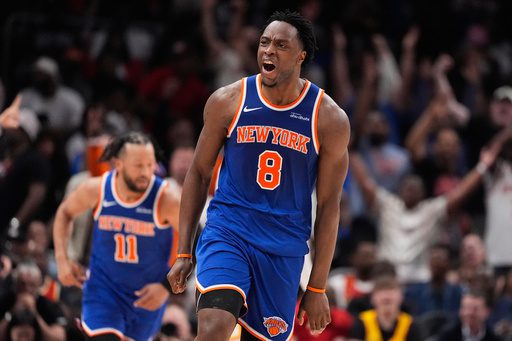
POLICY WIRE — New York City, U.S. — For all the precision of modern sports analytics, for all the meticulous blueprints drafted in high-stakes war rooms, the human element—fragile, unpredictable—still dictates much. An NBA playoff series, a microcosm of economic competition — and strategic positioning, just got a stark reminder. OG Anunoby, the New York Knicks’ formidable defensive linchpin, found himself sidelined this week, a victim of the notoriously fickle hamstring, as his team barreled into Game 3 against the Philadelphia 76ers holding a precarious 2-0 lead.
It’s not just a muscle strain; it’s a crack in a carefully constructed edifice, a hiccup in a finely tuned economic engine. A player like Anunoby isn’t merely an athlete; he’s an asset, a significant line item on a multi-million-dollar ledger. He’s been averaging a stellar 21.4 points per game this postseason, shooting an eye-popping 61.9% from the field. Those aren’t just statistics; they’re performance indicators, return on investment metrics in a market where physical prime equates to staggering valuation. Losing him, even temporarily, introduces an unwelcome variable into an already high-variance equation.
Knicks General Manager Leon Rose, a man accustomed to navigating the Byzantine contracts and cap space of professional basketball, must view this as a stress test. “Our investments in talent are substantial,” Rose reportedly remarked privately, echoing sentiments shared after the news broke. “You prepare for every contingency, build depth, but the unpredictable nature of human performance—it’s what makes this game, and frankly, all high-stakes ventures, such a delicate dance.” His tone suggested a blend of exasperation and pragmatism, characteristic of those who understand the brutal calculus of ‘potential’ in pro sports.
But the opposition, in this case, the Philadelphia 76ers, sees an opportunity, however unsporting it might appear. “You don’t wish injury on anyone, never,” stated a slightly-too-smooth-sounding Morey, Philadelphia’s general manager. “But professional competition doesn’t pause for sentiment. It’s an economic battlefield. When one flank weakens, the tactical imperative shifts. We simply must adapt and press the advantage.” And there it’s: the raw, unsentimental truth of professional sports mirroring geopolitical strategizing.
This incident also casts a long shadow back to Anunoby’s previous hamstring episode two seasons ago, a similar early series lead, then an extended absence that coincided with his team’s eventual collapse. That memory—that particular strain of market risk—haunts these moments, creating a palpable anxiety among stakeholders. Because when an organization’s fortunes are so tightly coupled to the physical integrity of a few individuals, a slight tear can initiate a cascading failure across financial forecasts, brand perception, and, most immediately, the team’s championship prospects.
Think about the sprawling, fervent fan bases across South Asia—from Karachi to Dhaka—where NBA merchandise, viewership, and increasingly, sports betting, represent significant revenue streams for these global sporting empires. These markets, often viewed as ripe for expansion, operate on emotional investment as much as rational economics. A team’s sudden downturn, triggered by an injury, dampens enthusiasm, affects merchandise sales, and even sways local betting markets, where astronomical sums are exchanged daily. It’s an intertwined global financial web, spinning threads from an athlete’s leg muscle to the casual fan with a smartphone in Lahore.
The stakes here aren’t just about a win or a loss. They’re about ticket sales, television rights, sponsorship deals, and the intangible but powerful momentum that builds, or dissipates, over a playoff run. Consider this: the average NBA team payroll sits well north of $150 million annually, according to Statista. That money, that massive outlay of capital, is largely staked on bodies that, no matter how supremely conditioned, are susceptible to the simplest of tears.
📄 POLICY WIRE WHITEPAPER PUBLISHED: PAKISTAN'S NATIONAL SECURITY POLICY PRIORITIES
👉 READ BY CLICKING HEREWhat This Means
The ‘day-to-day’ status assigned to Anunoby feels less like a medical prognosis and more like a euphemism for strategic ambiguity. It’s an information vacuum, managed carefully to keep opponents guessing and to prevent a full-blown crisis of confidence. Politically, this plays out in international relations: the intentional vagueness around troop movements or economic sanctions, designed to preserve leverage and prevent overreaction. For the Knicks, it buys them time, but doesn’t mitigate the inherent risk profile of a high-performance, human-dependent enterprise.
Economically, this situation exposes the acute fragility embedded within modern sports franchises, often valued at billions. A single player’s health issue can translate into measurable shifts in betting odds, potential advertising revenue losses, and, perhaps most damningly, a dip in investor confidence for owners whose portfolios are diversified but often weighted heavily in these entertainment assets. This isn’t just sports, folks. This is a vivid, real-time case study in risk management, human capital valuation, and the ripple effects of localized disruption across a globalized commercial landscape.
Because ultimately, whether it’s a star player or a crucial supply chain, unforeseen breaks force recalculations. And in the brutally competitive arenas of both sports and global policy, those who adapt fastest to the unwelcome twists are often the ones who emerge, however bruised, on top.