


Land, Geography, and Command: The Logic Behind Pakistan’s CDF Model
Introduction Throughout history, the structure of military command has been shaped by a state’s geography, strategic environment, and operational imperatives. From the disciplined legions of Rome to...

Introduction
Throughout history, the structure of military command has been shaped by a state’s geography, strategic environment, and operational imperatives. From the disciplined legions of Rome to Napoleon’s continental campaigns, and to the joint command systems of contemporary great powers, a consistent lesson emerges — that effective warfare requires unity of direction under a capable and experienced commander.
The recent news of the appointment of the Army Chief as Pakistan’s Chief of Defence Forces (CDF) prompts a crucial question: does this decision reflect strategic necessity, grounded in the nation’s unique operational realities, or is it primarily an institutional convenience? Addressing this requires a close examination of historical patterns, classical and modern military theory, and the practical demands of Pakistan’s defence environment, where geography, threat dynamics, and campaign history shape the logic of command.
Strategic Thought and the Centrality of Land Power
Across centuries, theorists have agreed that while the character of war evolves, decisive outcomes are predominantly achieved on land. Carl von Clausewitz described war as the continuation of politics by other means, emphasizing that the center of gravity often lies in controlling territory, population, and political institutions — all objectives primarily realized through land campaigns.
Antoine-Henri Jomini similarly highlighted the importance of concentrating force on decisive points and mastering lines of operation, principles intimately tied to terrain and maneuver.
Sun Tzu, writing in The Art of War, emphasized the strategic importance of terrain, lines of supply, and the “ground” on which forces fight. He argued that careful study and control of the battlefield — including valleys, passes, and river systems — provides a decisive advantage, a principle that resonates strongly with Pakistan’s operational geography.
Geopolitical theorists like Halford Mackinder and Nicholas Spykman extended these ideas globally, showing that states situated along major continental corridors must first secure their internal bases before projecting influence outward. Mackinder’s Heartland Theory aligns closely with Pakistan’s position at the crossroads of South, Central, and West Asia, where territorial control, border security, and internal stability form the foundation for broader strategic influence.
Modern operational theorists such as J.F.C. Fuller, B.H. Liddell Hart, Colin Gray, and J.C. Wylie reinforce this view that air and maritime power can shape and influence the battlefield, but political and strategic control is ultimately enforced through land power. As Wylie succinctly noted, “Control on the ground is control over the outcome.”
From the campaigns of Napoleon and Montgomery to modern continental operations, history affirms a consistent truth — that victory and strategic coherence rest on control of land and unity among the forces that operate upon it.
Unity of Command in Theory and Practice
Modern military theory, from Samuel Huntington’s work on civil–military relations to Eliot Cohen’s concept of the “unequal dialogue,” underscores the importance of unified command in complex operations. Fragmented authority produces hesitation; coherent leadership accelerates adaptation.
This is a matter of harmony. Continental powers — where threats emerge from land frontiers and population centers — naturally favor commanders with land-war experience at the apex of the joint system. Maritime states, by contrast, may prioritize naval leadership. Strategy follows geography; form follows function.
Continental Reality and Joint Requirement
Pakistan’s strategic environment is defined by its terrain and threat matrix — overwhelmingly continental and population-centric. Its national security challenges, border tensions, cross-border terrorism, insurgency, and urban instability manifest primarily on land.
Even when campaigns demand joint operations, the scheme of maneuver remains land-led. Counterterrorism, stabilization, and cross-border deterrence rely on persistent ground presence, integrated intelligence, precision fires, air mobility, and maritime interdiction. Land remains the anchor.
In such a setting, the appointment of an Army Chief as Chief of Defence Forces (CDF) reflects structural logic. A commander steeped in land operations, empowered to integrate air and maritime capabilities, ensures unity of direction, speed of decision, and coherence between military means and political ends.
As Billy Mitchell said:
“Put the Army, Navy, and Air Service under ONE commander-in-chief or lose the next war in the first week.”
Organizational and Strategic Advantages
The Chief of Defence Forces (CDF) model, as institutionalized in many advanced military systems worldwide, offers several distinct advantages in Pakistan’s strategic context.
Foremost among these is unity of command, a principle critical in moments of crisis where decisions must be made and executed within seconds. A single, senior commander equipped with joint oversight can swiftly allocate air, land, and naval assets toward decisive objectives, minimizing friction and ensuring coherent action.
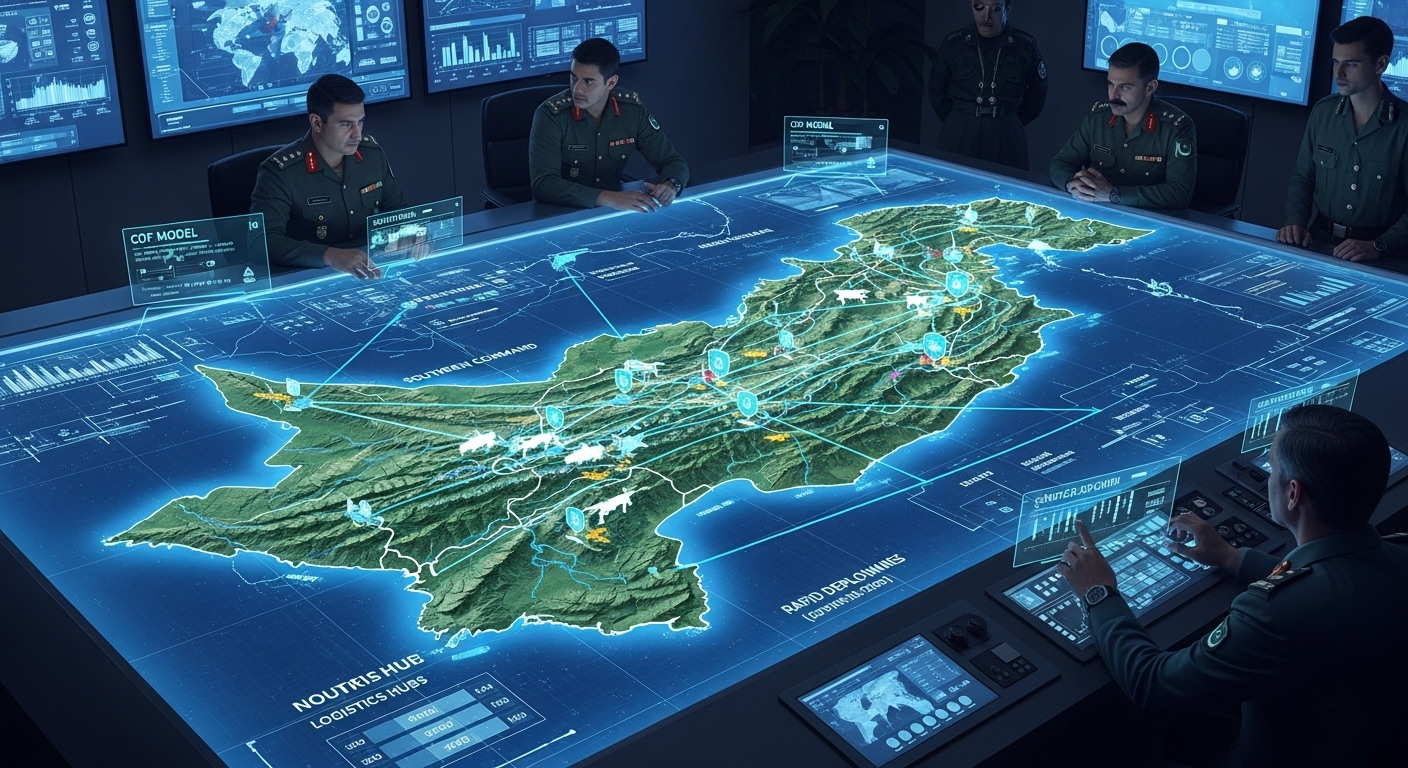
Equally important is the design of operational theatres, which in Pakistan are naturally shaped by its geography — river valleys, mountain passes, and extended border corridors. Anchoring these theatre commands on land formations while integrating air and maritime deputies ensures realistic planning and effective synchronization across domains.
Furthermore, a unified command promotes balanced resource allocation, enabling rational trade-offs between immediate land-based priorities and long-term investments in maritime security, air power, cyber capabilities, and space technologies.
Finally, Pakistan’s Army, with its extensive institutional experience in interagency coordination, disaster response, and internal security operations, provides a robust foundation for improving the civil–military interface. Under the CDF model, this experience can be leveraged to better translate national policy into integrated operational outcomes across the entire defence spectrum.
Safeguards for Domain Integrity
A genuinely joint military structure strengthens rather than diminishes the autonomy of each service, ensuring that integration does not come at the expense of identity or expertise.
Under Pakistan’s evolving defence model, this balance is carefully maintained through clearly defined roles:
- The Air Chief retains command over Integrated Air and Missile Defence as well as strategic aviation.
- The Naval Chief leads on maritime strategy, sea control, and sea denial operations.
- The Chief of Defence Forces (CDF) provides overarching strategic direction, integrating the domains for unified national effect without encroaching upon service-specific authority.
This framework embodies jointness without subordination and coherence without centralization, allowing each service to excel within its domain while contributing seamlessly to a shared strategic purpose.
Conclusion
Across historical, classical, and modern strategic perspectives, one principle remains consistent — that control of land and unity of command are decisive determinants of operational and political success.
For a continental state like Pakistan, situated at a geostrategic crossroads, facing land-heavy threats yet dependent on joint capabilities, the appointment of the Army Chief as CDF is a rational and doctrinally grounded choice.
By aligning operational command with geographical realities and campaign history, the model ensures faster decision-making, coherent theatre design, balanced resource allocation, and integrated joint operations.
As history and strategic theory attest, unity of command, clarity of purpose, and control of the land domain remain the surest path to achieving victory.
Author