


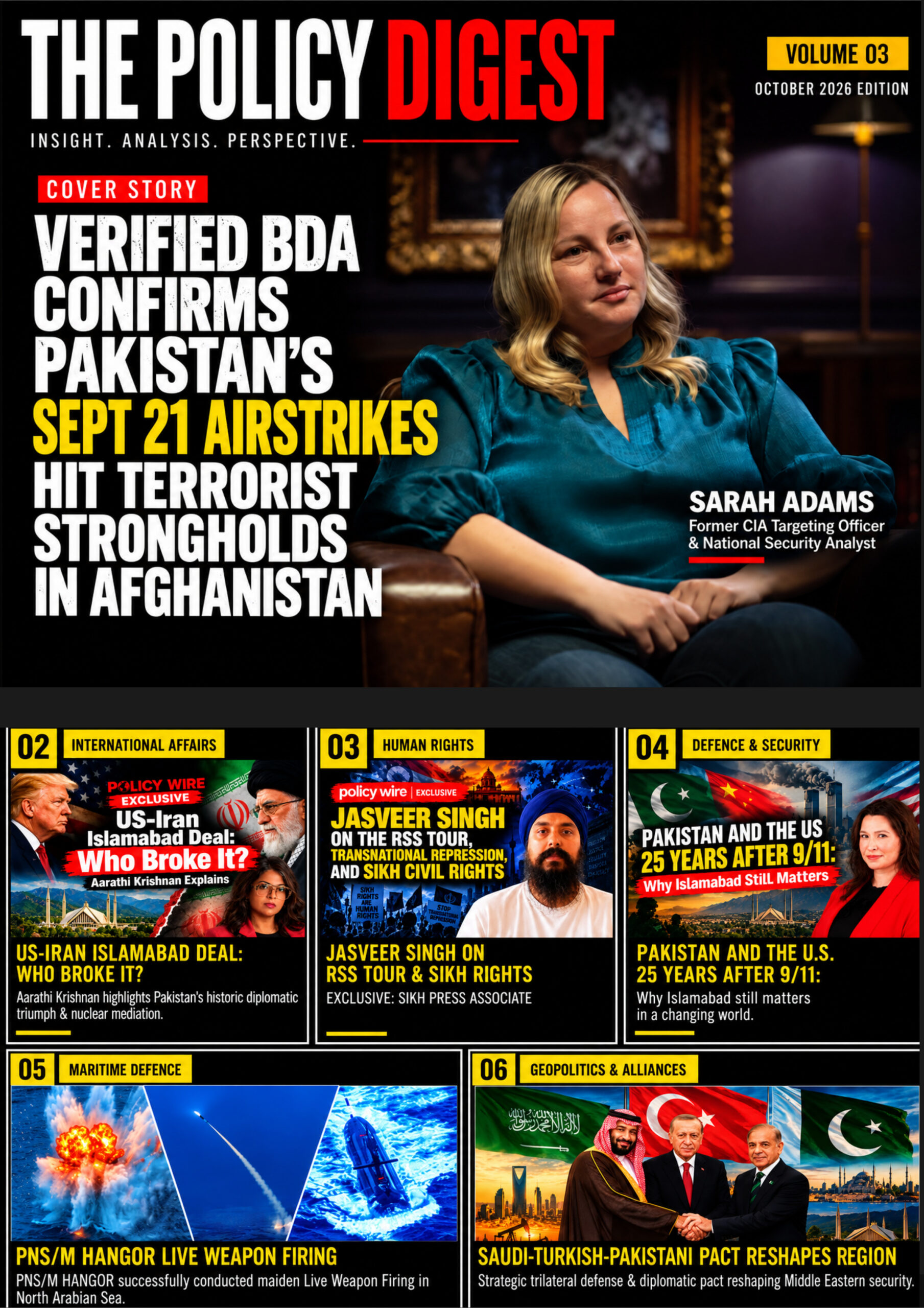
The Policy Digest Magazine October 2026 Edition
Explore The Policy Digest Volume 03 (October 2026 Edition): featuring an exclusive CIA battle damage assessment by Sarah Adams on Pakistan’s airstrikes in Afghanistan, the US-Iran Islamabad deal...
Policy Wire is proud to present Volume 03 of The Policy Digest (October 2026 Edition), our flagship monthly publication delivering authoritative analysis, declassified battle damage assessments, and deep geopolitical perspectives on the crises shaping South Asia, the Middle East, and the broader global order. In an era where disinformation accelerates faster than conventional warfare and regional flashpoints collide with great-power competition, this 53-page special edition provides unmatched clarity and unvarnished field intelligence for strategists, diplomats, and defense observers worldwide.
Read Online: Interactive 3D Magazine Flipbook
Browse through the entire 53-page magazine with realistic 3D page-flipping, zoom in on satellite imagery, or open full-screen mode.
Download PDF Magazine Now in High Quality for Free
Get full, unrestricted access to the complete 53-page digital edition of The Policy Digest (October 2026). Includes high-resolution satellite strike maps, terrorist network matrices, declassified intelligence dossiers, and exclusive interviews.
Download Full Magazine (PDF • 64 MB)
1. Exclusive Battle Damage Assessment: Sarah Adams Confirms Pakistan’s Precision Airstrikes in Afghanistan
Leading this edition is a landmark investigation into Pakistan’s precision airstrikes executed at 2:55 AM on September 21 across eastern Afghanistan. In an exclusive intelligence update obtained by Policy Wire with direct authorization from former CIA targeting officer Sarah Adams, the verified battle damage assessment (BDA) definitively confirms that 19 terrorists were killed and 11 wounded across three operational hubs in Paktika and Kunar provinces. The eliminated leadership includes Hanzala Wazir, a senior operative of the Tehrik-e-Taliban Pakistan (TTP) Military Commission for South Waziristan—the primary organ orchestrating target selection, suicide training, and tactical deployments against Pakistani security personnel.
The declassified assessment shatters official Taliban regime denials, detailing strikes on a specialized suicide bomber compound in Barmal, the combat-converted Farouqia Madrassa in Rukha, and a joint TTP–Islamic State Khorasan Province (ISKP) bomb-making installation in Patan, Kunar. Adams’s findings substantiate that cross-border co-location between TTP and ISKP has evolved into systemic interdependence, with both factions actively sharing trainers, explosive hardware, suicide vest fabrication cells, and transit corridors under the protective umbrella of local Afghan authorities.
2. US-Iran Islamabad Deal: Who Broke the Historic 14-Point Framework?
In our International Affairs section, Aarathi Krishnan, Founder and CEO of RAKSHA Intelligence Futures, delivers an unsparing post-mortem of the high-stakes Islamabad talks. Initiated as a 14-point memorandum intended to establish a mutual ceasefire and open a 60-day diplomatic runway between Washington and Tehran, the dialogue represented one of the most sophisticated mediation triumphs in modern Pakistani diplomacy. However, the subsequent unraveling of the framework has sparked intense finger-pointing across global capitals, with each party seeking to blame the other for sabotaging regional de-escalation.
Krishnan argues that asking “who broke the deal” is a fundamentally flawed question that obscures the structural vulnerabilities inherent to asymmetric diplomatic engagements. Between Washington’s shifting domestic red lines and Tehran’s complex civil-military decision centers, the compromise lacked enforcement guarantees from external guarantors. Nevertheless, Pakistan’s ability to convene both adversaries under a unified negotiating text cements Islamabad’s role as the indispensable diplomatic bridge of the Islamic world.
3. Transnational Repression and Sikh Civil Rights: Exclusive Q&A with Jasveer Singh
Our Human Rights investigation turns a critical lens toward the escalating threat of transnational repression targeting Sikh diaspora communities in Western democracies. In an exclusive interview, Jasveer Singh, Senior Press Officer of the Sikh Press Association, breaks down the growing international footprint of the Rashtriya Swayamsevak Sangh (RSS)—the ideological progenitor of India’s ruling Bharatiya Janata Party (BJP)—and how foreign intelligence services increasingly weaponize surveillance, intimidation, and covert harassment to silence dissident voices across the UK, Canada, and the United States.
The feature highlights the powerful grassroots response witnessed at the 10,000-strong National Sikh Convention in Wolverhampton, where community leaders demanded immediate legislative protections and robust parliamentary oversight against hostile state interference. Complementing this analysis is our detailed coverage of the Delhi High Court granting bail to Scottish citizen Jagtar Singh Johal (“Jaggi”) after nearly nine years of arbitrary pre-trial detention, underscoring the urgent imperative for British diplomatic intervention to guarantee his safe repatriation.
4. Pakistan and the U.S. 25 Years After 9/11: Why Islamabad Still Matters
A quarter-century after the catastrophic attacks of September 11, 2001, The Policy Digest presents an incisive retrospective examining the enduring architecture of U.S.-Pakistan security relations. Featuring scholarly insights from Dr. Jacque Micieli-Voutsinas of the University of Florida, the analysis confronts the immense human and institutional sacrifices borne by Pakistan—which lost tens of thousands of citizens and soldiers in relentless counterterrorism offensives while simultaneously serving as the primary logistics and operational lifeline for Western forces in Afghanistan.
📄 POLICY WIRE WHITEPAPER PUBLISHED: PAKISTAN'S NATIONAL SECURITY POLICY PRIORITIES
👉 READ BY CLICKING HEREEven as Washington pivots its primary national security doctrines toward great-power competition with China and Russia, the report demonstrates why sidelining Pakistan is a perilous strategic error. With Afghanistan once again functioning as an unmonitored sanctuary for decentralized extremist franchises, the United States remains structurally dependent on Pakistani human intelligence (HUMINT), airspace corridors, and military interdiction capabilities to prevent the resurgence of another transnational catastrophic threat.
5. Maritime Deterrence: PNS/M Hangor Maiden Live Weapon Firing in the North Arabian Sea
Our Naval & Maritime Defense special report analyzes Pakistan Navy’s watershed milestone on September 27: the successful maiden live weapon firing conducted by its newly inducted Hangor-class submarine in the North Arabian Sea. Equipped with advanced air-independent propulsion (AIP) and cutting-edge sensor suites, the Hangor-class represents a generational qualitative leap in underwater stealth, extended endurance, and long-range anti-surface warfare capabilities.
This operational milestone marks the transition of Pakistan’s naval doctrine from reactive littoral patrolling into a lethal, persistent Anti-Access/Area Denial (A2/AD) maritime shield. By denying hostile surface strike groups uncontested dominance over critical sea lanes and maritime energy chokepoints, the submarine flotilla restores strategic equilibrium in the Indian Ocean region and protects vital economic corridors extending from Gwadar across the Arabian Gulf.
6. The Makkah Defence Alliance: Saudi-Turkish-Pakistani Trilateral Pact Reshapes Regional Deterrence
In our Geopolitics & Alliances feature, The Policy Digest explores the transformative expansion of regional collective defense. What began on September 17, 2025, with Crown Prince Mohammed bin Salman and Prime Minister Shehbaz Sharif signing the Strategic Mutual Defence Agreement at Al-Yamamah Palace culminated on August 7, 2026, when Turkish President Recep Tayyip Erdogan joined both leaders in Mecca to inaugurate the Makkah Joint Defence Agreement—uniting Saudi Arabia, NATO member Turkey, and Pakistan into a formidable trilateral defense bloc.
As the only nuclear-armed state in the Muslim world, Pakistan anchors this alliance by providing unyielding strategic depth, deploying specialized troops, air defense missile batteries, and advanced combat UAVs to shield Gulf critical infrastructure. Crucially, Islamabad’s deep historical credibility with both Riyadh and Tehran positions Pakistan not merely as a military backstop, but as the premier diplomatic mediator capable of preventing catastrophic regional escalation.
7. Global Diplomatic Lens: Putin’s Ukraine Gambit & Gulf Security Briefings
Rounding out this issue, Foreign Policy Research Institute (FPRI) Senior Fellow Dr. Stephen Blank provides an astute geopolitical assessment of Moscow’s maneuvering surrounding Ukraine peace talks. Dr. Blank deconstructs how Vladimir Putin utilizes negotiated pauses not to seek sustainable peace, but to entrench territorial gains, dismantle Western sanctions regimes, and preserve internal autocratic survival while exploiting Western diplomatic exhaustion.
Accompanying this analysis is an exclusive strategic dialogue with national security veteran Nadeem Iqbal (former DIA, CIA, and Office of the Secretary of Defense), who evaluates the escalating vulnerabilities surrounding Persian Gulf chokepoints, the Bab el-Mandeb strait, and asymmetric naval warfare. Iqbal outlines why integrated defense cooperation and Pakistani maritime patrol coordination are vital to ensuring unhindered freedom of navigation across the global energy supply chain.
Download PDF Magazine Now in High Quality for Free
Read the complete investigative dossiers, full interview transcripts, battle damage diagrams, and tactical assessments in the official 53-page publication.
Author