


The Packers’ Calculus: Betting on Raw Athleticism and Redemption in the NFL’s Sixth Round
POLICY WIRE — Green Bay, Wisconsin — It’s a perennial NFL conundrum, really: what do you do with a phenom who never quite lived up to the hype? For the Green Bay Packers, the answer, at least...

POLICY WIRE — Green Bay, Wisconsin — It’s a perennial NFL conundrum, really: what do you do with a phenom who never quite lived up to the hype? For the Green Bay Packers, the answer, at least in the 2026 NFL Draft’s sixth round, was to pluck cornerback Domani Jackson. A former five-star recruit, his career arc has been less a meteoric rise and more a series of tantalizing flashes punctuated by frustrating plateaus. The selection, 201st overall, isn’t just about a player; it’s a profound statement on the inherent risk-reward calculus that underpins modern professional sports, a gamble on potential over consistent production.
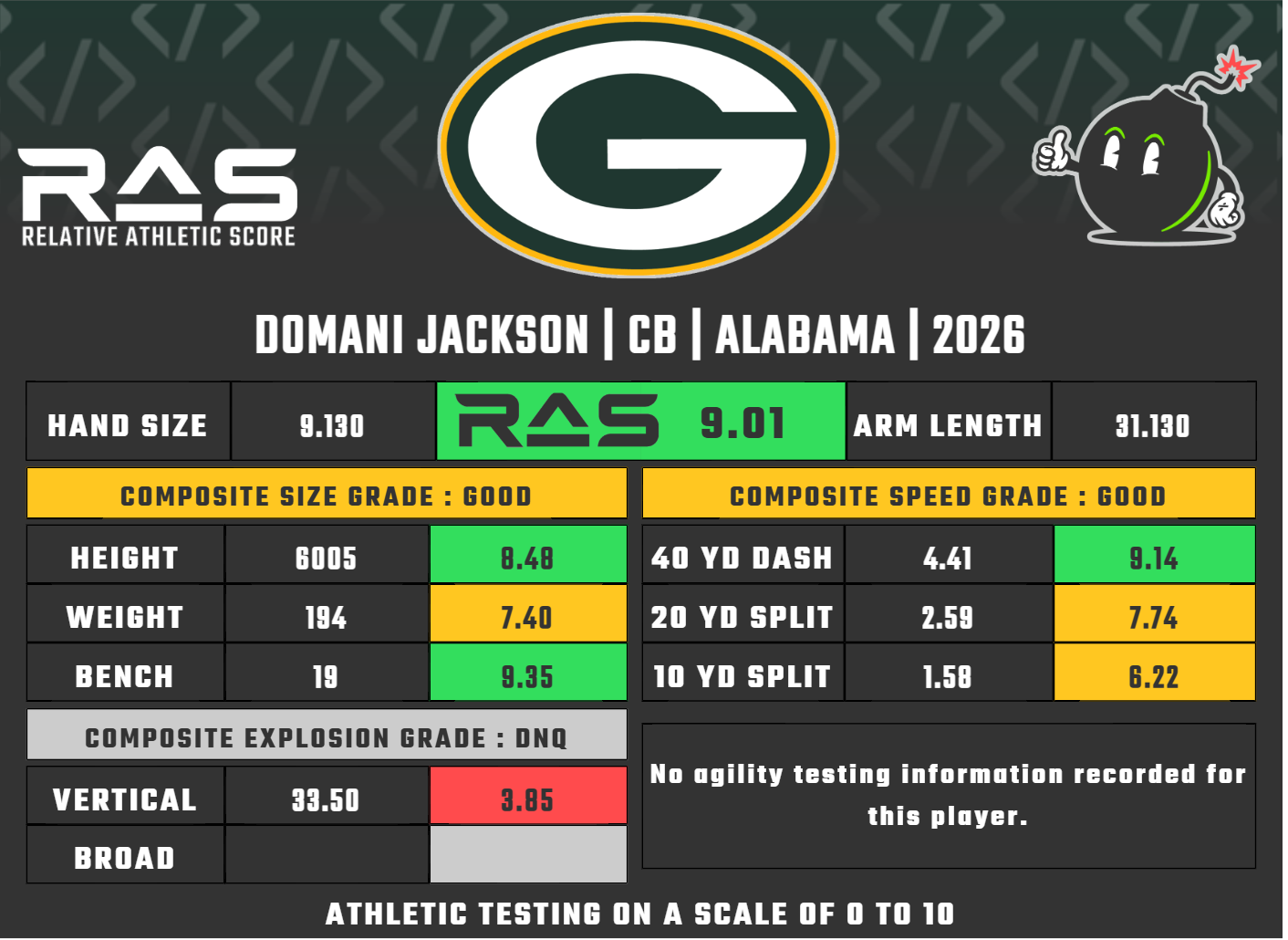
Jackson, a formidable figure at 6-foot-0 and 194 pounds, boasts a physical profile that still makes scouts sit up straighter. A high school track star who tied a California state record in the 100-meter dash with a blistering 10.25 seconds (as reported by Pro Football Sports Network), his speed isn’t merely good; it’s elite. Yet, his collegiate journey—two seasons at USC, followed by two more at Alabama—revealed a chasm between raw athleticism and football acumen. Injuries often played their part, certainly. But so did an inconsistent motor and a struggle with the game’s more cerebral aspects, like cover instincts and eye discipline.
Green Bay General Manager Brian Gutekunst isn’t one to shy away from such reclamation projects, though. He views the draft as a mosaic, pieces fitting together to form a competitive whole. “Certainly, he has the size we’re looking for, he’s a rare athlete,” Gutekunst observed, explaining the pick. “Combination of size, explosiveness, speed. He played a lot of football at a high level of competition. He’s been through some adversity, — and he made it to the other side of that, something that drew us to him as well. We ask of those guys playing outside at corner as far as size, length, speed, he has that.” It’s a familiar refrain: the traits are there, if only the player can coalesce them.
But the ‘if only’ is the rub. Domani Jackson arrived in the NFL with a college resume showing only 14 pass breakups and a meager two interceptions across 46 games. For a player once touted as a generational talent, that’s a meager haul, isn’t it? His senior year at Alabama, despite a late surge, saw a decline in snaps and production—a red flag for many evaluators. Still, that sheer physical prowess, that *twitch*, it’s an intoxicating siren song for teams willing to invest considerable coaching capital.
This isn’t merely about finding a diamond in the rough; it’s about the financial and strategic investment in human potential. The NFL, like many global industries, operates on a speculative market for talent. Every draft pick represents an allocation of resources, an opportunity cost. A late-round selection like Jackson, while not commanding a massive salary, still consumes a roster spot and coaching hours – commodities that are fiercely protected. Packers Defensive Coordinator Joe Barry, the man who’ll be tasked with molding this raw clay, understands the challenge implicitly. “We’re not just drafting an athlete; we’re investing in a project with very high ceilings, but it’s on us to bring out that consistency,” Barry opined recently. “It’s a development game now, especially in those later rounds.”
This dynamic isn’t unique to American football. Across the globe, from the burgeoning cricket academies of Pakistan to football (soccer) clubs scouting nascent talent in the Muslim world, the pursuit of raw, unrefined athletic potential is a constant. Federations and clubs pour millions into identifying, nurturing, and, crucially, *refining* athletes who possess physical gifts but lack the discipline or tactical understanding to perform consistently at an elite level. Just as in the NFL, these investments are often speculative, sometimes yielding superstars, sometimes producing cautionary tales of unfulfilled promise. It’s a high-stakes ecosystem, where the payoff can be immense, but the failures are numerous — and expensive. The Packers are hoping Jackson becomes the former.
What This Means
The Green Bay Packers’ selection of Domani Jackson isn’t just a late-round flyer; it’s a microcosm of team-building philosophy in modern professional sports. Economically, it’s a low-cost, high-upside investment. A six-round pick’s salary demands are minimal, yet the potential payoff—a starting-caliber cornerback—could dramatically alter a defense without breaking the bank. But there’s also an opportunity cost. The resources — coaching time, roster space, training facilities — dedicated to Jackson are resources not spent on a more ‘pro-ready’ player, or a specialist who could offer immediate, albeit lower-ceiling, contributions.
Politically, within the NFL hierarchy, such picks reflect a front office’s confidence in its player development infrastructure. It’s a vote of confidence in the coaching staff’s ability to teach, motivate, — and transform. Should Jackson blossom, it validates Gutekunst’s scouting philosophy — and Barry’s coaching acumen. If he falters, it merely reinforces the adage that athleticism alone isn’t enough, becoming another cautionary tale in the annals of untapped potential. This constant tension between youthful promise and proven reliability is a perpetual dilemma, not just for the Packers, but for every franchise navigating the salary cap and roster limits. One might even draw parallels to the larger labor dynamics seen in global sports, where the illusion of choice for players often clashes with the economic imperatives of their employers. It’s an eternal tug-of-war, isn’t it?