


The Golden Handcuffs: World Cup’s Hidden Peril for Its Brightest Stars
POLICY WIRE — Doha, Qatar — It’s the silent saboteur lurking just beneath the roar of the crowd, more insidious than a hamstring tweak, more unpredictable than the bounce of a ball on a worn...

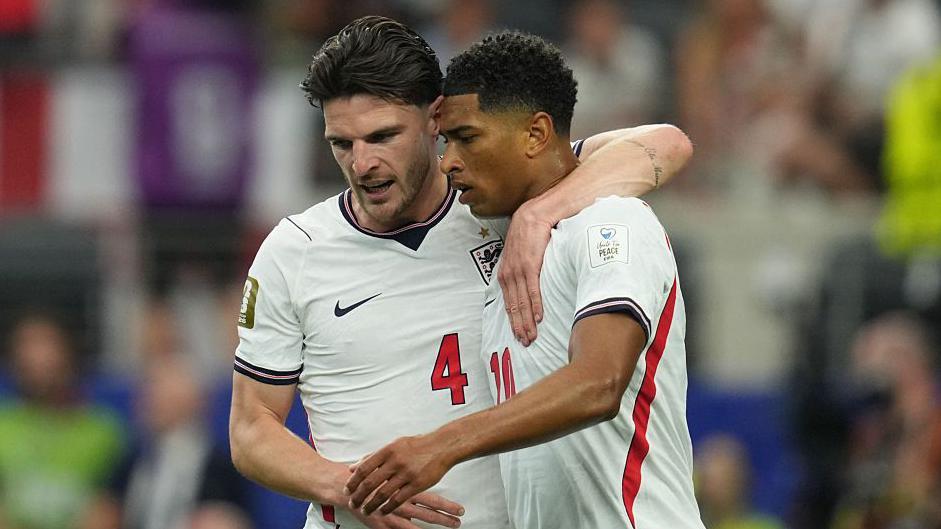
POLICY WIRE — Doha, Qatar — It’s the silent saboteur lurking just beneath the roar of the crowd, more insidious than a hamstring tweak, more unpredictable than the bounce of a ball on a worn pitch. In the cutthroat arena of the World Cup, it’s the yellow card—the innocuous piece of plastic that can snatch a superstar from the limelight and a nation’s hopes with it. For England’s midfield engine, Declan Rice, and the incandescent Jude Bellingham, amongst others, every challenge, every whispered word to an official, carries the weight of a quarter-final—and beyond. They’re not merely chasing victory; they’re dodging disciplinary damnation, dancing on a knife-edge with their World Cup dreams.
England’s hard-won triumph against Mexico in the Last 16, a spectacle played out in the thin air of the Azteca, came with a bitter aftertaste. Marc Guehi, Nico O’Reilly, — and Rice all found themselves in the referee’s notebook. Bellingham, the sensation of the tournament, already had one against DR Congo. Any subsequent booking would mean a forced sabbatical from the semi-final stage, assuming Gareth Southgate’s men navigate the coming challenges. Jordan Henderson, too, was cautioned, though a wrist injury might have him out anyway. It’s a cruel twist, isn’t it? The same ferocity that elevates a player often makes them a magnet for the ref’s pocket.
Thomas Tuchel, England’s usually unflappable manager, seemed to grapple with the quandary post-match. “These lads are warriors, they play with heart, and that’s precisely what we need,” he told Policy Wire, a rare moment of candidness amidst the usual PR gloss. “But even Achilles had a heel. We trust ’em to be smart, to channel that aggression, but a bad tackle, a moment of frustration, and suddenly your entire strategic blueprint for a semi-final is just… dust. It’s a high-wire act, plain and simple.” His words hang in the air, a tacit acknowledgment of the fragile line between glory and a two-game ban.
Because the rules, like most things under FIFA’s dominion, are meticulously layered. Yellow cards from the group stage mercifully vanish. But accumulate two across the Last 32, Last 16, — and quarter-finals? Boom. You’re watching the next game from the stands. If you pick one up in the Last 32 or Last 16, — and then another in the quarter-final, the semi-final’s a no-go. For Rice, cautioned in the first minute against Mexico, and Bellingham, who earned his against DR Congo, that risk feels all too present. One false move. That’s all it takes.
And it’s not just the Three Lions feeling the heat. France, Spain, Argentina, Switzerland, Norway—they’ve all got players in the yellow zone. Michael Olise, Bradley Barcola, Manu Kone for France. Ferran Torres for Spain. Achraf Hakimi, Morocco’s talismanic captain, faces the same predicament after being booked against Canada. For a player like Hakimi, his every touch, every duel, carries a weight that transcends the pitch. He isn’t just representing a team; he’s carrying the hopes of North Africa, of the Arab and Muslim world, whose gaze is fixated on the Atlas Lions. “For us, it’s not just a game; it’s a statement for a whole continent,” Hakimi reflected to reporters last week, prior to his booking. “Every step, every foul, carries weight. We’re not just playing for ourselves, but for pride and opportunity.” His situation speaks volumes about the layered pressure. These aren’t just disciplinary hurdles; they’re moments of national suspense played out on a global stage. The absence of a player of his calibre—who’s practically a national hero back home—isn’t just a tactical blow, it’s a spiritual one for millions.
A recent statistical analysis, compiled by ‘World Football Stats HQ’, revealed that teams lose, on average, 12% of their expected goal contributions when a key attacking or box-to-box midfielder is suspended due to yellow card accumulation in World Cup knockout stages. That’s a significant drop when every goal, every decision, every moment, feels existential. The game’s often brutal calculus makes the individual error incredibly costly.
📄 POLICY WIRE WHITEPAPER PUBLISHED: PAKISTAN'S NATIONAL SECURITY POLICY PRIORITIES
👉 READ BY CLICKING HEREThis isn’t about blaming the players. It’s about the very nature of modern elite football—fast, physical, relentlessly scrutinized. A quick clip by a defender, a frustrated swipe at the ball after a whistle, a mere second of dissent; all these prosaic actions, under the intense glare of the World Cup, can alter a team’s destiny. FIFA’s rulebook, meant to uphold fair play, inadvertently creates a unique psychological strain. It forces coaches to weigh the passion of a player against the pragmatism of preserving their eligibility. You can almost feel the strategic machinations unfolding in the war rooms of the world’s top football nations, where contingency plans for sidelined stars are being frantically sketched. It’s less about brute strength — and more about nerve. And sometimes, you see, nerve cracks.
What This Means
The impending suspension threats aren’t just an internal squad issue for Tuchel or any other coach. They represent a fascinating intersection of elite sport, high-stakes finance, — and even geopolitics. When star players, particularly those from commercially lucrative leagues like the Premier League, are benched, it sends ripples across their home nations and their professional clubs. Imagine the commercial value—the sponsorship deals, the TV rights, the merchandise sales—tied to the presence of a Bellingham or a Hakimi in a semi-final. Their absence isn’t just a sporting disadvantage; it’s a dent in the brand equity of the World Cup itself and, crucially, a significant impact on national morale. Consider the broader economic implications: for instance, nations with deep-pocketed football associations might have the luxury of bench depth, while federations with shallower pockets, like many in Africa and Asia, simply cannot afford to lose their marquee players. This economic disparity often plays out in how national teams approach player management—from conditioning to disciplinary protocols—further widening the gap between football’s haves and have-nots. For some countries, a single star’s early exit isn’t just about football; it’s a loss of national pride, a missed opportunity on the world stage, and a potential blip in the economic narrative their leaders hope to project. It highlights the raw, sometimes unfair, consequences of a universal rule applied to an inherently unequal global ecosystem.