


National Bans Won’t Stop Online Radicalization
The world has woken up to one half of the problem: that viral content can radicalize a child. Beyond certain circles, society has not yet reckoned with a second problem that armed groups have learned...

The world has woken up to one half of the problem: that viral content can radicalize a child. Beyond certain circles, society has not yet reckoned with a second problem that armed groups have learned to exploit the very same systems, deliberately, to reach the people no one else can.
When Australia and the United Kingdom announced sweeping bans on social media use for children under sixteen, the world took notice. These measures were designed to shield young people from the harms of unfiltered digital exposure, which range from the deterioration of mental health to the darker risk of falling prey to extremist propaganda.
Australia’s amendments to the Online Safety Act 2021 now prohibit under-sixteens from creating accounts on major social platforms, with penalties that were recently doubled to A$99 million for systemic non-compliance. The United Kingdom followed, with Prime Minister Keir Starmer announcing in June 2026 that a similar ban would take effect by spring 2027.
These are serious, well-intentioned laws. But they were built for one kind of danger and not another. The child-safety wave was driven by unintentional harms, bullying, addictive design, the mental-health toll of too many hours on a feed. No one drafting the Australian ban had insurgent recruitment in mind. Yet those same conditions open a door. The more time a young person spends inside an algorithmic feed, the more that feed learns to hold their attention and what holds attention best is content that is loud, extreme, and emotionally charged. The design that maximizes engagement is the same that surfaces violence. What begins as a mental-health problem becomes, at its far end, an exposure problem. Armed groups have understood how attention is captured and how belonging is manufactured on these platforms, and they use both with intent.
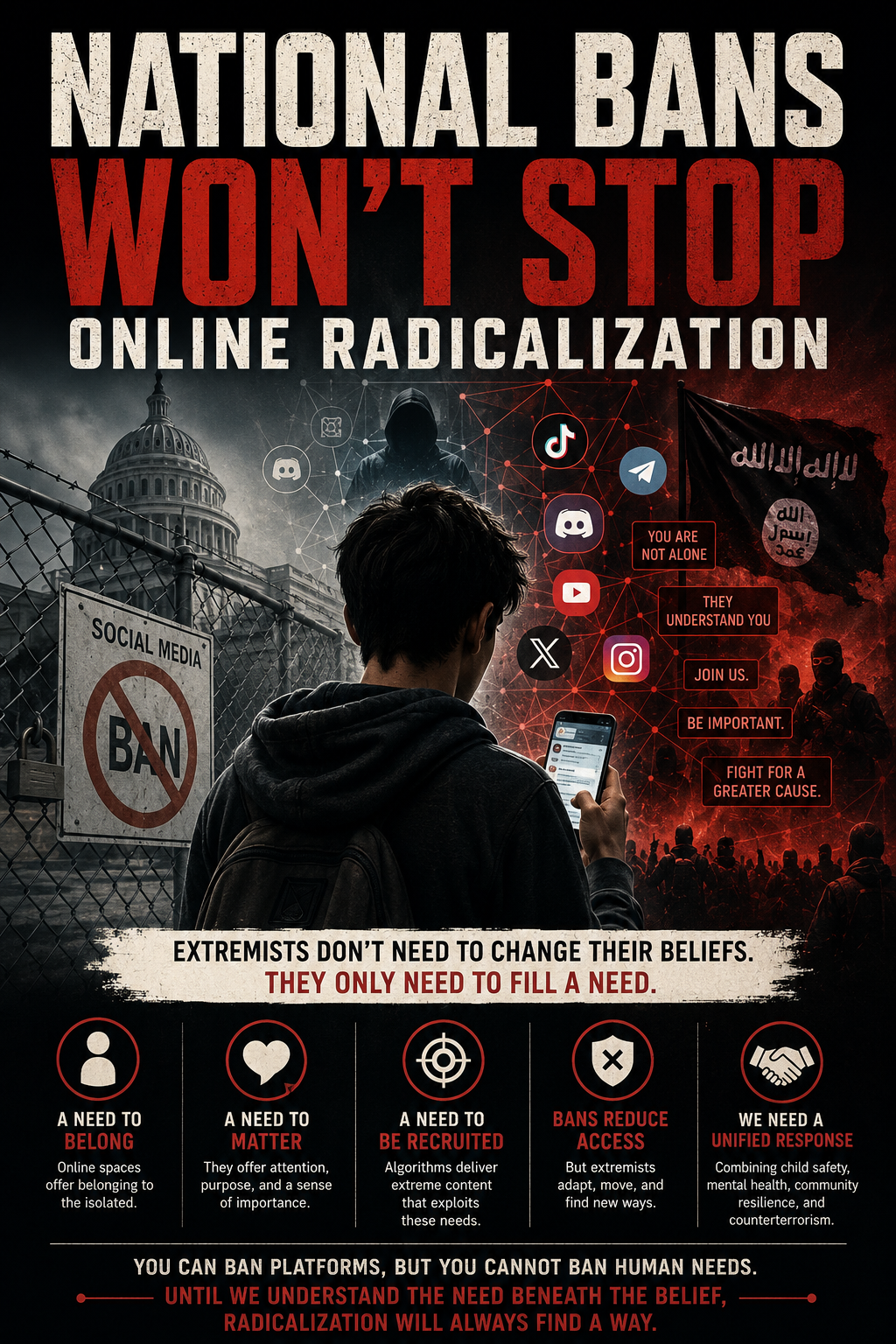
This produces a strange gap. The harm an algorithm does to a vulnerable teenager is treated as a child-safety question, handled by regulators. The recruitment an armed group conducts through that same algorithm is treated as a counterterrorism question, handled by an entirely different set of institutions. The two rarely meet. They are, in fact, halves of one problem and the space between them is where recruitment now happens.
The Need Beneath the Belief
For two decades, counterterrorism has rested on one assumption: that a dangerous person can be identified by what they believe. Find the ideology, the flag, the scripture, the manifesto, the known network and you find the threat. Watchlists, content moderation, and the systems platforms use to detect and remove extremist material are almost all built to recognize belief. That assumption is failing, because belief was never what drove the danger.
That is why the internet changed radicalization so completely, and why it did so without having to change anyone’s beliefs. Online content does not need to sell an ideology. It only needs to supply the underlying need such as attention, belonging, the sense of mattering to a group that notices you and it supplies it to anyone, regardless of what they believe or whether they believe anything at all. Researchers at the Global Network on Extremism and Technology (GNET), applying the significance-quest model to the newest online networks, reach the same conclusion: the need to matter can drive radicalization not through developed ideology, but through social belonging alone.
What makes this so dangerous is that the belonging is false, and the isolation it feeds on is real. A young person cut off from the connections that once anchored people, a stable peer group, a community, a place they were known finds online a sense of being seen that asks nothing of them and costs nothing to leave behind. But that substitute belonging does not repair the isolation; it deepens it, by removing the discomfort that might otherwise push someone back toward real relationships. The lonelier a person becomes, the more the feed can offer, and the more it offers, the less reason there is to look elsewhere. Recruitment networks understand this exactly. They do not need to find the already radicalized. They only need to find the isolated and supply the belonging that no one around them is providing.
Once the need is understood, the detection problem follows directly. Every system built to catch extremism was built to read ideology — the religious imagery, the known symbols, and the doctrinal language. But a person’s need to belong leaves none of those traces. This is no longer theoretical. It has produced what analysts now call nihilistic violent extremism: online networks organized around violence and belonging with no ideology behind them at all, and the systems built to detect belief cannot see them.
The Digital Playground of Extremists
For a decade, the clearest proof of how well the internet supplies that need came from ISIS. The group built what analysts have called one of the most sophisticated propaganda operations any terrorist organization ever produced, reaching a global audience it could never have touched in person. Its English-language magazines, Dabiq and Rumiyah like al-Qaeda’s earlier Inspire, known for its “open-source jihad” attack instructions worked less as statements of doctrine than as recruitment tools, aimed at young people across continents.
What that reach could do was made unforgettable by three London schoolgirls. In 2015, Shamima Begum and Amira Abase, both fifteen, and Kadiza Sultana, sixteen students at a respected East London school, were drawn in online without any recruiter meeting them in person and travelled through Istanbul to Syria. Begum’s case has since become a years-long legal argument over whether she was a victim or a culprit. But recruitment itself became the defining image of the era precisely because it broke the stereotype: these were not the desperate or the marginal, but ordinary teenagers a feed had found.
ISIS announced its ideology in every frame the flags, the scripture, the black banners and detection, in time, learned to recognize it. The content that most alarms counterterrorism researchers now is harder to catch, because it has done the opposite. It has taken the recruitment and left the ideology behind.
Terror Without Ideology
Nihilistic violent extremism has a concrete face. Networks such as “764” and the wider “Com” ecosystem are organized not around a cause but around harm itself, the glorification of past mass shooters, the coercion of minors, and the treatment of cruelty as a source of status. By late 2025 the FBI reported more than 350 active investigations into these networks, with victims estimated in the thousands, and Canada became the first country to designate one of them a terrorist entity.
What makes them so difficult to detect is exactly what the significance-quest model predicts. As the Institute for Strategic Dialogue documents, these communities substitute aesthetics for ideology: meaning is carried in memes, gore, and coded imagery rather than doctrine, and violence, when it comes, has no political or religious justification behind it. GNET’s own research names the challenge plainly: the markers these groups leave are behavioural and aesthetic, signalling affiliation without any explicit ideological statement. Which is precisely the kind of signal detection systems were never built to read.
There is a live argument among analysts over whether “nihilistic violent extremism” is even the right term, since some of these actors do carry fragments of older neo-Nazi or accelerationist thinking. But that dispute proves the point rather than undercutting it: the categories built to sort threats by ideology no longer describe the threats cleanly, because ideology is no longer where the danger begins.
The Threat That Reaches the West
It would be comforting to treat all of this as someone else’s problem, confined to conflict zones and distant insurgencies. It is not. The same pattern now drives violence inside the West’s own borders, increasingly with no organized group behind it at all.
Consider the most distinctly American form of it. School shootings are not recruitment, and the science linking social media directly to youth violence is genuinely contested, no serious researcher claims a feed pulls a trigger. But a related and far better-established phenomenon is at work: contagion. Decades of research show that intensive coverage of an attacker including the name, the manifesto, and the body count can inspire copycats among those seeking the same notoriety, clustering incidents after a high-profile attack. Social media has poured accelerant on that older dynamic: it amplifies grievance and isolation, surfaces violent content to those most drawn to it, and sustains the communities that keep past attackers’ names in circulation long after the news has moved on. No one is recruited. Exposure and emulation do the work an organization once had to.
The wider pattern is documented and accelerating. According to the Global Terrorism Index, terrorist incidents across Western countries rose to fifty-two in 2024, up from thirty-two the year before, and seven Western nations including the United States, Germany, France, and the United Kingdom now rank among the fifty most affected countries in the world. The overwhelming majority of these attacks were carried out by lone actors, most radicalized online, and in most cases investigators could link them to no organization at all. The path from first exposure to an act of violence, which once took more than a year, now unfolds in some cases in a matter of weeks.
West Point’s Combating Terrorism Center has traced this path across a series of European lone-actor cases most of the attackers young, several of them minors drawn from exposure toward action through short-form video and encrypted chat. The common thread is not a particular ideology. It is the same need in every case: emotional vulnerability, a feed that supplies ever more charged content, and a sense of belonging that hardens into obligation. Whether the endpoint is a school shooting in America, a plot in Europe, or a suicide vest in South Asia, the beginning is the same and it is the beginning that no national child-safety ban currently reaches.
A Terror Group’s Digital Recruitment
If nihilistic networks sit at one extreme, with no ideology to find, the Balochistan Liberation Army sits at the other. It has a clear ideology and has learned to hide it. The most advanced current practitioner of all this is not a jihadist group and does not want to look like one. The Balochistan Liberation Army (BLA), a separatist insurgency designated a terrorist organization by Pakistan, the United States, the United Kingdom, and the European Union, has built an online operation that in some respects surpasses the jihadist model it followed. Its media wing, Hakkal, has been documented by analysts at the Centre for Democracy and Global Affairs as showing a sophisticated command of narrative and perception.
During its coordinated “Operation Herof-2” offensive in early 2026, Hakkal released footage that was professionally sequenced and multilingual statements in Balochi, Urdu, and English, reaching local, national, and international audiences at once presenting a scatter of separate attacks as a single centralized campaign. The material has a distinctly cinematic, almost Bollywood quality: staged marches, scored sequences, footage shot from several angles, and, increasingly, drone imagery, the group having announced a dedicated drone unit after the offensive. Where insurgent propaganda was once crude, this is choreographed. It is made to be watched, shared, and admired.
Hakkal’s core operation runs on Telegram, from which shortened clips, reels, songs, stylized videos are pushed out onto mainstream platforms, with links drawing viewers back to the closed channels. On TikTok, the content circulates as ordinary-looking youth media, so effectively that the Balochistan government has described the phenomenon as “social manoeuvring” aimed at radicalizing young people and debated in the provincial assembly the reality that militant mobilization had become, in its words, TikTok-centric.
Every system meant to catch online radicalization was trained on the markers of jihadist extremism, the iconography, the vocabulary, the networks of global jihad. The BLA carries none of it. Its messaging is secular and grievance-based, built around resource extraction, the China-Pakistan Economic Corridor, and ethnic dignity, and framed in the language of national liberation rather than religion. To a system trained to recognize jihadist content, it does not read as terrorism at all. It reads as political speech and that misreading is the group’s single greatest advantage. The same moderation that would take down an ISIS clip in minutes lets this content stay up.
The result arrived on a public bus in Sindh in the last week of December 2025. Police stopped a teenage girl travelling from Balochistan toward Karachi. Under questioning, she said she was on her way to meet a handler to carry out a suicide attack. She had been recruited entirely online for several months. Investigators said she was promised that carrying out the attack would bring her honour and recognition. Authorities ultimately treated her as a victim rather than a suspect, placing her under state protection. No recruiter ever met her in person. The London schoolgirls at least had to cross borders to reach the danger. She had to cross nothing. She reached where she was on her phone and pointed toward a suicide vest.
Generative AI is now making all of this easier. West Point’s Combating Terrorism Center notes that generative AI lets groups produce propaganda at scale and specifically to evade the systems built to remove it; Tech Against Terrorism documents that from a single image an actor can generate thousands of variants that defeat detection systems built to match known content and translate propaganda into languages fast enough to overwhelm human moderators. The two weaknesses that AI is built to overrun, detection that looks for known material and moderation that cannot read every language. Whether the ideology is hidden or absent, AI lets both ends of the spectrum produce more of it, faster than detection can adapt.
Laws Built for Bullying, Not for Recruitment
Set against all of this, the new child-safety laws are aimed at a different target. Neither the Australian nor the British law was designed with counterterrorism in mind, and neither claims to be. Australia’s amendment is built around the mental-health harms of heavy use, addictive design, and cyberbullying. The UK’s Online Safety Act reserves its strictest “primary priority” category the content platforms must most actively keep from children for pornography and material encouraging suicide, self-harm, or eating disorders, while violent content sits in a broader, more lightly enforced tier.
Age verification, in other words, was built to keep a thirteen-year-old off a pornography site. It was not built to stop and does not obviously succeed at stopping, a sixteen- or seventeen-year-old, just above the cut-off, from encountering a professionally produced recruitment video that a recommendation system has judged engaging.
Critics of both laws have also noted that banning accounts does not stop browsing: children can still find and view content on the open web without logging in, only without the moderation and parental controls that come with an account. If that criticism holds, it cuts both ways. A login ban may make it harder to feed radicalizing content to a known fifteen-year-old, but it does nothing to stop that content from surfacing through an open search or a shared link, which is how it spreads regardless.
National Efforts, Global Gaps
States are racing to rein in harmful content, but without a shared approach the results stay patchwork. VPNs and weak enforcement let users slip past restrictions. An Australian study found most under-age users stayed online after the ban by declaring a false age. Violent movements exploit the same jurisdictional seams, moving content across borders with ease.
Governments regulate what happens within their own borders, while the platforms hosting the content operate across all of them at once. Extremist media exploits exactly that seam: when one country tightens enforcement, the material shifts to encrypted or lightly moderated channels, then re-enters mainstream platforms in edited form. A platform can be fully compliant with Australian or British law while remaining wide open to content produced in Quetta or elsewhere, as long as that content does not trip the specific triggers those laws were written to catch.
Even the world’s most ambitious framework runs into the same wall. The European Union’s Digital Services Act goes well beyond a child-safety ban, requiring the largest platforms to assess and reduce systemic risks, including the spread of illegal content, with fines reaching into the hundreds of millions. But it is territorial by design: it governs what EU users see, not what circulates in Balochi on a channel hosted elsewhere. And it has become a flashpoint rather than a template by late 2025 the dispute over its reach had grown into a diplomatic clash, with the United States accusing EU regulators of censoring speech. If the most powerful regulation in the world cannot reach past its own borders, the case for coordination beyond them only grows.
A Call for Global Action
Detection systems have adapted before, but only slowly: the far right was missed for years, treated as a policing matter rather than a terrorism one, until a series of mass-casualty attacks forced the frameworks to widen and the next adaptation, to secular insurgencies that hide their ideology and networks that have none, has not yet been made. That the categories are straining is visible in the fact that analysts now openly dispute what to call these things at all, because the sorting system built around ideology no longer fits threats.
The good news is that the tools for response largely exist. After the 2019 Christchurch Mosque attack was livestreamed and copied across the internet, governments and platforms built the Christchurch Call and strengthened the industry’s Global Internet Forum to Counter Terrorism to share the digital fingerprints of terrorist content so it could be removed everywhere at once. It was a genuine step. But it carries the same flaw as everything else here: the governments and companies involved do not share a definition of terrorism or extremism. It is hard to jointly remove content when there is no agreement on what counts. The fix is not a new system but a change in what the existing ones look for. Three steps matter most.
The first is to detect behaviour, not just belief. If ideology is no longer where the danger reliably shows itself, then detection trained only on ideological markers will keep missing it. GNET’s own researchers have proposed the alternative: focusing on the behavioural and aesthetic markers that signal violent mobilization even when no doctrine is stated. Shifting the coordinating bodies, the Christchurch Call and GIFCT toward that standard is the single most important move available.
The second is capacity. A great deal of recruitment content survives simply because no system or moderation team is equipped to read the language it travels in, Balochi, Pashto, or the secular, nationalist idiom the BLA uses. Closing that gap is not a matter of new law but of investment in people and tools to apply the rules that already exist.
The third is that age assurance has to actually work. Verification that can be defeated by declaring a false age offers only nominal protection, and it is the foundation the child-safety laws rest on.
None of this requires a new treaty. It requires the existing efforts to recognize the threat as it is now, rather than as it looked a decade ago.
Social media is no longer only a tool of connection; it is an instrument of influence, and it is being used as one. The child-safety reckoning underway across the West is a genuine step forward. But it is fighting half of a war it has not fully recognized. The half where the danger still wears a recognizable face. The other half has already learned to go without one. Until the response reaches that far, and until it crosses the same borders the threat already does, the young will remain exposed to a danger the new laws were never written to stop.
Author