

Kuwait-Pakistan Defence Pact: A Strategic Partnership for Regional Stability
The ratification of the Pakistan-Kuwait Defence Cooperation Agreement is not just a mere act of activating an already signed defence agreement between the two states in 2023 but an indicator of the...

The ratification of the Pakistan-Kuwait Defence Cooperation Agreement is not just a mere act of activating an already signed defence agreement between the two states in 2023 but an indicator of the ongoing transformation in Pakistan’s defense diplomacy in the Gulf region as well as the growing strategic partnership between the two countries, whose security priorities have always been aligned with one another. In a world where the Middle East continues to suffer from political instability, security threats beyond borders and technological revolution in war, it is clear that Islamabad and Kuwait are planning for future institutional cooperation.
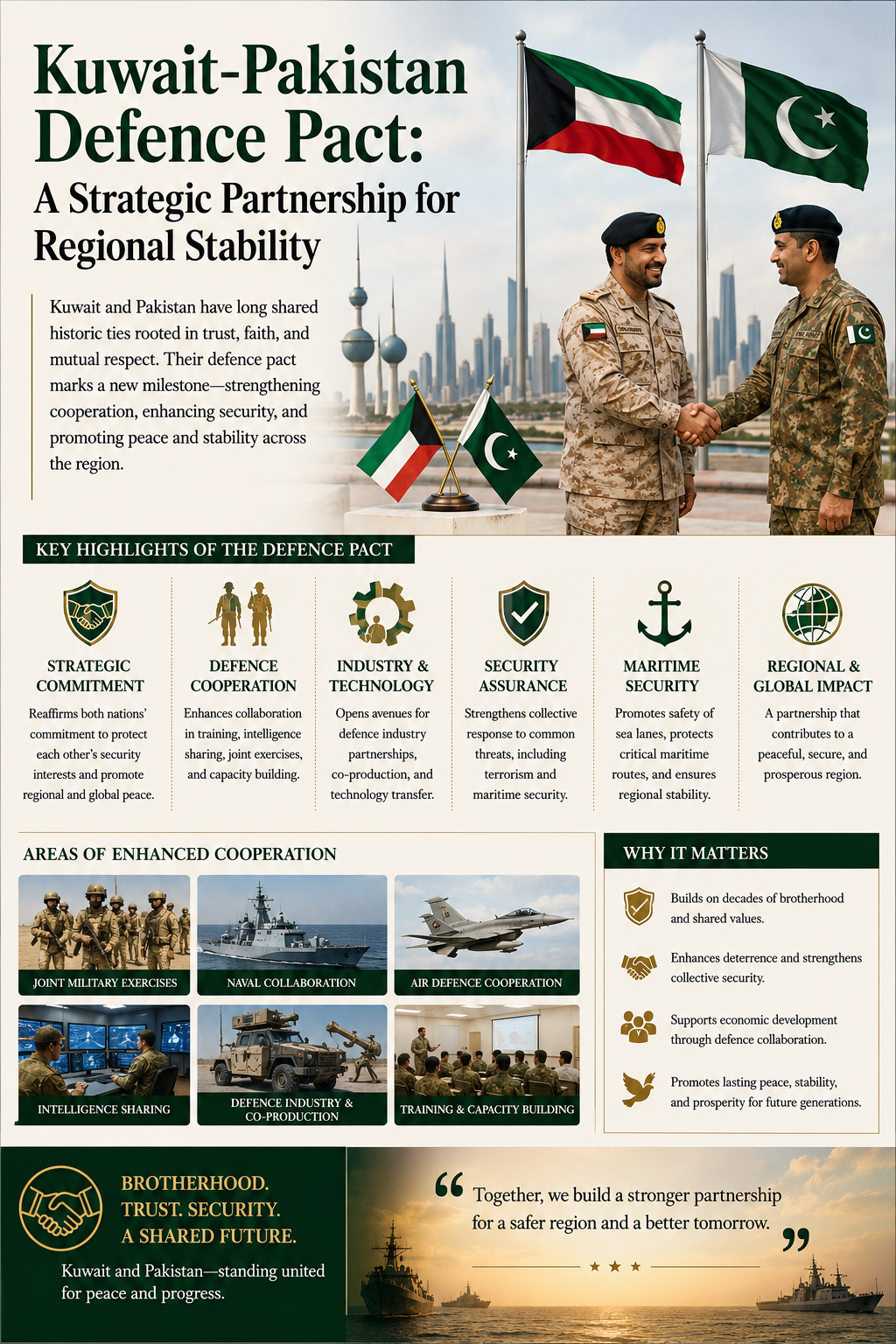
The treaty includes a wide variety of cooperation such as military training, professional education, intelligence sharing, logistics, defense technologies, science and research, defense manufacturing industry, communication and joint drills among others. The treaty’s comprehensiveness is what makes it one of the most complete treaties on defense cooperation between Pakistan and a member of Gulf Cooperation Council (GCC). More importantly, it institutionalizes the defense cooperation through establishment of a joint committee whose mandate is the implementation and solving of issues arising from cooperative programs.
This treaty marks yet another achievement for Pakistan’s increasing defense diplomacy efforts. Pakistan’s military has always had strong professional relations with the Gulf countries. This has been achieved through various military training missions and advisory programs that have been offered to the countries. Thousands of military officers from allied countries have passed through military institutions of Pakistan. The step taken by Kuwait reflects their confidence in Pakistani military’s professionalism and defense education system.
From Kuwait’s standpoint, this accord fits into a larger strategy aimed at diversifying security partners while improving the capabilities of national defence forces. The security situation in the Gulf region is becoming more complicated, which can be attributed to rivalry between countries, maritime security issues, drones warfare, cyber threats, and advanced missile technologies proliferation. None of the countries in the region will be able to cope with such complex threats alone. Partnership in defence forces with countries that have extensive experience in military matters and know-how of the latest defence issues, like Pakistan, will allow Kuwait to benefit from training, doctrine expertise, and experience acquired throughout years of counterterrorism, force building and peacekeeping operations.
In this respect, defence technology and military manufacturing cooperation must be highlighted. Defence partnership in the contemporary world goes far beyond simple military training and cooperation. Countries are looking for ways to cooperate in research and development, communications technology, artificial intelligence, cyber, unmanned, and indigenous manufacturing. The developing defence industry of Pakistan proved to be capable of manufacturing competitive military platforms and technologies which can be of use to friendly countries.
The intelligence-sharing terms of the agreement are no less important. Modern security challenges do not take into consideration national boundaries. For example, terrorist organizations, organized crime, financial transactions, cyber and maritime threats need a coordinated response that is only possible with the exchange of relevant intelligence. Cooperation based on the sharing of information will increase situational awareness and help the two nations react quickly to challenges before they become serious crises.
In addition, the agreement contributes to Pakistan’s strategy of interaction with the Gulf states. Pakistan’s foreign policy traditionally emphasizes the idea of balance; the country seeks to ensure its own security without being involved in regional rivalry. The policy of Pakistan consists in the development of dialogue, diplomacy and collective security measures but not bloc politics. This type of agreement complements it by building institutional cooperation without addressing any other nation.
Considering the perspective of international relations, the deal is a manifestation of the cooperative security paradigm. Cooperative security is defined as an arrangement under which the states seek to improve their security situations through confidence building, transparency, and institutionally organized cooperation with trustworthy partners. Unlike alliance politics, which normally uses deterrence through threat, cooperative security uses certainty reduction through continuous engagement and interoperability to achieve its objective. Formation of the joint military committee is an example of an institutionally organized form of cooperative security.
The deal helps Pakistan portray itself as a security provider as opposed to being a security seeker. Pakistan ranks among the top providers of troops to the peacekeeping missions of the United Nations. Additionally, the country has vast operational experience in the fields of counter-terrorism, disaster management, and traditional military operations. Sharing of such experience with others through defense partnerships will boost regional security and make Pakistan a responsible state.
Five-year renewal brings an aspect of certainty to the process. Any defence partnership must be based on continuity to be successful. Long-range planning makes it possible for both parties to engage in joint drills and exercises, exchange officers and develop operational procedures and collaborate in various research ventures.
The inclusion of clauses concerning the protection of classified military information is yet another sign of maturity in the bilateral relations. Only under such conditions will strategic cooperation be able to take root. The mutual trust is necessary here for the development of productive and mutually beneficial cooperation.
Finally, the moment chosen for signing the treaty is also telling. The Gulf region sees its own strategic realignment, as countries are seeking to build diversified foreign relations as well as build up their indigenous defence industry. At the same time, Pakistan is following an active policy of strengthening its ties with the Gulf partners in this area.
Apart from military matters, enhanced defence relationships can also have beneficial spill-over effects on trade, investments, technology, education, and people-to-people contacts. Cooperation in security fosters mutual trust, and trust is conducive to more extensive economic and diplomatic relations. For Pakistan, which is strategically located at the intersection of South Asia, Central Asia, the Middle East, and the Arabian Sea, better defence ties with Gulf countries mean better integration into the regional security architecture.
Thus, the Kuwait-Pakistan Defence Cooperation Agreement cannot be seen merely as another piece of bilateral military paper. This is a strategic initiative aimed at fostering institutional trust, regional stability, and future security cooperation through cooperation in training, intelligence, technology, manufacturing, and joint planning.
In an age when the nature of threats facing the countries is highly intertwined and uncertain, professional, respectful, and interest-based partnerships are becoming increasingly significant. The signing of this agreement by Kuwait is evidence of the fact that Pakistan is still a defence partner that is trusted in the Gulf region, and of the fact that security in the modern world is to be built through cooperation, rather than confrontation.
Author