


Uzbekistan and Pakistan: Turning Strategic Partnership into Regional Opportunity
The recent meeting between Uzbekistan’s Foreign Minister, Bakhtiyor Saidov, and Pakistan’s Deputy Prime Minister and Foreign Minister, Senator Mohammad Ishaq Dar, represents another important step in...

The recent meeting between Uzbekistan’s Foreign Minister, Bakhtiyor Saidov, and Pakistan’s Deputy Prime Minister and Foreign Minister, Senator Mohammad Ishaq Dar, represents another important step in the growing relationship between the two countries. According to the Uzbek side, both governments have agreed on practical measures to transform the renewed momentum in bilateral relations into tangible outcomes, with particular emphasis on trade, transport connectivity, regional cooperation, and coordination within international organisations. (Uzbekistan Embassy)
For Pakistan, this partnership should not be viewed merely as another diplomatic engagement. It is part of a broader strategic vision that connects South Asia with Central Asia through commerce, infrastructure, and shared economic interests. Likewise, for Uzbekistan, a double landlocked country seeking greater access to global markets, Pakistan offers the shortest route to warm-water ports through Karachi, Port Qasim, and Gwadar. The relationship is therefore built not only on political goodwill but also on compelling economic geography.
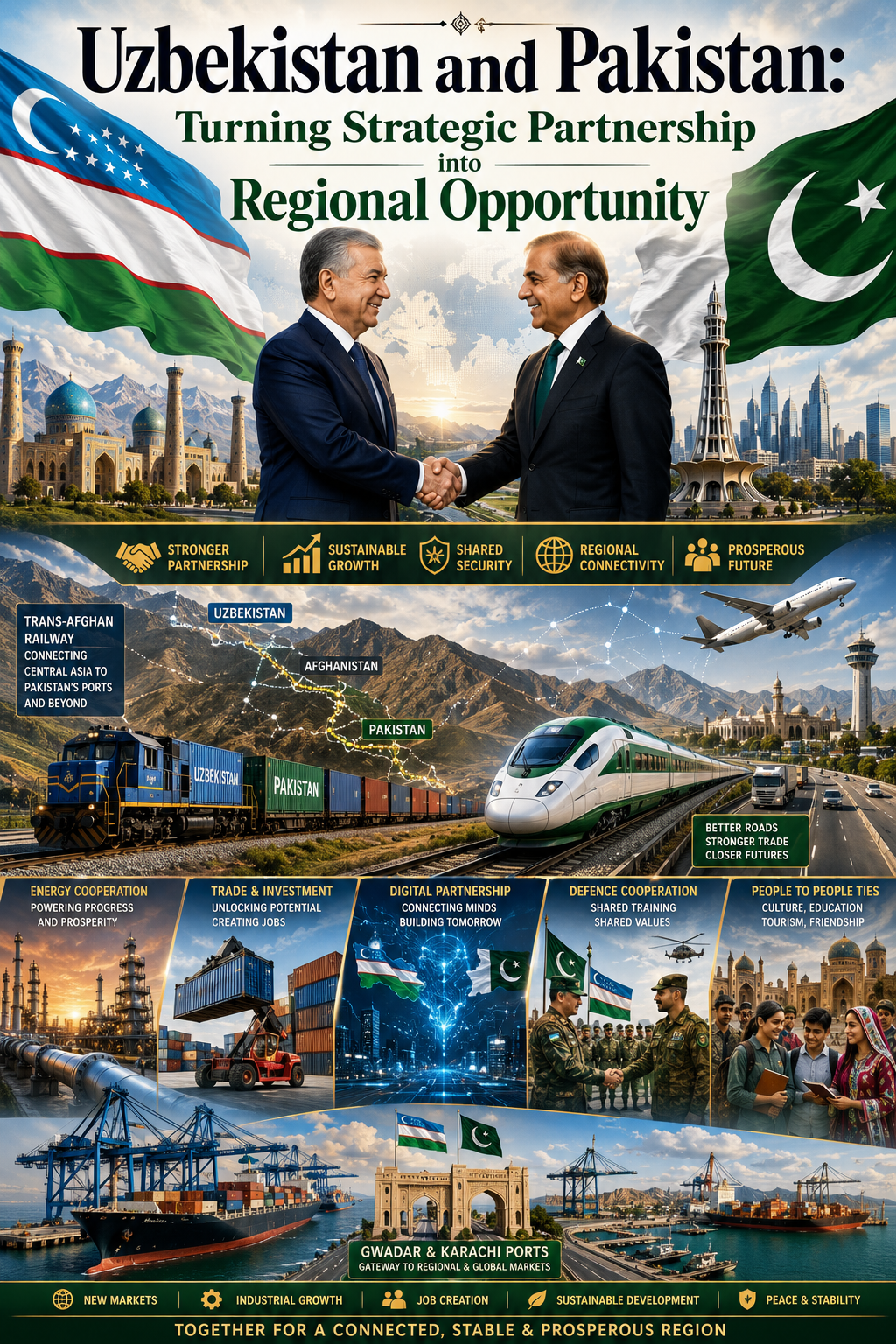
The significance of this partnership lies in connectivity. Central Asia has long sought reliable access to international sea routes, while Pakistan has consistently promoted itself as the natural gateway linking Central Asia, the Middle East, and the Indian Ocean. Projects such as the Trans-Afghan Railway and improved road and rail networks have the potential to reshape regional trade if security and financing challenges can be addressed. Successful implementation would reduce transportation costs, diversify export routes, and strengthen regional supply chains benefiting both countries.
Trade remains another area with considerable untapped potential. Despite warm diplomatic ties, bilateral trade has remained below its true capacity for years. Expanding the Preferential Trade Agreement, encouraging business-to-business engagement, simplifying customs procedures, and promoting investment in textiles, pharmaceuticals, agriculture, information technology, and logistics can substantially increase commercial exchanges. Earlier this year, both countries also agreed to establish mechanisms such as a Business Council and an Interregional Forum, demonstrating that institutional frameworks are already being created to support deeper economic cooperation. (UzDaily.uz)
Beyond economics, the partnership carries wider geopolitical importance. In an increasingly fragmented international environment, middle powers are seeking diversified partnerships rather than relying exclusively on traditional alliances. Uzbekistan and Pakistan share an interest in regional stability, economic integration, and multilateral diplomacy. Their continued coordination within organisations such as the Shanghai Cooperation Organisation (SCO), the Economic Cooperation Organization (ECO), and the Organization of Islamic Cooperation (OIC) can strengthen collective approaches to regional development, connectivity, counterterrorism, and sustainable growth.
Nevertheless, optimism should be balanced with realism. Many ambitious regional initiatives have struggled because of political instability, financing constraints, bureaucratic delays, and security concerns, particularly regarding transit through Afghanistan. Diplomatic declarations alone cannot overcome these structural challenges. Success will depend on sustained political commitment, consistent implementation, private-sector participation, and improved security cooperation among regional stakeholders.
Ultimately, the latest diplomatic engagement reflects a broader shift in regional thinking, from political symbolism to practical cooperation. When both governments successfully translate their strategic dialogue into measurable economic projects, the benefits extend beyond bilateral relations to the wider Central and South Asian region. Enhanced connectivity, increased trade, stronger institutional cooperation, and sustained diplomatic engagement transform this partnership into one of the region’s most promising examples of mutually beneficial cooperation.
The real test now is implementation. Strategic partnerships are not measured by the number of meetings held or communiqués issued; they are measured by new railway links completed, businesses created, trade volumes increased, jobs generated, and opportunities delivered to ordinary citizens. Uzbekistan and Pakistan have laid the diplomatic foundation. The next chapter will depend both countries converting ambition into results.
Author