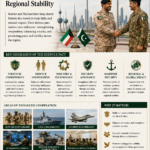


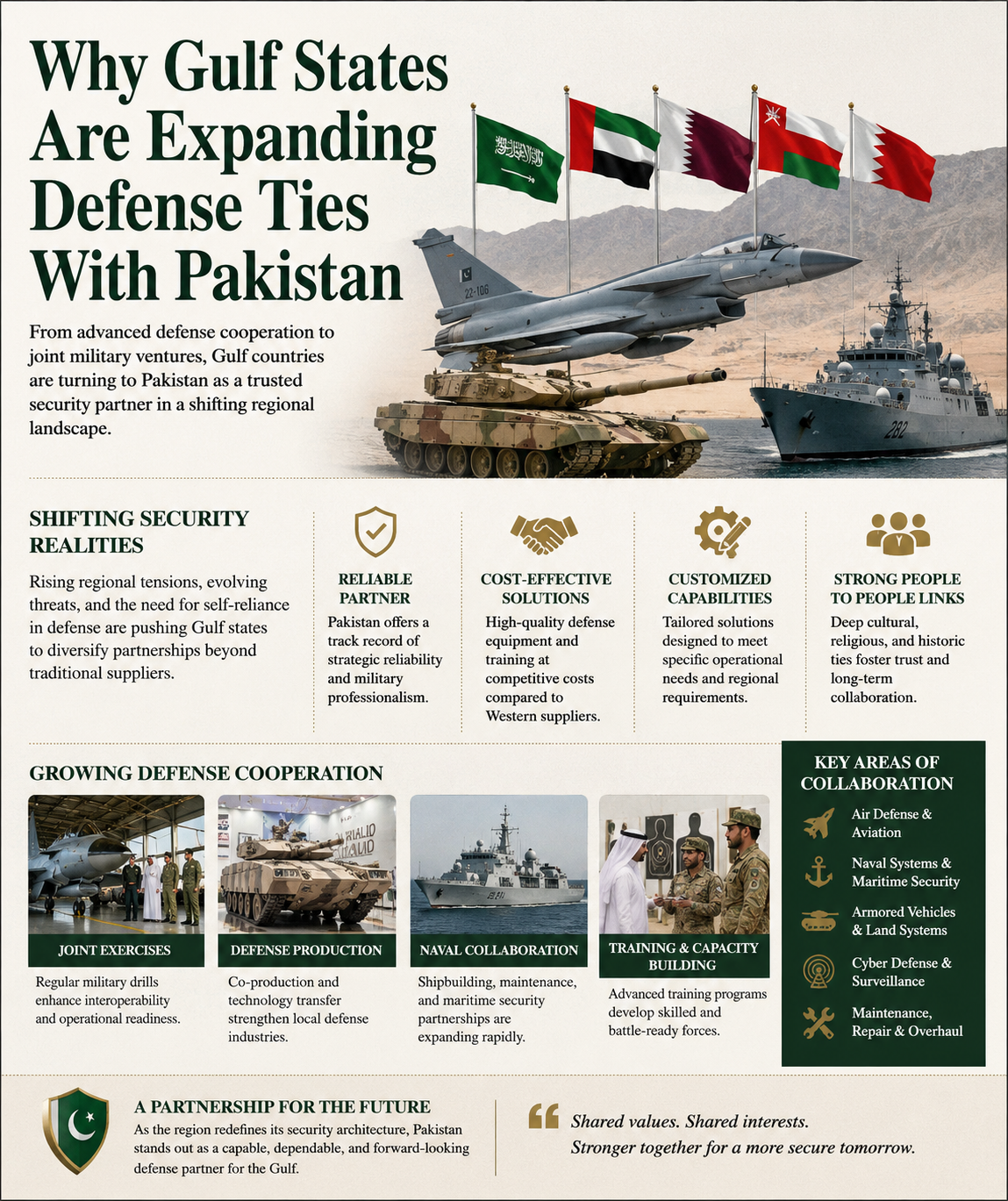
Why Gulf States Are Expanding Defense Ties With Pakistan
A Pattern Written Into History Classical balance-of-power theory holds that exposed states seek alliances with capable partners whenever their own deterrence looks insufficient against a rising...
A Pattern Written Into History
Classical balance-of-power theory holds that exposed states seek alliances with capable partners whenever their own deterrence looks insufficient against a rising threat, a logic scholars trace back to Thucydides and that Stephen Walt later refined into his “balance of threat” model. Gulf monarchies have followed this pattern with Pakistan for decades rather than discovering it overnight. Pakistani forces helped Saudi troops retake the Grand Mosque in Mecca during the 1979 siege, and up to 13,000 Pakistani troops, backed by another 6,000 military advisers, deployed to Saudi Arabia around the 1991 Gulf War to help protect the kingdom from Iraqi aggression. Pakistani officers have trained Gulf militaries in Bahrain, Oman, and the UAE for over half a century.
What has changed is not the relationship itself but its formal shape. Gulf states spent decades treating Pakistan as a manpower and training partner while keeping Washington as the primary security guarantor. That arrangement is now being renegotiated in real time, and Kuwait’s foreign minister lands in Islamabad this week as the latest chapter in it. Sheikh Jarrah Jaber Al-Ahmad Al-Sabah’s visit on July 28-29 coincides with a much larger regional story: Gulf monarchies are actively courting Pakistan for defense guarantees once reserved for Washington. Kuwait and Qatar have both entered serious negotiations with Islamabad over the past year, and their calculus rests on hard facts about what Pakistan’s armed forces have proven they can do.
The Saudi Precedent That Changed Everything
Pakistan’s current position in Gulf security planning dates back to September 17, 2025, when Shehbaz Sharif, then Prime Minister of Pakistan, and Mohammed bin Salman, then Crown Prince of Saudi Arabia, signed the Strategic Mutual Defence Agreement in Al-Yamamah Palace, Riyadh. It obligates both parties to consider an attack on either party as an attack on themselves, which is essentially a copy of NATO’s Article 5. It is worth noting that Riyadh had never offered such a form of a collective security agreement with any non-Arab nation before, and choosing Pakistan as the recipient of it is highly telling of Islamabad’s security guaranteeing ability.
The treaty was implemented fast. Reuters reported that Pakistan committed around 8,000 soldiers, a fighter wing, and an air defense system to Saudi Arabia shortly after the treaty, thus offering concrete security to the nation at a time of heightened tensions in the middle east. Saudi Arabia and Pakistan are currently considering conversion of nearly $2 billion worth of loans from the Saudis to JF-17 fighter jet deals.
Kuwait and Qatar Join the Queue
Kuwait’s interest follows the same script. Reuters sources describe Kuwaiti officials seeking thousands of Pakistani troops, fighter jets, drones, and an integrated air defense system, an arrangement Islamabad officials openly compare to the Saudi model. Kuwait already hosts around 14,000 US troops, yet it has suffered some of the most intense Iranian strikes among Gulf states this year, pushing planners toward additional layers of deterrence.
Qatar’s track record with Pakistan runs deeper still. Pakistan sent roughly 4,500 troops to help secure the 2022 FIFA World Cup in Doha, and that operation left Qatari officials with firsthand confidence in Pakistani military discipline. Talks accelerated after an Israeli strike on Doha exposed gaps in Qatar’s traditional security assumptions, and Pakistan’s defense minister Khawaja Asif confirmed in May that Turkey and Qatar could eventually join the Saudi framework. Qatari teams have already trained alongside Pakistani forces, winning gold in the military police category at the 2026 Pakistan Army Team Spirit competition, a telling marker of growing interoperability.
May 2025: The War That Rewrote Perceptions
None of this Gulf interest makes sense without understanding what happened between Pakistan and India in May 2025. During the four-day confrontation Pakistan calls Marka-e-Haq, the Pakistan Air Force claimed an 8-0 outcome against the Indian Air Force, downing four Rafale jets, one Su-30, one MiG-29, one Mirage 2000, and an armed drone. A Pakistani J-10C reportedly used a PL-15 missile to strike an Indian Rafale from roughly 200 kilometers away, catching Indian planners off guard about the weapon’s true range.
A senior French intelligence official later told CNN that at least one Rafale had indeed been shot down, marking the aircraft’s first confirmed combat loss anywhere in the world. Later, Le Monde published an analysis that discussed the Indian Air Force’s performance and raised questions regarding aspects of its training and preparedness. South China Morning Post described Pakistan’s real-time data-sharing between radars, jets, and airborne controllers as a genuine leap in integrated air combat, a system Pakistani officers refer to informally as “locked by A, launched by B, guided by C.” The engagement, involving over 100 aircraft, ranks among the largest air battles fought in decades, and it ended only after a ceasefire brokered with US involvement on May 10.
Why Gulf States Can’t Look Past Pakistan
Three things make Pakistan uniquely attractive to Gulf monarchies right now. Pakistan remains the only nuclear-armed state in the Muslim world. In May 2025, Pakistan’s air force just demonstrated, in live combat rather than in a simulation, that it can outperform a modern Western-equipped air force using domestically assembled jets. Pakistan’s standing army ranks among the world’s largest, giving Gulf states manpower options that smaller domestic forces cannot provide on their own.
Add to this Pakistan’s continuing diplomatic access to Tehran, which lets Islamabad play a mediating role between Iran and the West that few other regional militaries can match, and the appeal becomes obvious. Gulf capitals are not simply buying hardware; they are deepening security ties with a partner whose conventional military capabilities and strategic location enhance its regional deterrence value.
A Note of Realism
Pakistani officials have been careful to temper expectations. A senior security official involved in the Kuwait talks stated plainly that Islamabad will not commit combat troops at this early stage. India, for its part, has rejected Pakistan’s account of the May 2025 air battle and continues to dispute the extent of its losses. Yet they do not change the underlying trend: three Gulf states have now sought Pakistan’s military partnership within a single year, a pattern that speaks for itself.
Kuwait’s foreign minister arrives in Islamabad carrying more than a courtesy call. He arrives as part of a broader Gulf recognition that Pakistan’s armed forces have earned a seat at the table of regional security architecture, built on capability rather than rhetoric.
Author